Introduction
On August 20, 2026, German software engineer Jonathan Wilke sat down for a late evening build session. By the following morning, his side project, outbid.lol, had become one of the most visited links across tech communities. The concept discarded algorithmic feeds and complex ad bidding matrices in favor of an unapologetic mechanism: a public directory where whoever pays one dollar more than the current leader takes the top position.
Within twelve hours of launch, the application logged more than ten thousand visitors and attracted four figure bids from funded software startups and indie developers. Teams began monitoring the board minute by minute to protect their referral traffic, while Wilke reported receiving an unsolicited six figure acquisition offer before the day ended.
The project demonstrates how transparent, gamified mechanics can instantly reprice digital real estate. It offers a clear window into modern distribution economics, showing how a lean development stack can capture global developer attention when paired with pure economic competition.
The three hour build and the viral launch
Jonathan Wilke, the twenty nine year old developer behind supastarter, built outbid.lol in a single three hour coding sprint. Rather than constructing custom user directories or intricate pricing algorithms, he created a bare minimum leaderboard designed around one principle: rank equals total dollars spent. When Wilke shared the first link on social media, the initial reaction moved fast through developer circles. The platform offered an immediate alternative to standard advertising networks, stripping away ad managers, keyword bidding groups, and opaque platform algorithms.
Early traffic spiked as soon as the first submissions went live. Solo developers tested the mechanism with modest wagers of five or ten dollars to place their landing pages in front of early adopters. The website logged over 4,500 unique visitors in its opening hours, a number that doubled by mid afternoon as screenshots of the leaderboard circulated on timeline feeds. Startup discovery portals like Tiny Startups and search marketing tools like Ranked AI monitored the influx as visibility on the board translated into direct referral clicks.
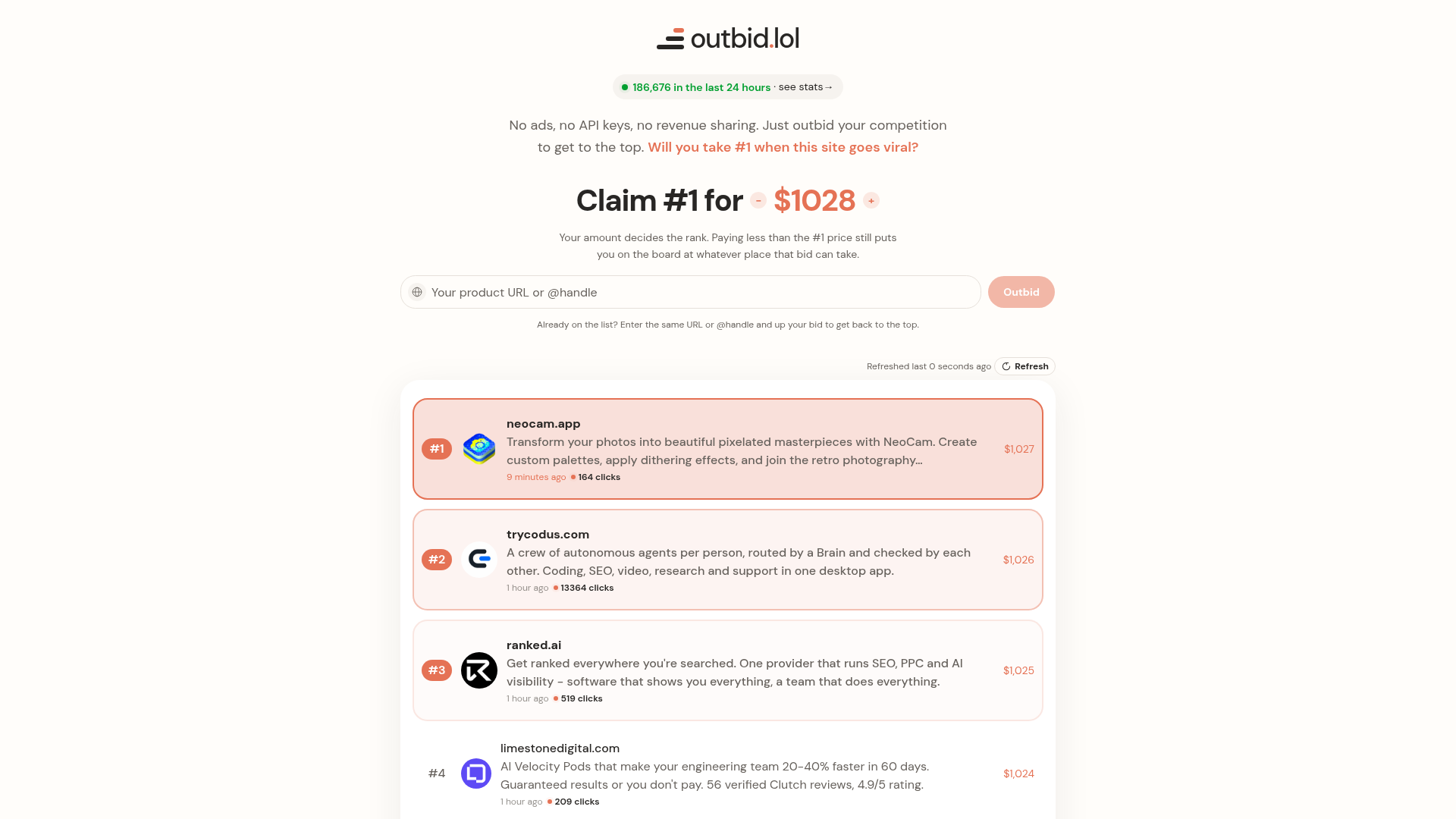
The homepage displays each submission in strict order of total cash committed, pairing product names with live click counts and bid amounts.
The rapid surge of concurrent visitors tested the project's external integrations. Users began noticing tracking glitches as analytics providers struggled to keep pace with the real-time event volume.
Founder moreyh documented how the analytics tracking buckled under the traffic surge:
Tweet unavailable. View on X
By the twelfth hour, the site crossed ten thousand visits. The momentum fed on itself: every outbid notification prompted a social post, which brought fresh eyes to the board, which attracted new bidders eager to buy their way into the conversation. Tech enthusiasts tracked the live count on outbid.lol as it became a real-time spectator sport for software founders across global communities. What began as a brief experiment in rapid deployment rapidly transformed into one of the most talked-about indie hacker launches of the season, validating Wilke's thesis that aggressive simplicity often captures broader digital engagement than complex feature sets.
Mechanics of the pure pay to rank auction
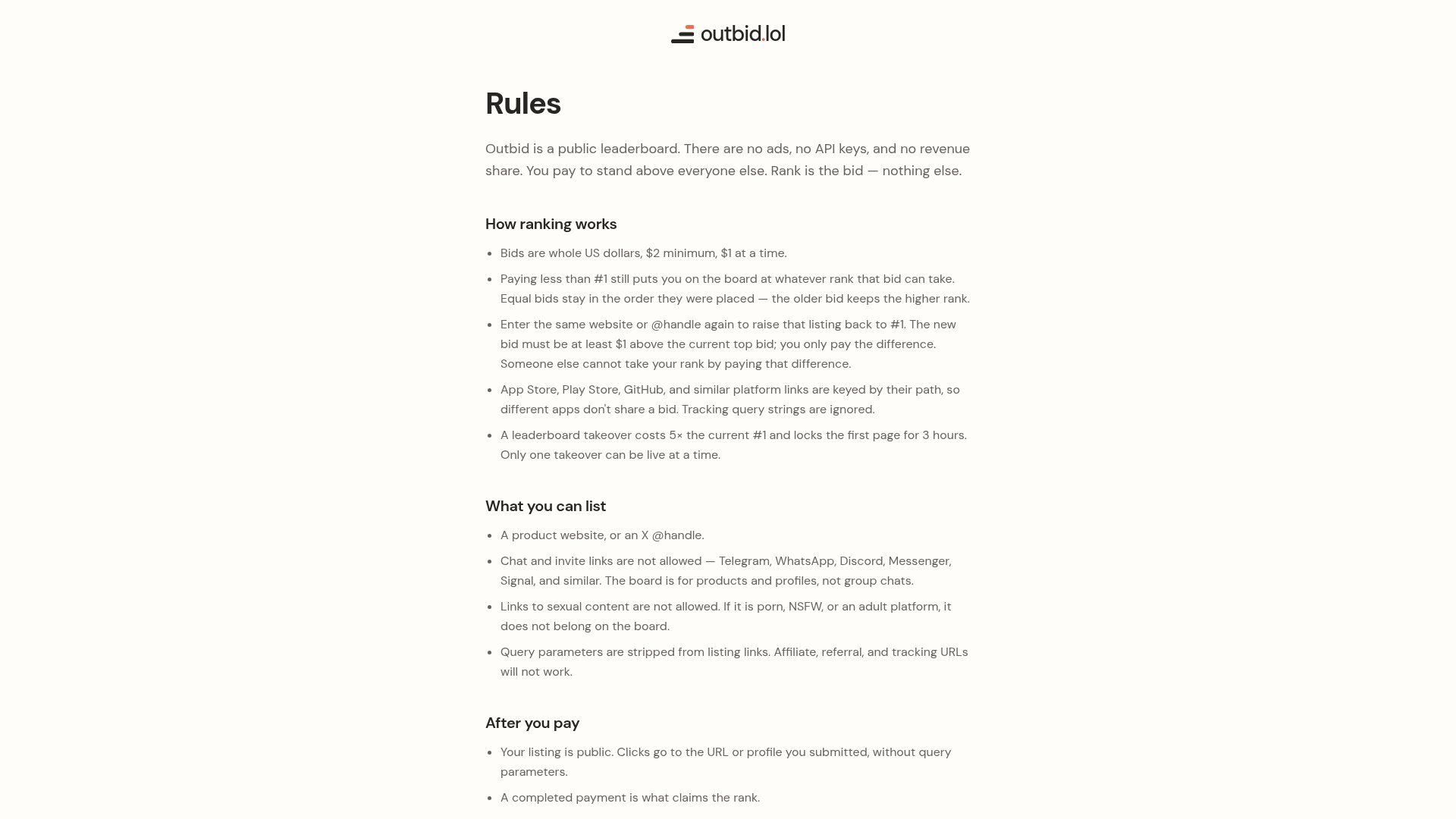
The rules governing outbid.lol prioritize simplicity over platform customization. The site sets a minimum entry bid of two dollars, requiring whole US dollar amounts for every submission. When two participants submit identical bid amounts, the system breaks the tie in favor of the older entry, creating an incentive for early placement. To maintain directory quality, the system strips tracking query parameters and excludes direct chat links to prevent low quality spam from degrading the board's value.
The official documentation lays out these operational constraints, showing how the leaderboard determines rank, sanitizes submissions, and manages checkout terms.
To keep the auction moving without forcing participants to pay full price repeatedly, Wilke added an incremental bidding option. If a founder pays fifty dollars and drops to third place, they can reclaim the top rank by paying only the dollar difference between their prior bid and the current leader plus one dollar. This mechanic lowers the psychological barrier to re-entering the race and keeps the top spot in constant motion.
For companies seeking guaranteed exposure during peak traffic hours, the platform offers a full takeover option. By paying five times the current top bid, a sponsor can lock the first page for three consecutive hours. This mechanism introduced strategic timing to the auction, as brands waited for high traffic windows to deploy larger capital allocations. Companies listed on Invofox and early stage discovery directories like Tiny Startups quickly adapted to these mechanics to defend their referral positions. The transparent auction design eliminated middleman commissions and ad review delays, giving participants immediate feedback on whether their bids succeeded in securing top placement.
Bidding wars and the battle for the crown
The competitive dynamic transformed rapidly once commercial software products joined the fray. Small ten dollar bids from hobbyists gave way to aggressive multi-hundred dollar counter bids from growing tech companies. Software platforms like Codus, an autonomous coding workspace, and NeoCam, a retro camera application, entered an active contest for first place. Bids blew past three hundred dollars, surged beyond five hundred, and eventually crossed the one thousand dollar mark.
The financial commitment made sense when measured against the incoming referral numbers. Codus recorded over 13,364 clicks during its tenure at the top of the leaderboard, while compliance services like StartGlobal and code review platforms like Prelint each collected more than 1,000 direct visitor clicks. For these businesses, the effective cost per visitor compared favorably to competitive search terms on platforms like Ranked AI.
Alberto Gimeno, the founder of Invofox, stepped into the bidding early to capture a slice of the incoming traffic.
Agency founders and enterprise software providers recognized the public relations value of maintaining a top five placement while thousands of developers watched the board refresh.
Mark Ajzenstadt shared his team securing third place on the public board:
The rapid price escalation generated active debate around dynamic pricing and link longevity across developer forums.
I think there could be other solutions than outright sharing profits. I'm thinking something like higher tractor-rent during more desirable weeks. I don't know
im3w1l on Hacker News
Participants realized that outbid.lol offered double exposure: direct clicks from the live directory, and secondary impressions from every screenshot shared across social platforms. The board became a live stage where founders competed for visibility in front of an audience of potential users and investors. As the total bids mounted, the leaderboard evolved into a high-stakes display of brand confidence, where staying near the pinnacle served as undeniable proof of traction in the fast-moving tech space.
Technical infrastructure and the Polar stack
Operating a viral leaderboard with instantaneous financial transactions requires an architecture that prevents race conditions and handles rapid write bursts. Wilke built the application on top of his supastarter boilerplate, which runs on Next.js and Postgres. Using an existing production grade template let him eliminate the setup time typically spent on schema migrations, session management, and UI styling, allowing him to ship the initial product within three hours.
The database layer manages concurrent bid submissions through relational constraints. When two users submit bids simultaneously, Postgres transaction locks verify the current highest amount before committing the update. This guarantees that no bidder gets assigned a top rank without meeting the strict price differential rules. The frontend relies on real-time webhooks to trigger re-renders the moment a transaction settles, ensuring immediate gratification for the paying user.
Handling cross-border payment processing and sales tax compliance was solved by using Polar as the merchant of record. Rather than managing individual sales tax registrations across US states and European jurisdictions, Polar processes the transaction, remits local taxes, and distributes net funds directly to the developer. This architectural choice removed legal and accounting hurdles that normally slow down experimental software launches.
By keeping the client application lightweight and delegating heavy transactional processing to proven infrastructure services like Polar and Postgres, the site handled thousands of concurrent viewers without downtime. Companies appearing on the board, including analytics platforms and tools indexed on Ranked AI or document processing services like Invofox, benefited from continuous uptime throughout the viral peak. The smooth infrastructure demonstrated how modern serverless platforms and specialized billing providers enable solo engineers to handle massive viral scale without dedicated operations teams.
Monetization metrics and the hundred thousand dollar offer
The economic velocity of outbid.lol matched its traffic growth. Within its first twenty four hours, the platform produced thousands of dollars in pure software margin. The top ten positions alone represented several thousand dollars in cumulative spend, with top contenders regularly paying increments of fifty to one hundred dollars to unseat competitors. The site operated with virtually zero marginal cost beyond standard payment processing fees and basic server hosting.
This cash flow and audience concentration caught the attention of software acquirers. By Thursday evening, Wilke published a screenshot showing a formal buyout inquiry valued at six figures.
Wilke shared the direct buyout message sent by an interested acquirer:
International tech commentators quickly picked up on the numbers, analyzing the revenue density of a single page application with no traditional ad banners.
Indie maker Fox broke down the financial metrics behind the viral ranking board:
The influx of acquisition interest started just hours after the first public post, reflecting how quickly tech investors spot viral distribution channels.
Wilke noted the speed of incoming buyout inquiries on social media:
For Wilke, the platform delivered dual value: direct transaction revenue from bids, and massive inbound visibility for supastarter. Product discovery sites like Tiny Startups and automation products like Invofox served as live demonstrations that single page experiments can generate immediate business outcomes without institutional funding. The six-figure acquisition offers highlighted how concentrated web traffic and high user engagement can instantly turn weekend side projects into lucrative digital assets.
Copycats and the game theory of digital attention
The sudden visibility of outbid.lol triggered an immediate wave of clone projects across the indie developer ecosystem. Within twenty four hours, alternative versions surfaced with varying mechanics, including reverse auctions where lowest bids take the top, and personal directories where individuals compete for social status.
Developer 0x0abyss announced the launch of an alternative auction directory:
Tweet unavailable. View on X
Other builders adapted the ranking mechanic away from software products toward personal branding and profile links.
Kamil B. Demirci launched a personal directory clone built on the same pay to rank mechanic:
Tweet unavailable. View on X
Developers also explored inverted economic structures, designing boards where smaller sums received prime placement.
Cosmo shared plans for an inverted ranking board:
The rapid emergence of these copycats demonstrates the core game theory of attention platforms. An auction directory holds no inherent utility without an active audience. The value resides entirely in the concentration of visitors looking at the screen. Clones struggled to duplicate the original's success because they lacked the initial viral distribution loop that Wilke established on day one.
For participants on the original board, the incremental bidding rule created an escalating commitment trap. Once a company spent three hundred dollars, paying an extra twenty dollars to regain the top slot felt rational when compared to letting the initial investment slip below the fold. Platforms featured on Tiny Startups and tracked via Ranked AI recognized that audience attention remains scarce, and a transparent bidding board provides a direct path to securing it. The phenomenon underscored how simple viral mechanics can reshape product discovery when built around open market bidding.