Introduction
A few days ago, benchmark numbers from the OpenDesign project surfaced across developer feeds. Running the newly previewed DeepSeek V4.1 Flash against their automated UI evaluation suite, the model scored 81.2 out of 100 on everyday interface generation. That matches 98 percent of the score set by GPT-6 Astra (82.7) and edges past Claude Fable 5.1 (80.3).
The practical disparity sits in the bill. The DeepSeek run took 5.3 minutes and burned $0.023 in API tokens. Astra required 11.1 minutes and cost $1.61. Fable took 12.8 minutes and cost $3.66. Out of 13 evaluated models, 11 scored lower than DeepSeek while charging up to 150 times more per completed task.
For anyone bootstrapping developer tools on a tight monthly budget, these numbers demand attention. Frontier closed models have held a near monopoly on frontend generation for the past year. When an open-weight model running on cheap commodity chips produces production-ready HTML, CSS, and component state for two cents, the baseline math for shipping software shifts immediately.
The numbers behind the OpenDesign Arena benchmark
The OpenDesign Arena evaluation tested 13 models on identical interface construction prompts. Rather than testing abstract logic or competitive programming puzzles, the team pulled prompts from actual user sessions inside their open-source design workspace. The maintainers behind nexu-io/open-design set up a headless test harness that executes each model against five specific application scenarios: web apps, mobile apps, desktop software, dashboards, and marketing websites.
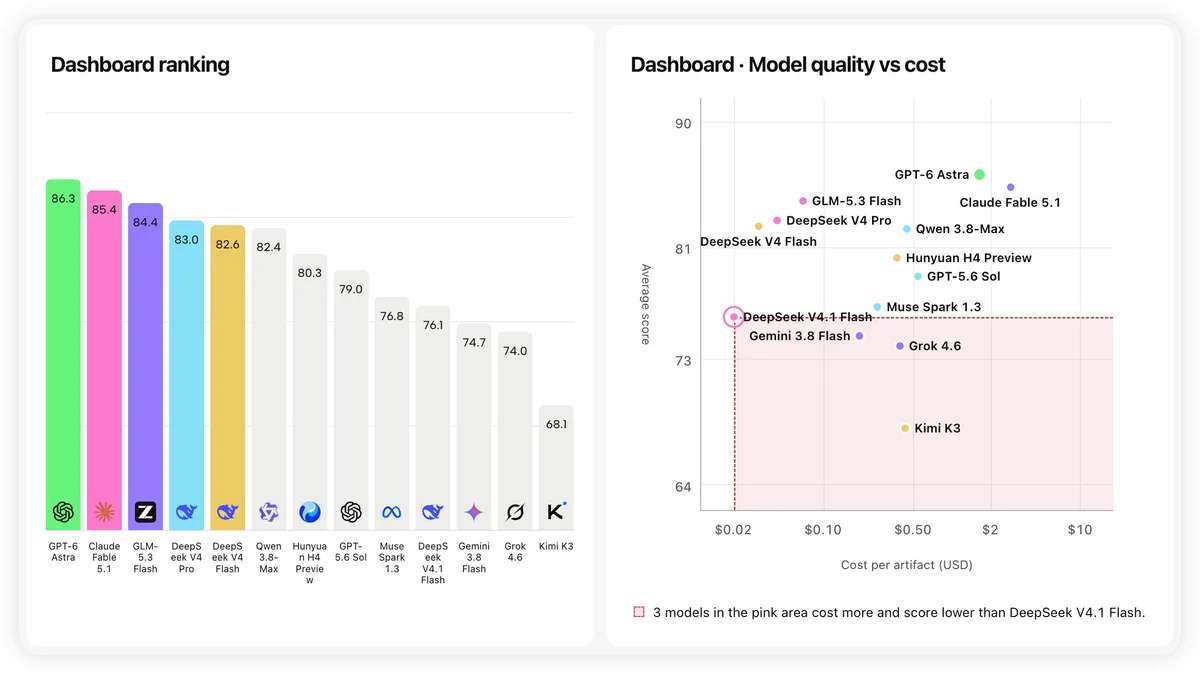
The overall ranking puts DeepSeek V4.1 Flash in second place for quality, trailing only GPT-6 Astra by 1.5 points. When balancing quality, cost, and latency, the arena algorithm ranks V4.1 Flash as the top option overall with an aggregate index of 78.8. DeepSeek V4 Flash sits at 68.6, GPT-5.6 Sol reaches 65.7, Gemini 3.8 Flash takes 64.7, and Claude Fable 5.1 drops to 52.1 due to its high cost and generation latency.
The OpenDesign Arena landing page displays a performance evaluation card for DeepSeek V4.1 Flash comparing its design quality against competing commercial endpoints:
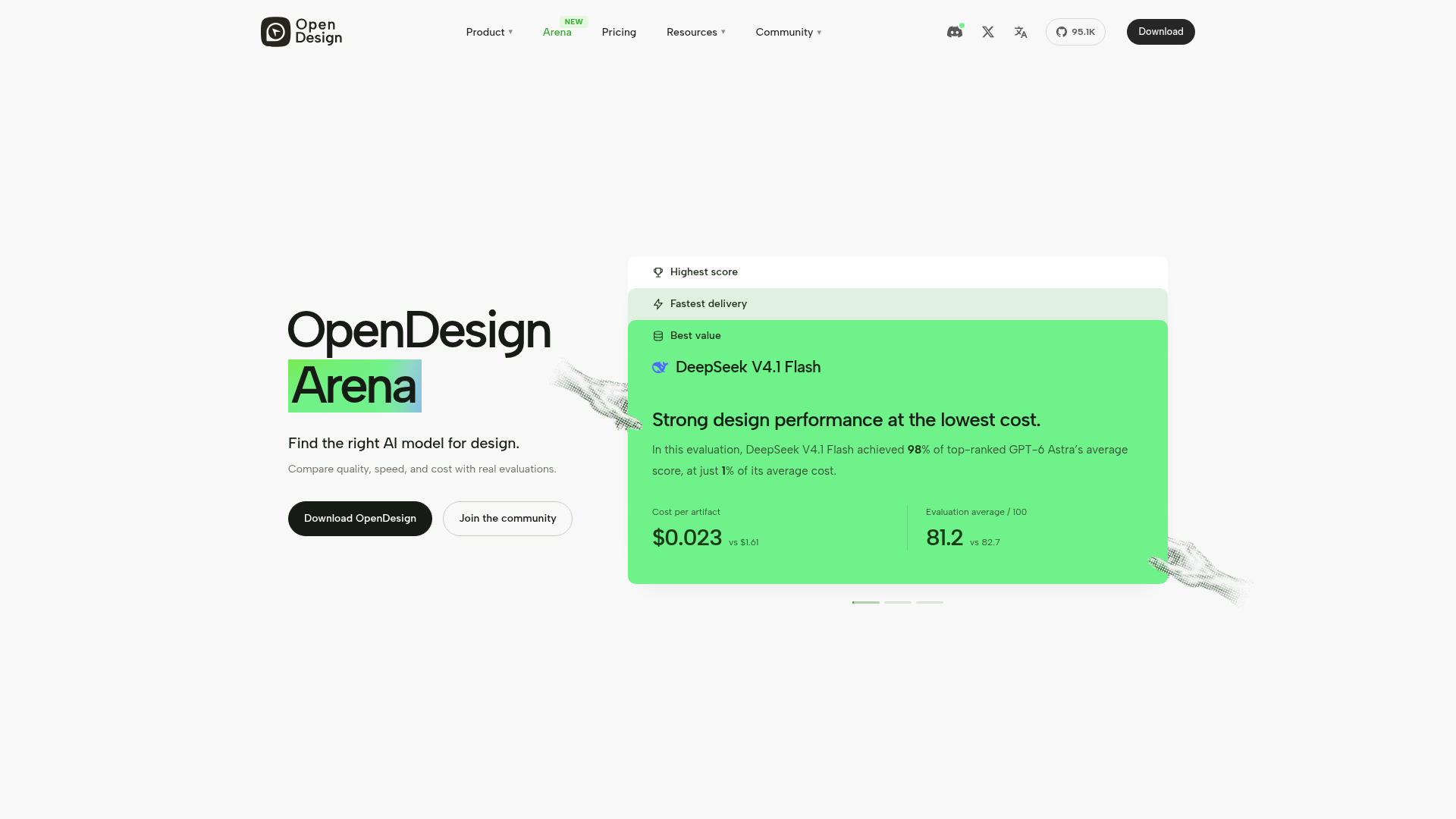
The difference between generations becomes evident when you review the raw outputs. DeepSeek V4.1 Flash delivered an average requirement fulfillment score of 28.4 out of 30, outperforming both GPT-6 Astra at 26.5 and Claude Fable 5.1 at 27.1. On raw visual polish and design quality, Astra retains a slight lead at 56.2 out of 70 compared to DeepSeek's 52.8. By matching nearly 98 percent of Astra's raw visual score while operating at roughly 1.4 percent of the financial expenditure, the model establishes a radically altered economic reality for frontend generation tasks cataloged on the official OpenDesign platform.
The time investment tells an even stronger story for daily workflow. DeepSeek completed its average run in 5.3 minutes. Astra required 11.1 minutes, and Claude Fable 5.1 dragged to 12.8 minutes. When an engineer sits in a terminal waiting for an agent to draft a prototype, a six-minute difference determines whether you maintain focus or drift over to social media.
The OpenDesign team summarized these headline metrics in their initial public disclosure:
Community members testing the workspace echoed the speed gains. In an active evaluation thread on Reddit's r/SideProject, early adopters noted how quickly lightweight models return working layouts compared to heavy proprietary options. For teams prototyping ten variations a morning, saving six minutes per generation loop adds up across an entire sprint. Rather than burning hours waiting on frontier endpoints to resolve layout tokens, developers can spin up multiple interface branches concurrently, iterating through structural variations in real time without incurring catastrophic API throttling or workflow interruptions.
How the benchmark measures interface quality without human judges
Automated UI benchmarks usually fail because visual quality feels subjective. To avoid relying on arbitrary human voting or superficial HTML tag counts, the OpenDesign test framework splits evaluation into strict mechanical phases. First, the harness executes a runtime check. The generated code loads directly in a headless Chromium instance. If the artifact shows a blank viewport, broken imports, unrendered markdown blocks, or uncaught JavaScript exceptions in the console, the run receives an automatic zero. The suite does not grant retries or fix missing syntax.
Artifacts that survive execution face a 100-point rubric. Requirement fulfillment accounts for 30 points. The system inspects DOM trees to verify specific components requested in the brief: interactive modal states, form validation bindings, table column sorting, and responsive layout wrappers. The remaining 70 points measure design structure across five categories including layout hierarchy, color harmony, accessible contrast ratios, component compliance, and responsive adaptation across mobile and desktop breakpoints. Automated checks compute color luminance differences to enforce strict WCAG AA contrast standards, flag overlapping absolute elements, and evaluate layout behavior across 375px, 768px, and 1440px viewport widths.
The OpenDesign team addressed community questions regarding this testing philosophy in an official update on OpenDesign's X announcement:
A score of 80 or higher qualifies an artifact as deliverable. Across the entire test catalog, DeepSeek V4.1 Flash maintained a 57.7 percent delivery rate. GPT-6 Astra reached 60.0 percent, while Claude Fable 5.1 scored 56.7 percent. The open-weight model produced fewer catastrophic regressions than established commercial models that charge 50 times more per token.
The framework also tracks structural alignment using agent standards like the Anthropic Claude Code skills convention, ensuring generated artifacts follow clean file separations and modular component boundaries.
To visualize how these dimensions balance out across the top tier, OpenDesign published a five-dimension radar comparison:
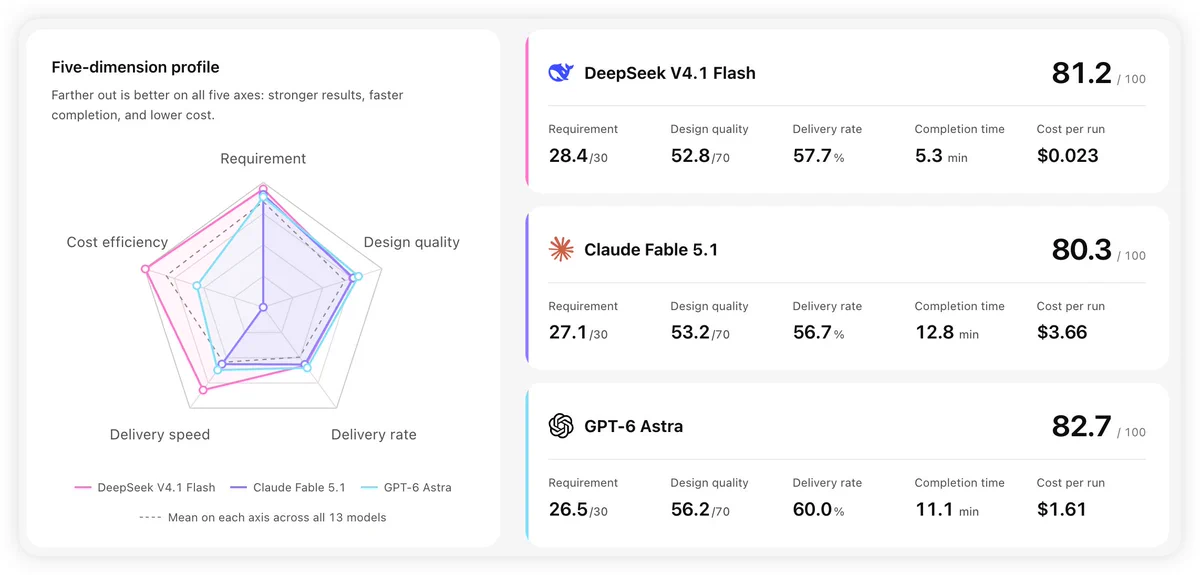
By focusing on mechanical validity and structural integrity, the benchmark provides a reproducible path for developers to evaluate automated design agents without guessing. Instead of relying on qualitative visual impressions, engineering teams can verify whether an artificial intelligence model produces valid semantic tags, predictable responsive state machines, and stable component hierarchies that will not collapse under dynamic production data loads.
Token economics and the 70x price disparity
The unit economics of frontier AI models pose a genuine barrier for bootstrapped startups. Running a team of five developers on agentic coding tools with unmetered frontier models can run past fifteen hundred dollars every month. When developer agents iterate on an interface, the tool loops through multiple turns, reading files, executing build commands, inspecting browser DOM trees, and rewriting entire files.
According to the benchmark data, generating a single full web application prototype through Claude Fable 5.1 averages $3.66 to $5.55. That same task costs $1.61 to $1.87 on GPT-6 Astra, $0.537 on GPT-5.6 Sol, and between $0.023 and $0.030 on DeepSeek V4.1 Flash. The pricing gap spans two orders of magnitude, a disparity highlighted by comparisons published on the OpenDesign documentation portal.
A scatter plot comparing average quality scores directly against cost illustrates how starkly the models diverge:
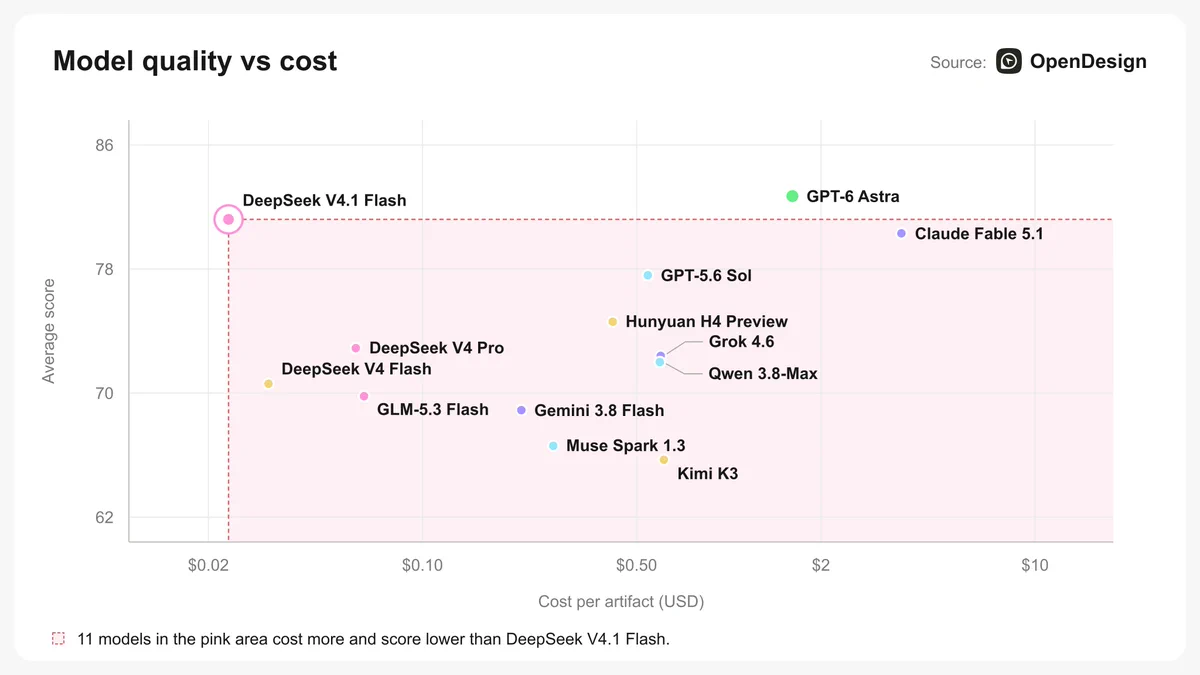
DeepSeek achieves these numbers by pairing high cache hit rates with rapid generation speed. In testing, V4.1 Flash maintained an 89.0 percent prefix cache hit rate. It processed 1.5 million input tokens while generating 29,000 output tokens. DeepSeek documentation for their agent harness lists off-peak input cache hits at $0.003 per million tokens, uncached input at $0.15 per million, and output tokens at $0.60 per million.
Because prompt caching prevents repeated computation across multi-turn agent conversations, keeping the context window warm costs fractions of a cent. Independent runs clocked decoding throughput between 350 and 427 tokens per second on raw generation passes.
The OpenDesign maintainers broke down this cost advantage across model runs:
For a solo founder testing ten interface ideas in an afternoon, spending twenty-five cents total on DeepSeek beats spending thirty-five dollars on Claude Fable. That margin frees up capital for infrastructure, customer acquisition, or domain names. Over the course of a multi-week engineering sprint involving hundreds of component iterations, an agile product squad can reduce its synthetic design billing from hundreds of dollars down to pocket change, permanently transforming how early-stage teams approach interactive prototyping and user research experiments.
Task breakdowns between landing pages, web apps, and dashboards
Aggregate scores can mask critical flaws. A model capable of generating clean landing pages might struggle when building data-heavy administrative tables. The OpenDesign team isolated model performance across five specific interface formats, revealing distinct behavioral profiles across each generation category.
On landing pages and marketing websites, DeepSeek V4.1 Flash secured fourth place with a score of 79.3, placing it directly ahead of GPT-6 Astra. The model handled hero typography, flexbox alignments, responsive call-to-action sections, and SVG icon placement without visual drift. On desktop software prototypes, it tied for third place with an 84.4 score. On mobile interfaces, it held fifth place at 82.5, cleanly managing touch targets, sheet drawers, and thumb-friendly navigation bars.
The breakdown changes when you look at complex data dashboards and admin panels. DeepSeek dropped to tenth place with a score of 76.1. It struggled with complex data grid alignments, multi-filter query sidebars, and nested data visualization widgets. Models like GPT-6 Astra performed far better on dense, information-heavy tables where spatial reasoning matters more than styling flair.
The maintainers highlighted this categorical split in their task breakdown analysis:
A comparative view of landing page rankings and dashboard rankings reveals the divergence clearly:
Reviewing the project's studio prototype gallery shows how well the model handles consumer flows. Conversely, examining complex live dashboard examples reveals why spatial logic still requires careful oversight. When building marketing collateral and customer sign-up journeys on the OpenDesign application, lightweight flash architectures excel because visual styling follows predictable component patterns. In contrast, complex enterprise dashboards require relational table alignments, nested status metrics, and complex responsive filters where reasoning-heavy frontier architectures maintain an advantage. Knowing where a model struggles tells you how to route tasks in your pipeline. Use DeepSeek V4.1 Flash to crank through consumer app screens, marketing funnels, and mobile views. When you need an enterprise analytics interface with twenty chart states, route the job to a model with stronger spatial structure.
The engineering reality of running open weights in a local harness
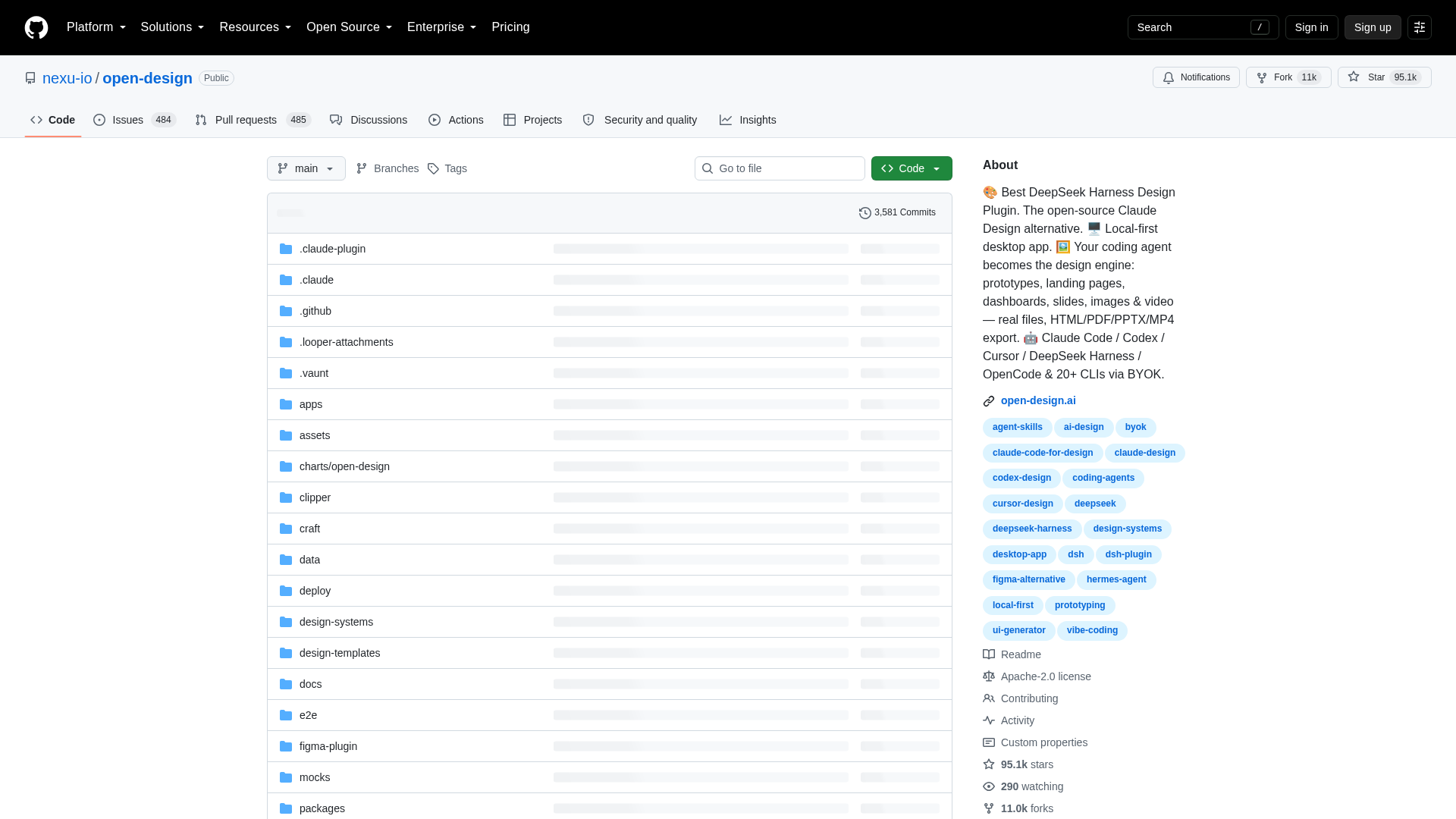
Most discussions treat models as abstract drop-in replacements. In production, your orchestrating client matters as much as the model weights. The official nexu-io/open-design repository crossed 90,000 GitHub stars within 116 days, as noted in their milestone announcement, demonstrating strong demand for local, controllable developer tooling that avoids proprietary cloud vendor lock-in.
OpenDesign operates as a local-first desktop application with an integrated Node daemon, connecting directly to local coding agent CLIs. Running DeepSeek V4.1 Flash requires precise client configuration. If your harness mishandles prompt caching prefixes or leaves reasoning effort locked on high for basic operations, your generation speed drops and costs multiply. The ecosystem expanded further with the official Codex Plugin Directory integration, bringing a real-time visual canvas directly into popular developer environments.
The OpenDesign documentation outlines broad compatibility across local agent command-line tools:
Another critical factor is cache hygiene. If your agent injects dynamic timestamps or random request IDs into the prompt prefix, you wipe out provider-side key-value caching. When caching works, input tokens cost a fraction of a cent. When caching misses, that price spikes fiftyfold. Keeping system prompts, brand guidelines, and shared tool definitions pinned at the head of the context buffer is what keeps your runs at pennies.
Tech reviewer WorldofAI walked through the setup process and showcased the live component generator in action:
Local execution harnesses allow developers to avoid unmetered frontier subscriptions that regularly exceed $200 per seat per month. By pairing open-source orchestrators with low-cost inference endpoints, indie developers can build production software without incurring enterprise overhead. Furthermore, maintaining local state ensures that proprietary brand assets, unpublished client wireframes, and internal design tokens remain entirely on the developer's physical machine rather than streaming into proprietary external storage systems.