

Skip to content

Free to start: 1,000 credits, no card, nothing to install.

Claude Opus 5.5 vs GPT-5.5 Pro

Capability, human votes, price, speed and context, side by side, each with its source and date.

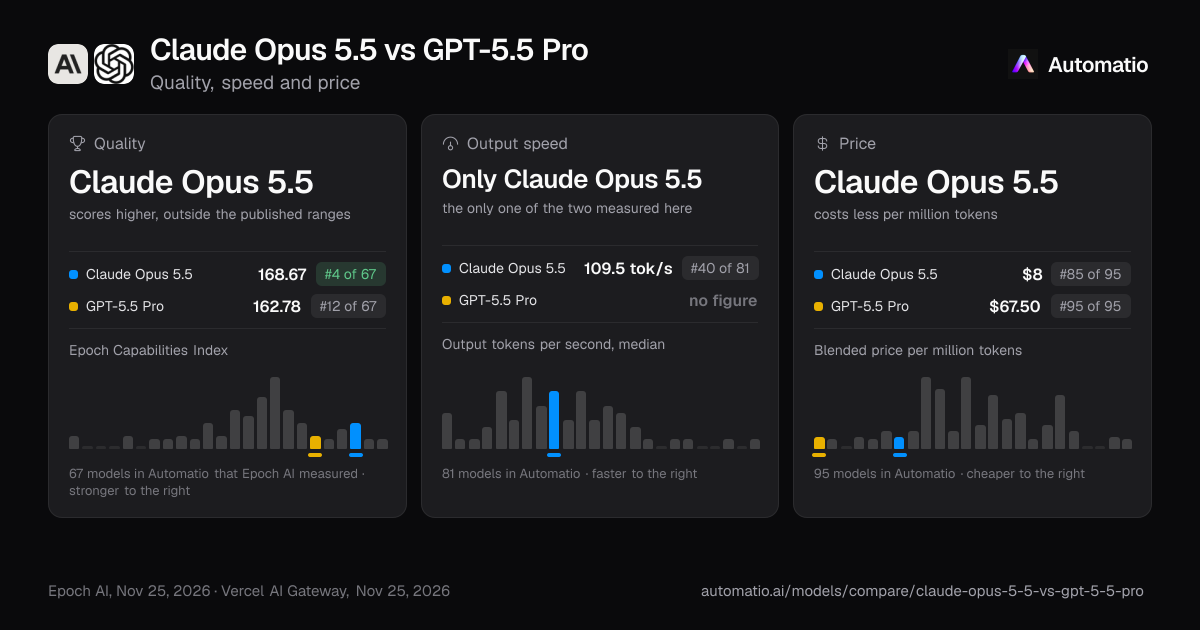
Quality, speed and price

The three figures people check first, for both models. A rank counts the models in Automatio that the source measured.

Quality

Claude Opus 5.5

scores higher, outside the published ranges

Claude Opus 5.5168.67#4 of 67
GPT-5.5 Pro162.78#12 of 67

Epoch Capabilities Index

67 models in Automatio that Epoch AI measured · stronger to the right

Output speed

Only Claude Opus 5.5

the only one of the two measured here

Claude Opus 5.5109.5 tok/s#40 of 81
GPT-5.5 Prono figure

Output tokens per second, median

81 models in Automatio · faster to the right

Price

Claude Opus 5.5

costs less per million tokens

Claude Opus 5.5$8#85 of 95
GPT-5.5 Pro$67.50#95 of 95

Blended price per million tokens

95 models in Automatio · cheaper to the right

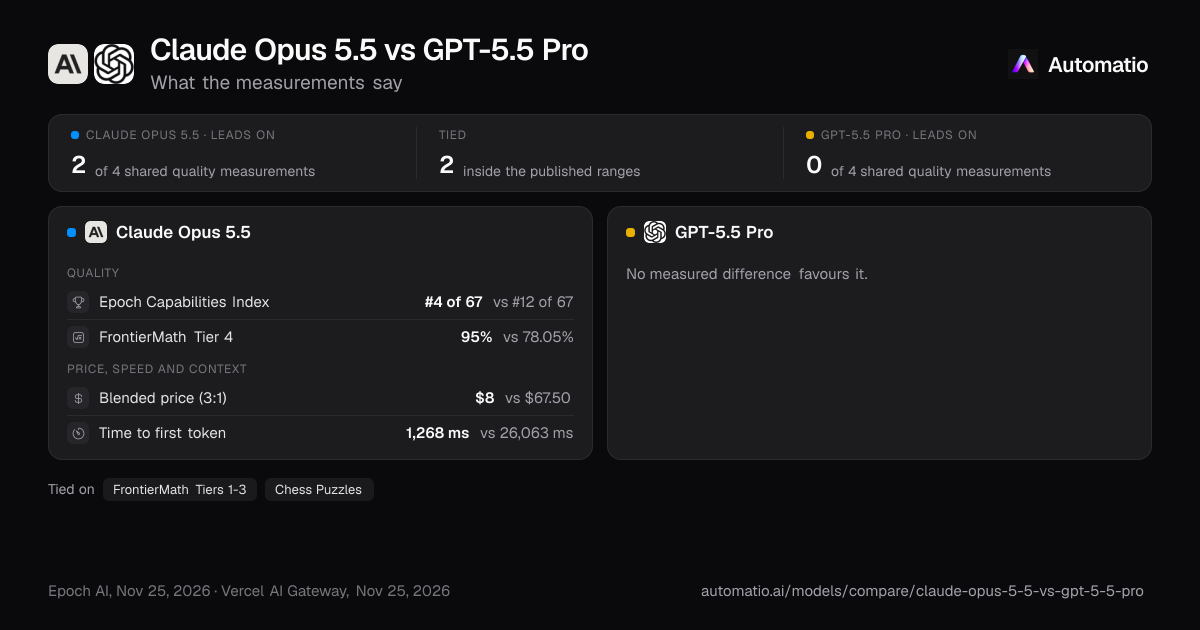
What the measurements say

Where each one leads, measure by measure. A quality lead counts only when the two published ranges do not overlap.

Claude Opus 5.5 · leads on
2of 4 shared quality measurements
Tied
2inside the published ranges
GPT-5.5 Pro · leads on
0of 4 shared quality measurements

Claude Opus 5.5

Quality

  • Epoch Capabilities Index#4 of 67 vs #12 of 67
  • FrontierMath Tier 495% vs 78.05%

Price, speed and context

  • Blended price (3:1)$8 vs $67.50
  • Time to first token1,268 ms vs 26,063 ms

GPT-5.5 Pro

No measured difference favours it.

Tied onFrontierMath Tiers 1-3Chess Puzzles

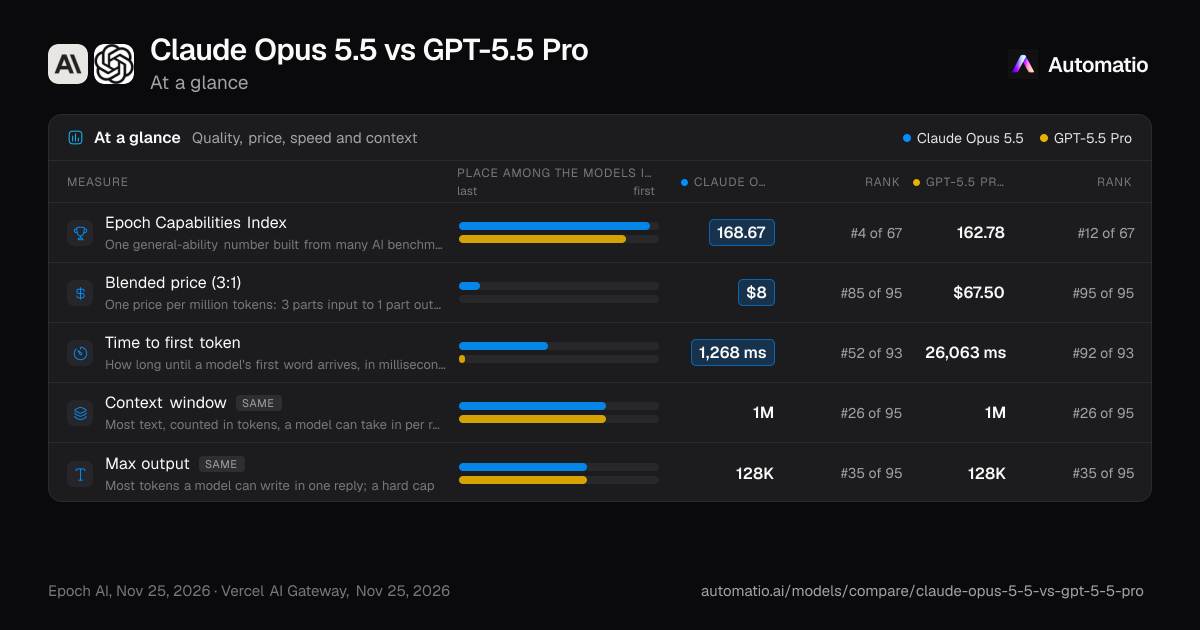
At a glance

The headline figures both have, side by side. Each bar is the place among the models in Automatio measured, so longer is better on every row, and a figure is marked better only where the gap is outside the published ranges.

At a glanceQuality, price, speed and contextClaude Opus 5.5GPT-5.5 Pro

Epoch AI's index combines scores from over 50 benchmarks into one general-capability number: a model scores higher if it does better on harder benchmarks, and each benchmark's difficulty is inferred statistically from models that took several of them. The scale is arbitrary, set so that Claude 3.5 Sonnet = 130 and GPT-5 = 150, and as with Elo scores there is no maximum, so only comparisons between models mean something. Each model's score is the mean of an estimated distribution and comes with a 90% credible interval (5th to 95th percentile); Epoch notes that the intervals of top models often overlap.

Scale: Index; higher is better; no fixed maximum; anchored at Claude 3.5 Sonnet = 130 and GPT-5 = 150; each score has a 90% credible interval (5th to 95th percentile).

Automatio computes it from the AI Gateway's list prices: three input tokens for every output token, at the base rate (no cached-input or long-prompt rate). The gateway's pricing page says a request's charge depends on the model and on the number of input and output tokens processed, at rates based on the provider's list price, so what you pay follows your own mix of input and output.

Scale: US dollars per 1 million tokens; lower is cheaper.

Vercel's AI Gateway defines latency as time to first token (TTFT), measured in milliseconds: the duration between the request reaching the provider and the first response token arriving, where lower latency means a faster perceived response. It is measured from live AI Gateway traffic for each model and provider (requests that use your own provider key are excluded) and published as a median (P50) and a 95th percentile (P95) over the last hour; the model catalog row shows the best value across providers.

Scale: milliseconds; P50 (median) and P95 over the last hour per provider; lower is better.

Vercel's AI Gateway lists a model's context window as its maximum context length in tokens (for each provider endpoint, the maximum context window in tokens). On Vercel's model pages the prompt and the response share this window.

Scale: tokens (for example a 1M-token or 128K-token window).

Vercel's AI Gateway lists a model's max output as the maximum number of output tokens (per provider endpoint, max_completion_tokens). On Vercel's model pages this is described as a hard cap on generated tokens, and for reasoning models the reasoning tokens count toward it.

Scale: tokens (for example 16,384 for GPT-4o, 128,000 for Claude Opus 5, as listed on Vercel's model pages).

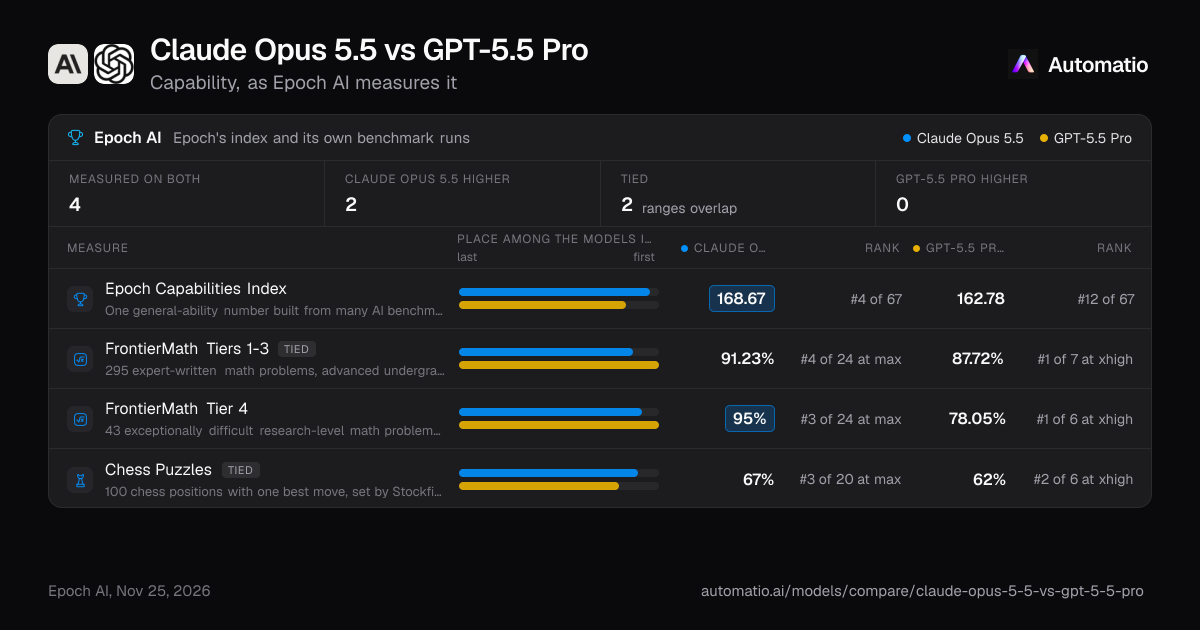
Capability, as Epoch AI measures it

Epoch's index and every benchmark Epoch ran on both: what each one tests, and each model's place among the models in Automatio measured on it. Open a row for what the benchmark is.

Epoch AIEpoch's index and its own benchmark runsClaude Opus 5.5GPT-5.5 Pro
Measured on both
4
Claude Opus 5.5 higher
2
Tied
2ranges overlap
GPT-5.5 Pro higher
0

Epoch AI's index combines scores from over 50 benchmarks into one general-capability number: a model scores higher if it does better on harder benchmarks, and each benchmark's difficulty is inferred statistically from models that took several of them. The scale is arbitrary, set so that Claude 3.5 Sonnet = 130 and GPT-5 = 150, and as with Elo scores there is no maximum, so only comparisons between models mean something. Each model's score is the mean of an estimated distribution and comes with a 90% credible interval (5th to 95th percentile); Epoch notes that the intervals of top models often overlap.

Scale: Index; higher is better; no fixed maximum; anchored at Claude 3.5 Sonnet = 130 and GPT-5 = 150; each score has a 90% credible interval (5th to 95th percentile).

Each problem is an original math question written and vetted by expert mathematicians; a typical one takes a researcher in that field multiple hours, and the hardest take multiple days. The model can reason and run Python, then submits a Python function answer() that returns its answer, and gets 1 point if it is correct and 0 if it is wrong or nothing is submitted. This is Epoch AI's FrontierMath, which was developed with funding from OpenAI; Tiers 1-3 are the 295-problem base set of the 338-problem v2 dataset (released 2026-06-12), and the numbers on Epoch's hub are for the private set.

Scale: Percent of the 295 Tiers 1-3 problems answered correctly (1 point each).

Tier 4 is the 43-problem expansion set of exceptionally difficult problems in FrontierMath's 338-problem v2 dataset; the problems are original and were written and vetted by expert mathematicians, and solving a typical FrontierMath problem takes a researcher multiple hours and, for the upper end, multiple days. The model can reason and run Python, then submits a Python function answer() that returns its answer, and gets 1 point if it is correct and 0 if it is wrong or nothing is submitted. FrontierMath was developed with funding from OpenAI, and the numbers on Epoch's hub are for the private set.

Scale: Percent of the 43 Tier 4 problems answered correctly (1 point each).

Each task shows a chess position as FEN text and asks for the best next move, submitted as a four-character string such as b1c3 and compared for an exact match with the answer key. Epoch generated the 100 positions programmatically, and the best move in each is the single one found by the Stockfish chess engine; positions are filtered out where the best move is simply capturing an undefended piece, or a higher-value piece with a lower-value one. Five human players (ratings from 1700 to 2400) answered samples of 20 puzzles without AI or an engine, and the two best got 75% right; Epoch says the sampled puzzles are harder than the full set on average.

Scale: Percent of 100 puzzles answered with the single best move; human sample: best two of five players scored 75%.

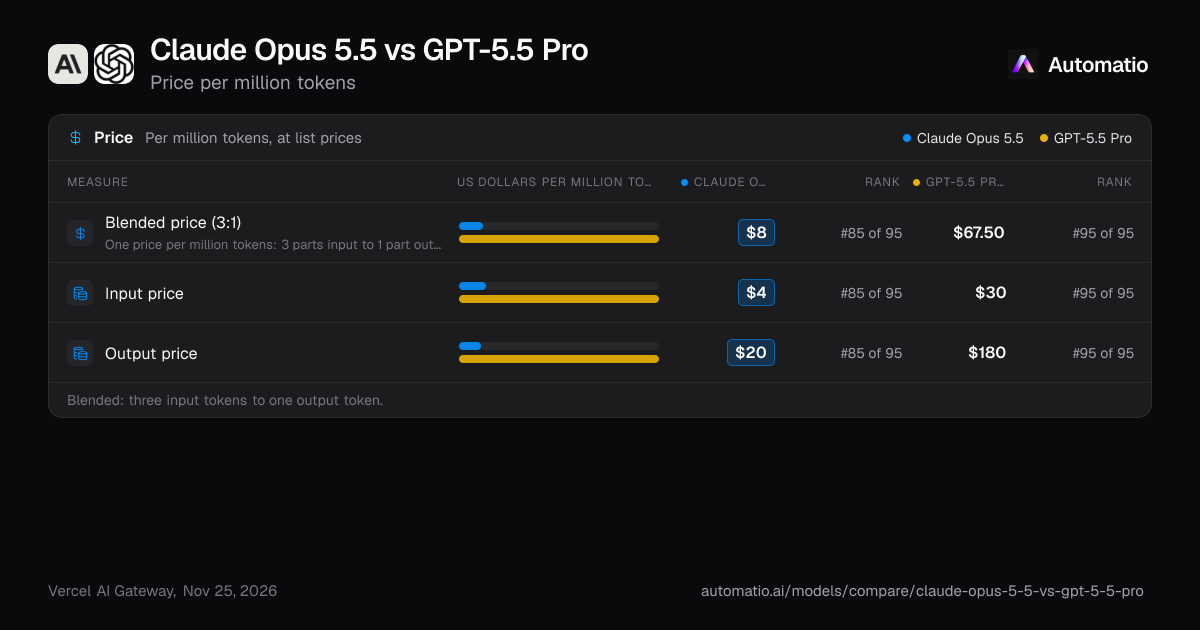
Price per million tokens

List prices per million tokens on Vercel AI Gateway. Each bar is the price, the dearer of the two full, so shorter is cheaper.

PricePer million tokens, at list pricesClaude Opus 5.5GPT-5.5 Pro

Automatio computes it from the AI Gateway's list prices: three input tokens for every output token, at the base rate (no cached-input or long-prompt rate). The gateway's pricing page says a request's charge depends on the model and on the number of input and output tokens processed, at rates based on the provider's list price, so what you pay follows your own mix of input and output.

Scale: US dollars per 1 million tokens; lower is cheaper.

Input price
$4the better of the two#85 of 95$30#95 of 95
Output price
$20the better of the two#85 of 95$180#95 of 95

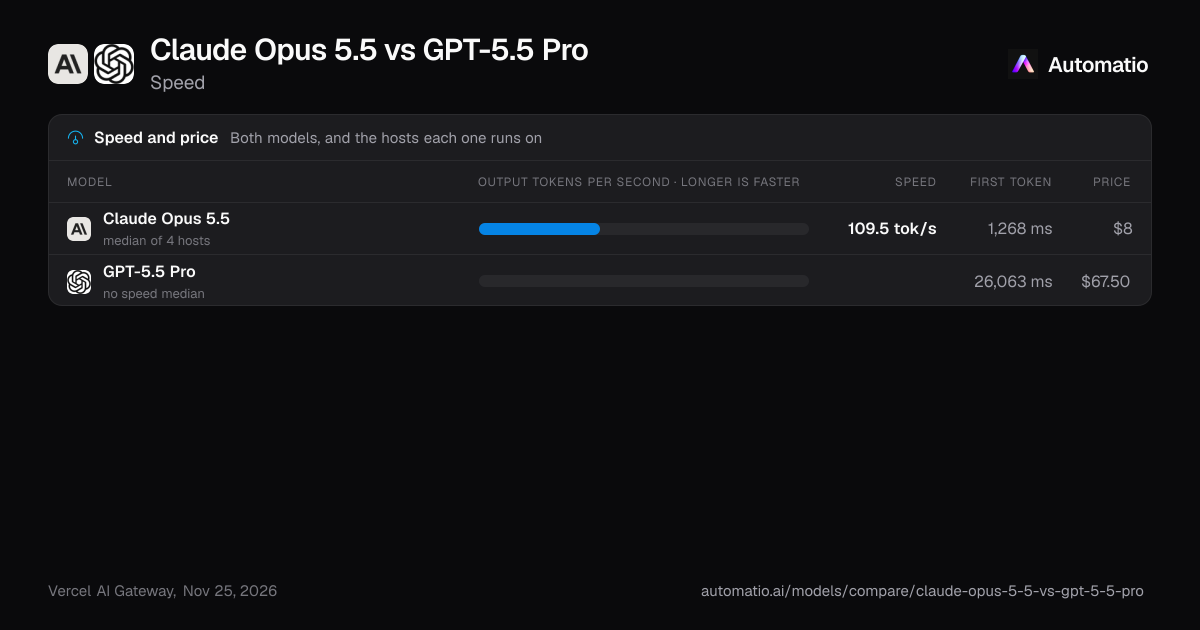
Output speed, the wait for the first token and the price of both, host by host, then the same answer from each, simulated from those medians.

Speed and priceBoth models, and the hosts each one runs on
Claude Opus 5.5
109.5 tok/s#40 of 81

Context, and what each one reads

When each came out, how much it takes in and gives back, and what our model list says each can read and do.

Claude Opus 5.5

Released
Sep 22, 2026the newer one · knows up to Jun 2026
Context window
1M tokensup to 128K out
Reads
Can

GPT-5.5 Pro

Released
Apr 24, 2026knows up to Dec 2025
Context window
1M tokensup to 128K out
Reads
Can

Vercel AI Gateway · Nov 25, 2026

Creative tests

The same prompt to both, one run each, the first output as it came back.

GPT-5.5 Pro has not been run on these prompts yet.

A boat at sunset, as an animated SVG

Claude Opus 5.5

A boat at sunset, as an animated SVG: a frame of the first output from Claude Opus 5.5
RenderedFirst output, not pickedNov 25, 2026high effort$0.15866.9 s7,848 tokens out
The prompt and our note

Polished flat sunset: a sloop with a red pennant and lit portholes on three layered wave lines under a gradient sky, with drifting clouds, a flock of gulls, a glowing sun and a striped reflection; between the frames the sun sinks, birds and clouds move and the boat tilts.

The prompt, version 1

Create one self-contained animated SVG, 800×600 pixels (width="800" height="600" viewBox="0 0 800 600"). Scene: a sailing boat rocking on rolling ocean waves at sunset, with the sun slowly sinking toward the horizon, its reflection shimmering on the water, and a few birds flying across the sky. Everything should move, and the animation should loop smoothly. Animate with SMIL or CSS inside the SVG only: no JavaScript, no external images, fonts or links. Keep it under 30 KB. Reply with only the SVG code, from <svg to </svg>, with no explanation and no Markdown fences.
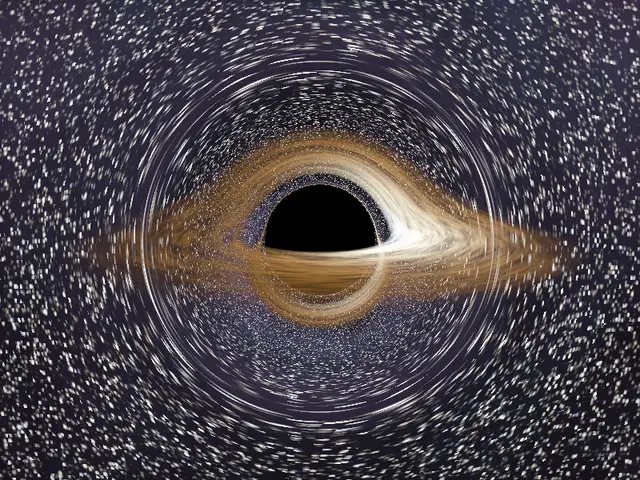
A black hole, rendered live with WebGL

Claude Opus 5.5

A black hole, rendered live with WebGL: a frame of the first output from Claude Opus 5.5
RenderedFirst output, not pickedNov 25, 2026high effort$0.331149.9 s16,472 tokens out
The prompt and our note

Raw-WebGL lensed black hole in the Interstellar style: black shadow, the disk's far side arched over the top and imaged under the bottom, a Doppler-bright right side and a photon ring, turning between frames; the starfield is very dense and smeared into concentric streaks, which looks noisy.

The prompt, version 1

Create one self-contained HTML file that renders an animated black hole in real time with WebGL. Show a black event horizon, a bright accretion disk that rotates, and gravitational lensing that visibly bends the light of the disk and of a starfield behind the hole (the far side of the disk should appear to arch over and under the hole). Fill the browser window, handle resizing, and animate continuously. Use raw WebGL, or three.js loaded exactly as <script src="https://cdnjs.cloudflare.com/ajax/libs/three.js/r128/three.min.js"></script>. No other external resources: no other scripts, fonts, images, textures or network requests. Reply with only the HTML, from <!DOCTYPE html> to </html>, with no explanation and no Markdown fences.

Blackjack, playable, in one page

Claude Opus 5.5

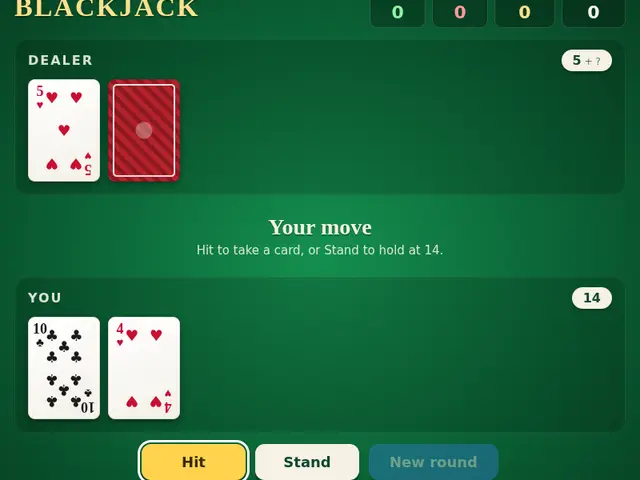
Blackjack, playable, in one page: a frame of the first output from Claude Opus 5.5
RenderedFirst output, not pickedNov 26, 2026high effort$0.262104.9 s13,054 tokens out
The prompt and our note

Green felt table with a score row, both hands as drawn cards with their totals, and Hit, Stand and New round buttons. The render check's Hit drew an 8 on 14: bust at 22, the dealer's card turned over (12), 'Bust! You lose.' and the loss counted.

The prompt, version 1

Create one self-contained HTML file with a playable game of blackjack: one player against the dealer. Use a shuffled 52-card deck, deal two cards each with the dealer's second card face down, count aces as 1 or 11, let the player Hit or Stand, then reveal the dealer's card and have the dealer draw until 17 or more. Show both hands as drawn cards with their totals, say who won the round (blackjack, bust, push), keep a running score of rounds won and lost, and offer a New round button. Draw the cards with HTML and CSS or a canvas. No external resources: no scripts, fonts, images or network requests. Reply with only the HTML, from <!DOCTYPE html> to </html>, with no explanation and no Markdown fences.
Call both through our API

The same OpenAI-compatible endpoint for both: only the model id changes.

  • Make a key with the AI models permission on the Integrations page.
  • Each call is billed in credits from your account.

Read the API docs

JavaScript, OpenAI SDK
import OpenAI from "openai";

const client = new OpenAI({
  baseURL: "https://automatio.ai/api/v1",
  apiKey: process.env.AUTOMATIO_API_KEY,
});

for (const model of ["anthropic/claude-opus-5.5","openai/gpt-5.5-pro"]) {
  const res = await client.chat.completions.create({
    model,
    messages: [{ role: "user", content: "Hello" }],
  });
  console.log(model, res.choices[0].message.content);
}
curl
curl https://automatio.ai/api/v1/chat/completions \
  -H "Authorization: Bearer $AUTOMATIO_API_KEY" \
  -H "Content-Type: application/json" \
  -d '{"model":"anthropic/claude-opus-5.5","messages":[{"role":"user","content":"Hello"}]}'

Questions

Still have a question?

Ask us on Discord
Which is cheaper, Claude Opus 5.5 or GPT-5.5 Pro?

Claude Opus 5.5: $8 against $67.50 per million tokens, blended three input tokens to one output token, at Vercel AI Gateway's list prices of Nov 25, 2026.

Which scores higher on Epoch's Capabilities Index?

Claude Opus 5.5: 168.67 against 162.78, outside each other's published ranges.

Which has the larger context window?

Neither: both take 1,000,000 tokens.

Can I use both Claude Opus 5.5 and GPT-5.5 Pro in Automatio?

Yes. Pick either one in a chat's model menu, or call both through our API with the model ids anthropic/claude-opus-5.5 and openai/gpt-5.5-pro.

Where the numbers come from

Every number on this page comes from one of these: public sources first, then what we measured and collected ourselves.

  1. Vercel AI Gateway1

    Prices, context windows, and each host's speed and time to first token.

    Prices, context and speed via Vercel AI Gateway, 2026-11-25
    As of Nov 25, 2026Public model catalogueOpen source
  2. Epoch AI2

    Its own benchmark runs and the Epoch Capabilities Index.

    Source: Epoch AI (epoch.ai), CC BY 4.0, 2026-11-25
    As of Nov 25, 2026CC BY 4.0Open source

Try them on your own request

Type it in the box at the top of the page, then pick either model in the chat.

  • A task can repeat on a schedule, as often as every 5 minutes.

    How schedules work
  • Results can also come to you in Discord or Telegram.