

Free to start: 1,000 credits, no card, nothing to install.


DeepSeek V4.1 Flash 1017 vs Gemini 3.8 Flash
Capability, human votes, price, speed and context, side by side, each with its source and date.
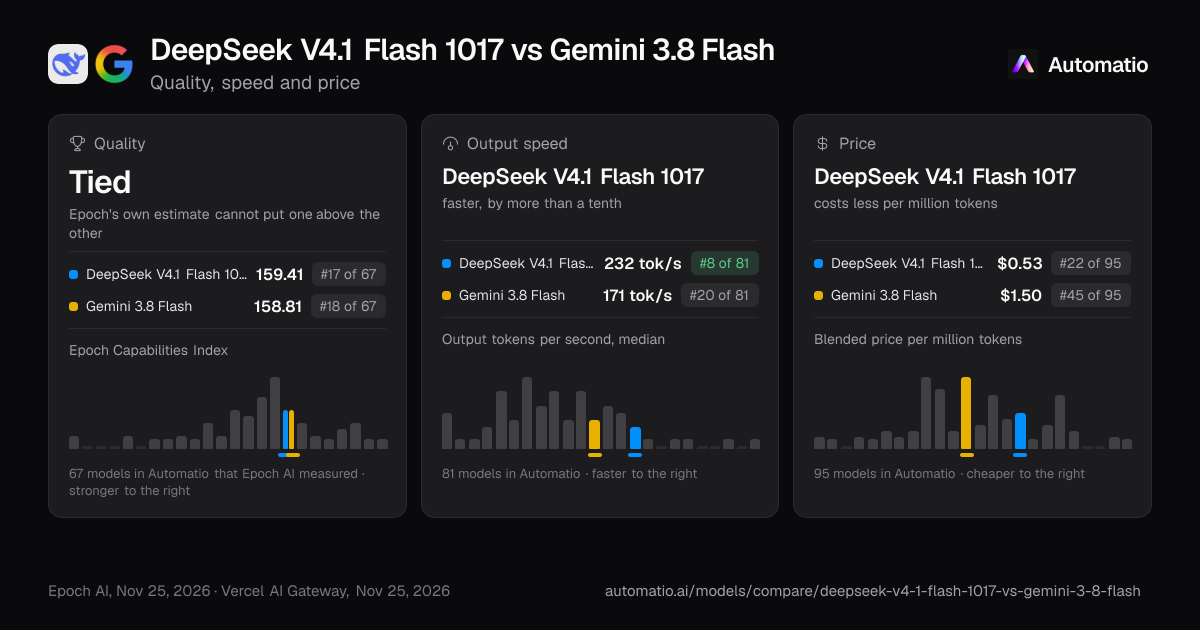
Quality, speed and price
The three figures people check first, for both models. A rank counts the models in Automatio that the source measured.
Quality
Tied
Epoch Capabilities Index
67 models in Automatio that Epoch AI measured · stronger to the right
Output speed
DeepSeek V4.1 Flash 1017
Output tokens per second, median
81 models in Automatio · faster to the right
Price
DeepSeek V4.1 Flash 1017
Blended price per million tokens
95 models in Automatio · cheaper to the right
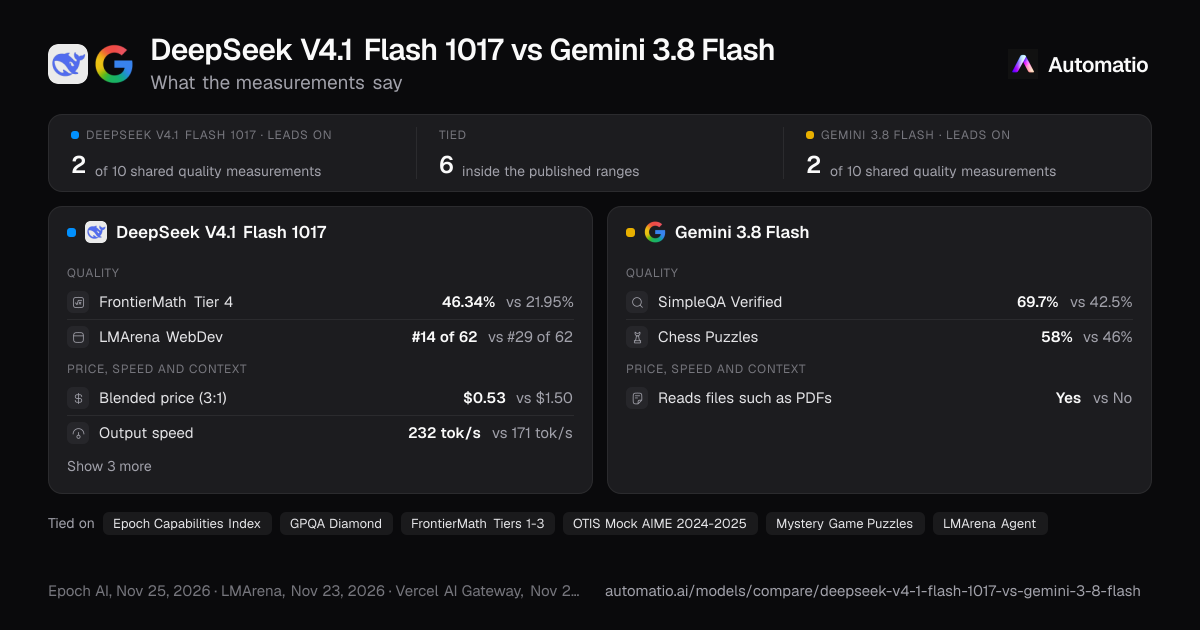
What the measurements say
Where each one leads, measure by measure. A quality lead counts only when the two published ranges do not overlap.
- DeepSeek V4.1 Flash 1017 · leads on
- 2of 10 shared quality measurements
- Tied
- 6inside the published ranges
- Gemini 3.8 Flash · leads on
- 2of 10 shared quality measurements
DeepSeek V4.1 Flash 1017
Quality
- FrontierMath Tier 446.34% vs 21.95%
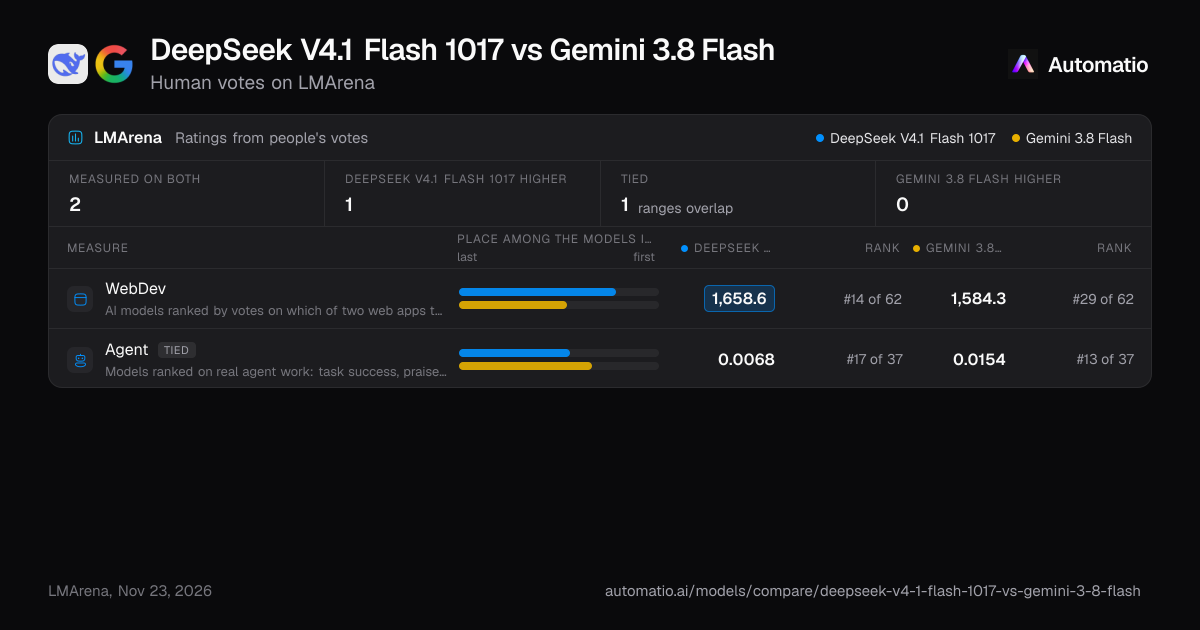
- LMArena WebDev#14 of 62 vs #29 of 62
Price, speed and context
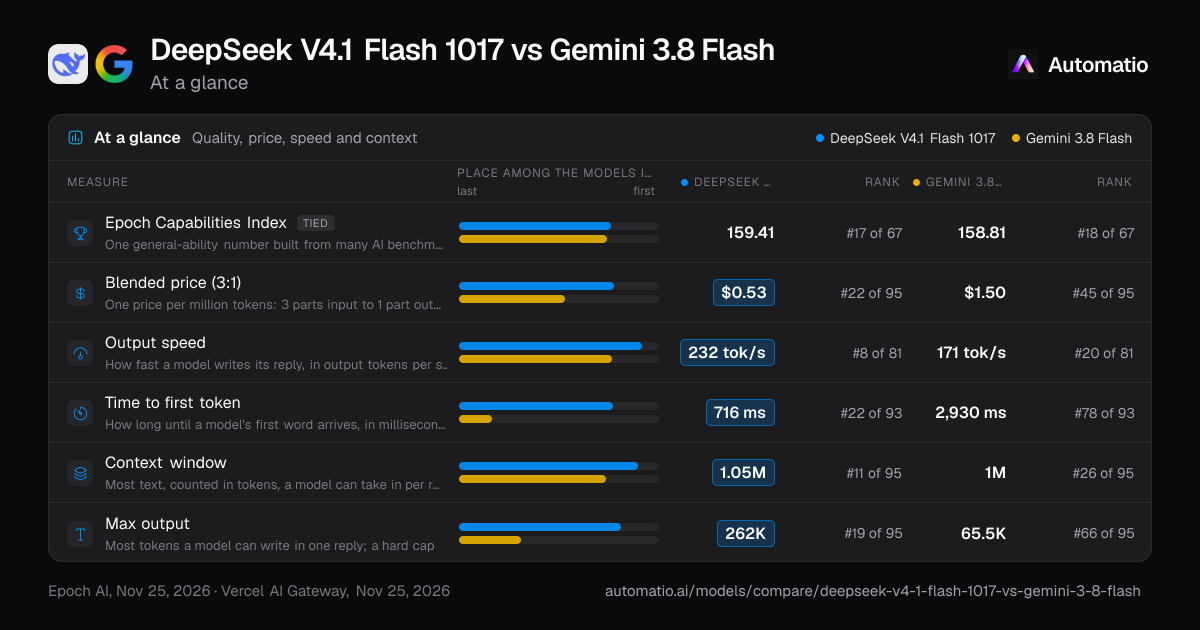
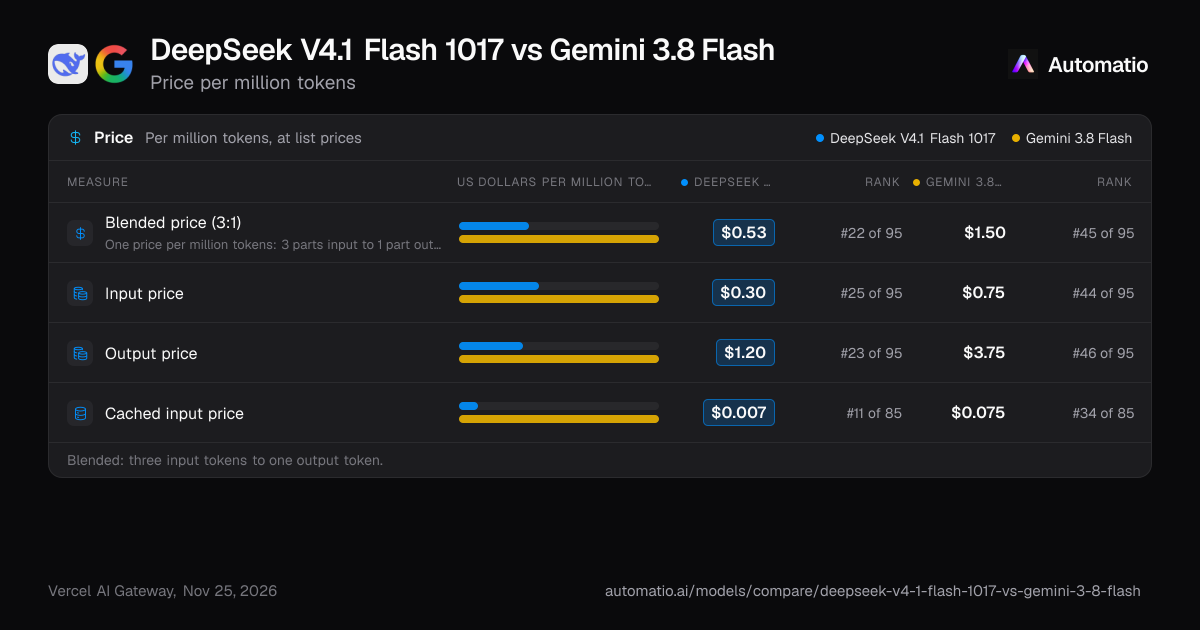
- Blended price (3:1)$0.53 vs $1.50
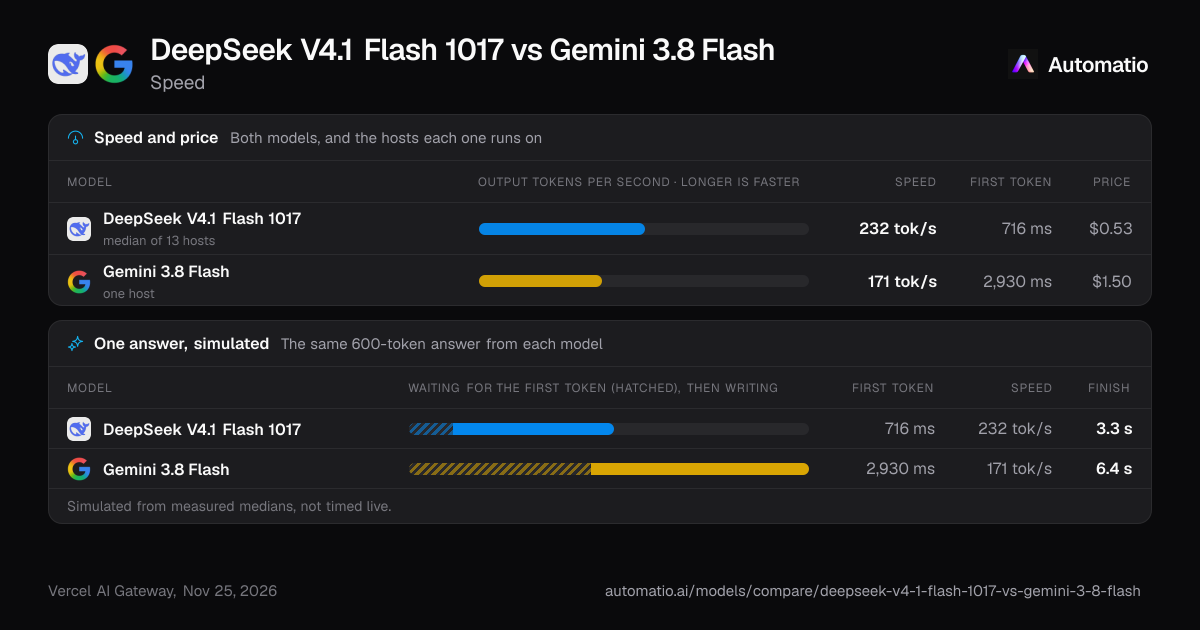
- Output speed232 tok/s vs 171 tok/s
- Time to first token716 ms vs 2,930 ms
- Context window1.05M vs 1M
- Max output262K vs 65.5K
Gemini 3.8 Flash
Quality
- SimpleQA Verified69.7% vs 42.5%
- Chess Puzzles58% vs 46%
Price, speed and context
- Reads files such as PDFsYes vs No
Tied onEpoch Capabilities IndexGPQA DiamondFrontierMath Tiers 1-3OTIS Mock AIME 2024-2025Mystery Game PuzzlesLMArena Agent
Quick tests, head to head
The same 8 questions, each asked 10 times to both models at high effort and graded by code. Every answer is kept.
DeepSeek V4.1 Flash 1017 got 67 of 80 answers right, Gemini 3.8 Flash 80 of 80. They part most on Repeat a number 31 times (DeepSeek V4.1 Flash 1017 0/10, Gemini 3.8 Flash 10/10). The runs cost us $0.181 on DeepSeek V4.1 Flash 1017 and $0.334 on Gemini 3.8 Flash, as billed; a median answer took 1.8 s and 6.3 s.
| Question | DeepSeek V4.1 Flash 1017 | Gemini 3.8 Flash |
|---|---|---|
| Walk or drive to the car washRight answer: drive | 10/101 sFirst answer: Drive | 10/104 sFirst answer: Drive |
| Letters in “Zermmmmmmat”Right answer: 6 | 9/103 sFirst answer: 6 | 10/104.9 sFirst answer: 6 |
| A decimal equationRight answer: 0.79 | 10/100.8 sFirst answer: 0.79 | 10/103.6 sFirst answer: 0.79 |
| Socks in a dark roomRight answer: 2 | 10/102.8 sFirst answer: 2 | 10/108.9 sFirst answer: 2 |
| The largest shapeRight answer: the large rectangle | 10/100.8 sFirst answer: A large rectangle | 10/103.5 sFirst answer: A large rectangle |
| Three doorsRight answer: 1 | 8/104.4 sFirst answer: 1 | 10/1012.8 sFirst answer: 1 |
| Repeat a number 31 timesRight answer: 248 characters | 0/1070.6 sFirst answer: 368 characters | 10/1016.7 sFirst answer: 248 characters |
| A sentence ending in “m”Right answer: m | 10/101.7 sFirst answer: She handed the book to him | 10/1021.8 sFirst answer: She woke up from a peaceful dream |
At a glance
The headline figures both have, side by side. Each bar is the place among the models in Automatio measured, so longer is better on every row, and a figure is marked better only where the gap is outside the published ranges.
Epoch AI's index combines scores from over 50 benchmarks into one general-capability number: a model scores higher if it does better on harder benchmarks, and each benchmark's difficulty is inferred statistically from models that took several of them. The scale is arbitrary, set so that Claude 3.5 Sonnet = 130 and GPT-5 = 150, and as with Elo scores there is no maximum, so only comparisons between models mean something. Each model's score is the mean of an estimated distribution and comes with a 90% credible interval (5th to 95th percentile); Epoch notes that the intervals of top models often overlap.
Automatio computes it from the AI Gateway's list prices: three input tokens for every output token, at the base rate (no cached-input or long-prompt rate). The gateway's pricing page says a request's charge depends on the model and on the number of input and output tokens processed, at rates based on the provider's list price, so what you pay follows your own mix of input and output.
Vercel's AI Gateway defines throughput as the rate at which a provider returns output tokens, measured in tokens per second, where higher throughput means a provider returns output tokens faster. It is measured from live AI Gateway traffic for each model and provider (requests that use your own provider key are excluded) and published as a median (P50) and a 95th percentile (P95) over the last hour; the model catalog row shows the best value across providers.
Vercel's AI Gateway defines latency as time to first token (TTFT), measured in milliseconds: the duration between the request reaching the provider and the first response token arriving, where lower latency means a faster perceived response. It is measured from live AI Gateway traffic for each model and provider (requests that use your own provider key are excluded) and published as a median (P50) and a 95th percentile (P95) over the last hour; the model catalog row shows the best value across providers.
Vercel's AI Gateway lists a model's context window as its maximum context length in tokens (for each provider endpoint, the maximum context window in tokens). On Vercel's model pages the prompt and the response share this window.
Vercel's AI Gateway lists a model's max output as the maximum number of output tokens (per provider endpoint, max_completion_tokens). On Vercel's model pages this is described as a hard cap on generated tokens, and for reasoning models the reasoning tokens count toward it.
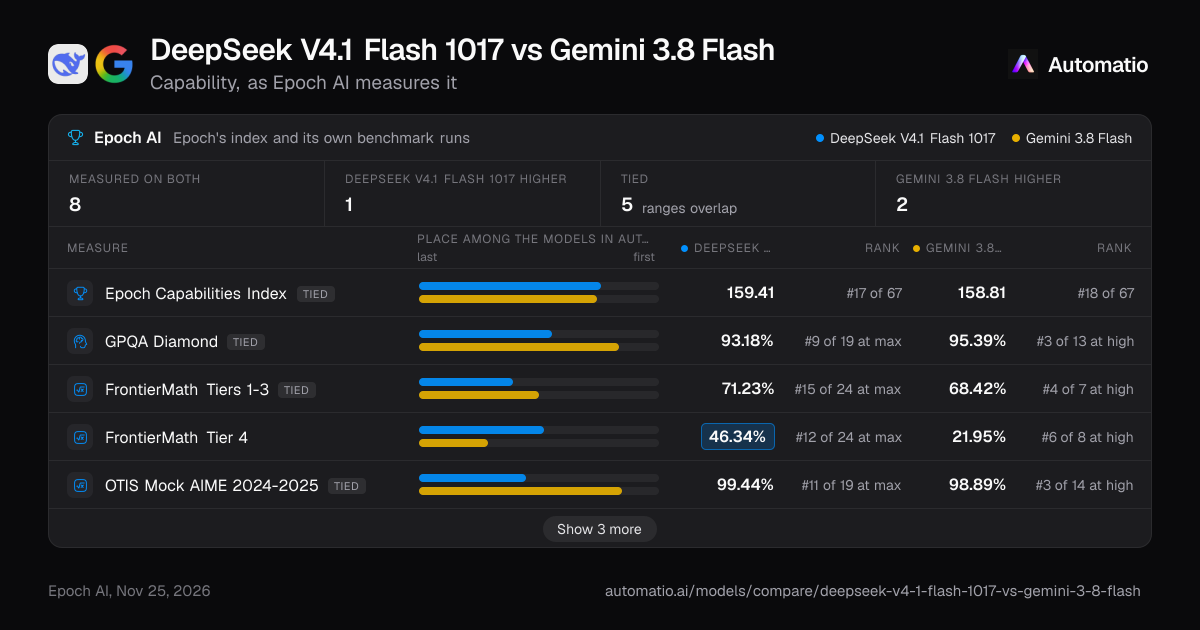
Capability, as Epoch AI measures it
Epoch's index and every benchmark Epoch ran on both: what each one tests, and each model's place among the models in Automatio measured on it. Open a row for what the benchmark is.
- Measured on both
- 8
- DeepSeek V4.1 Flash 1017 higher
- 1
- Tied
- 5ranges overlap
- Gemini 3.8 Flash higher
- 2
Epoch AI's index combines scores from over 50 benchmarks into one general-capability number: a model scores higher if it does better on harder benchmarks, and each benchmark's difficulty is inferred statistically from models that took several of them. The scale is arbitrary, set so that Claude 3.5 Sonnet = 130 and GPT-5 = 150, and as with Elo scores there is no maximum, so only comparisons between models mean something. Each model's score is the mean of an estimated distribution and comes with a 90% credible interval (5th to 95th percentile); Epoch notes that the intervals of top models often overlap.
Each question is a four-option multiple-choice problem in biology, chemistry or physics, written by people with or pursuing PhDs and designed to be very hard for non-experts even with unrestricted internet access; the Diamond subset is the 198 questions that both expert annotators got right but most non-experts got wrong. GPQA was introduced in a 2023 paper by David Rein and colleagues. Epoch scores the share answered correctly (a reply not in the form 'ANSWER: LETTER' gets no points); random guessing scores 25%, and PhD-level experts recruited by OpenAI scored 69.7%.
Each problem is an original math question written and vetted by expert mathematicians; a typical one takes a researcher in that field multiple hours, and the hardest take multiple days. The model can reason and run Python, then submits a Python function answer() that returns its answer, and gets 1 point if it is correct and 0 if it is wrong or nothing is submitted. This is Epoch AI's FrontierMath, which was developed with funding from OpenAI; Tiers 1-3 are the 295-problem base set of the 338-problem v2 dataset (released 2026-06-12), and the numbers on Epoch's hub are for the private set.
Tier 4 is the 43-problem expansion set of exceptionally difficult problems in FrontierMath's 338-problem v2 dataset; the problems are original and were written and vetted by expert mathematicians, and solving a typical FrontierMath problem takes a researcher multiple hours and, for the upper end, multiple days. The model can reason and run Python, then submits a Python function answer() that returns its answer, and gets 1 point if it is correct and 0 if it is wrong or nothing is submitted. FrontierMath was developed with funding from OpenAI, and the numbers on Epoch's hub are for the private set.
Each task is a problem from an OTIS Mock AIME exam (2024, 2025 I or 2025 II), written by students of the Olympiad Training for Individual Study (OTIS) program as an unofficial exam that emulates the American Invitational Mathematics Exam. The model solves it step by step and ends with 'ANSWER: X', an integer from 000 to 999; a model-based extractor pulls out the final answer, and it is compared for an exact match with the answer key. Epoch says the problems are harder than MATH Level 5 but easier than FrontierMath.
Each task is a short factual question asked with no answer options, followed by a prompt telling the model to give its best guess rather than decline. A grader model labels each answer correct, incorrect or not attempted, and Epoch reports the simple proportion answered correctly. The benchmark was created by Google, building on OpenAI's SimpleQA; Epoch notes that this differs from Google's own score, which is an F1-style harmonic mean.
Each task shows a chess position as FEN text and asks for the best next move, submitted as a four-character string such as b1c3 and compared for an exact match with the answer key. Epoch generated the 100 positions programmatically, and the best move in each is the single one found by the Stockfish chess engine; positions are filtered out where the best move is simply capturing an undefended piece, or a higher-value piece with a lower-value one. Five human players (ratings from 1700 to 2400) answered samples of 20 puzzles without AI or an engine, and the two best got 75% right; Epoch says the sampled puzzles are harder than the full set on average.
Each task gives a game state as text and asks for the single best next move, submitted through a tool; the move is normalized into the game's standard notation and compared with the answer key. Epoch made it like its Chess Puzzles benchmark but keeps the game's identity secret to reduce the risk of benchmark-specific preparation, so the prompt and example positions are not published. A response with no valid move gets no credit and is recorded as unanswered, and a response naming an illegal move is marked incorrect.
Human votes on LMArena
The arenas both are ranked in: people compare two answers side by side and vote, and each score is a rating from those votes.
- Measured on both
- 2
- DeepSeek V4.1 Flash 1017 higher
- 1
- Tied
- 1ranges overlap
- Gemini 3.8 Flash higher
- 0
Users submit a prompt such as “Build a simple chess game”, two LLMs generate competing web apps, and users interact with both apps and vote on the better one. Arena rates models with the Bradley-Terry model on these pairwise votes and says the ranking is similar to Elo; the arena launched in December 2024. Arena's leaderboard changelog now calls it “Code Arena: WebDev”.
Agent Arena is not a pairwise vote: people do real work in Agent Mode, each session goes to a randomly chosen orchestrator model, and Arena measures signals from the session (in the index: Task Completion, Praise vs Complaint, Steerability and Bash Reliability) and treats the random assignment like a randomized trial to estimate each model's effect. Until 18 Nov 2026 the score was a net improvement, a model's average signal minus the average over all active models with each signal z-score normalized, which is why scores were small numbers around zero; the Agent Arena Index now shows 1000 times that score plus an anchor offset, one point being 1/1000th of a standard deviation of the signal. The leaderboard also plots each score against the model's measured median cost per task.
Price per million tokens
List prices per million tokens on Vercel AI Gateway. Each bar is the price, the dearer of the two full, so shorter is cheaper.
Automatio computes it from the AI Gateway's list prices: three input tokens for every output token, at the base rate (no cached-input or long-prompt rate). The gateway's pricing page says a request's charge depends on the model and on the number of input and output tokens processed, at rates based on the provider's list price, so what you pay follows your own mix of input and output.
Output speed, the wait for the first token and the price of both, host by host, then the same answer from each, simulated from those medians.
- DeepSeek V4.1 Flash 1017
- 232 tok/s#8 of 81
- Gemini 3.8 Flash
- 171 tok/s#20 of 81
DeepSeek V4.1 Flash 1017median of 13 hostsGemini 3.8 Flashone host- Fastest to finish
- DeepSeek V4.1 Flash 10173.3 s
- Gemini 3.8 Flash finishes in
- 6.4 s
- Answer
- 600 tokens
DeepSeek V4.1 Flash 1017Gemini 3.8 FlashContext, and what each one reads
When each came out, how much it takes in and gives back, and what our model list says each can read and do.
DeepSeek V4.1 Flash 1017
- Released
- Oct 17, 2026the newer one
- Context window
- 1.05M tokensup to 262K out
- Reads
- Can
Gemini 3.8 Flash
- Released
- Sep 2, 2026
- Context window
- 1M tokensup to 65.5K out
- Reads
- Can
Call both through our API
The same OpenAI-compatible endpoint for both: only the model id changes.
- Make a key with the AI models permission on the Integrations page.
- Each call is billed in credits from your account.
import OpenAI from "openai";

const client = new OpenAI({
  baseURL: "https://automatio.ai/api/v1",
  apiKey: process.env.AUTOMATIO_API_KEY,
});

for (const model of ["deepseek/deepseek-v4.1-flash-1017","google/gemini-3.8-flash"]) {
  const res = await client.chat.completions.create({
    model,
    messages: [{ role: "user", content: "Hello" }],
  });
  console.log(model, res.choices[0].message.content);
}
curl https://automatio.ai/api/v1/chat/completions \
-H "Authorization: Bearer $AUTOMATIO_API_KEY" \
-H "Content-Type: application/json" \
-d '{"model":"deepseek/deepseek-v4.1-flash-1017","messages":[{"role":"user","content":"Hello"}]}'Which is cheaper, DeepSeek V4.1 Flash 1017 or Gemini 3.8 Flash?
DeepSeek V4.1 Flash 1017: $0.53 against $1.50 per million tokens, blended three input tokens to one output token, at Vercel AI Gateway's list prices of Nov 25, 2026.
Which scores higher on Epoch's Capabilities Index?
Neither: 159.41 and 158.81 sit inside each other's published ranges, so they are statistically tied.
Which has the larger context window?
DeepSeek V4.1 Flash 1017: 1,048,576 tokens against 1,000,000.
Which one is faster?
DeepSeek V4.1 Flash 1017: 232 tok/s against 171 tok/s, medians over the hour before Nov 25, 2026, each on its own host.
Can I use both DeepSeek V4.1 Flash 1017 and Gemini 3.8 Flash in Automatio?
Yes. Pick either one in a chat's model menu, or call both through our API with the model ids deepseek/deepseek-v4.1-flash-1017 and google/gemini-3.8-flash.
More comparisons
Other pairs among the models nearest to these two.



Where the numbers come from
Every number on this page comes from one of these: public sources first, then what we measured and collected ourselves.
Vercel AI Gateway1
Prices, context windows, and each host's speed and time to first token.
Prices, context and speed via Vercel AI Gateway, 2026-11-25
Epoch AI2
Its own benchmark runs and the Epoch Capabilities Index.
Source: Epoch AI (epoch.ai), CC BY 4.0, 2026-11-25
LMArena3
Leaderboards of people voting between two anonymous answers.
Source: LMArena (arena.ai), leaderboard of 2026-11-23, CC BY 4.0
Try them on your own request
Type it in the box at the top of the page, then pick either model in the chat.
A task can repeat on a schedule, as often as every 5 minutes.
How schedules workResults can also come to you in Discord or Telegram.