

Free to start: 1,000 credits, no card, nothing to install.

GPT-4.1 Mini vs GPT-OSS 120B
Capability, human votes, price, speed and context, side by side, each with its source and date.
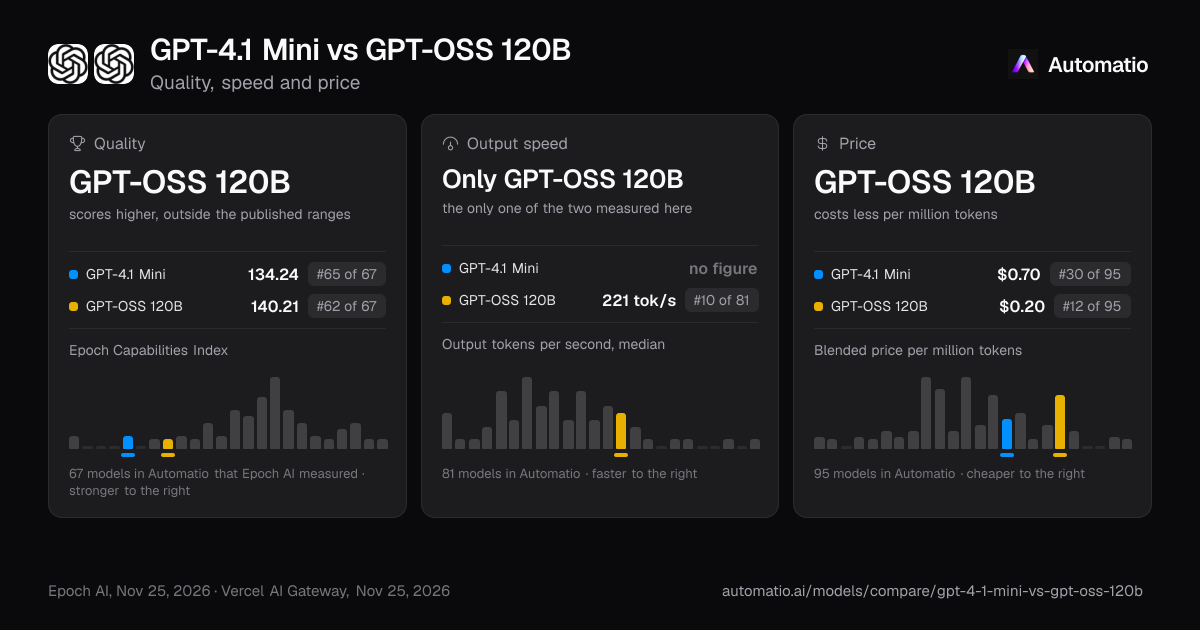
Quality, speed and price
The three figures people check first, for both models. A rank counts the models in Automatio that the source measured.
Quality
GPT-OSS 120B
Epoch Capabilities Index
67 models in Automatio that Epoch AI measured · stronger to the right
Output speed
Only GPT-OSS 120B
Output tokens per second, median
81 models in Automatio · faster to the right
Price
GPT-OSS 120B
Blended price per million tokens
95 models in Automatio · cheaper to the right
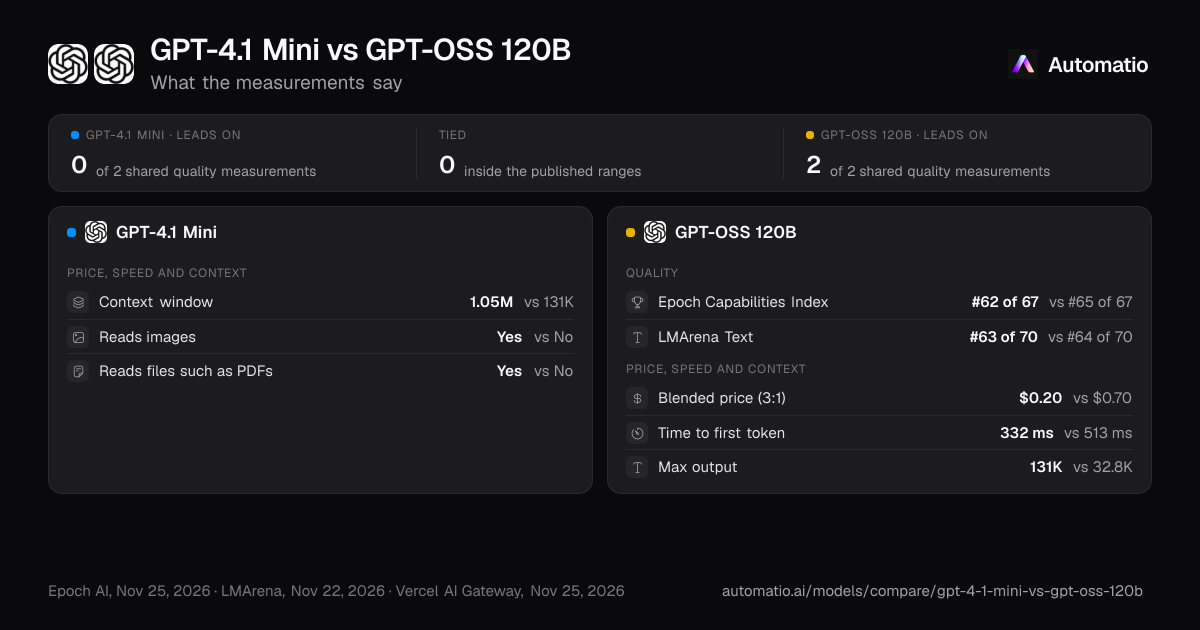
What the measurements say
Where each one leads, measure by measure. A quality lead counts only when the two published ranges do not overlap.
- GPT-4.1 Mini · leads on
- 0of 2 shared quality measurements
- Tied
- 0inside the published ranges
- GPT-OSS 120B · leads on
- 2of 2 shared quality measurements
GPT-4.1 Mini
Price, speed and context
- Context window1.05M vs 131K
- Reads imagesYes vs No
- Reads files such as PDFsYes vs No
GPT-OSS 120B
Quality
- Epoch Capabilities Index#62 of 67 vs #65 of 67
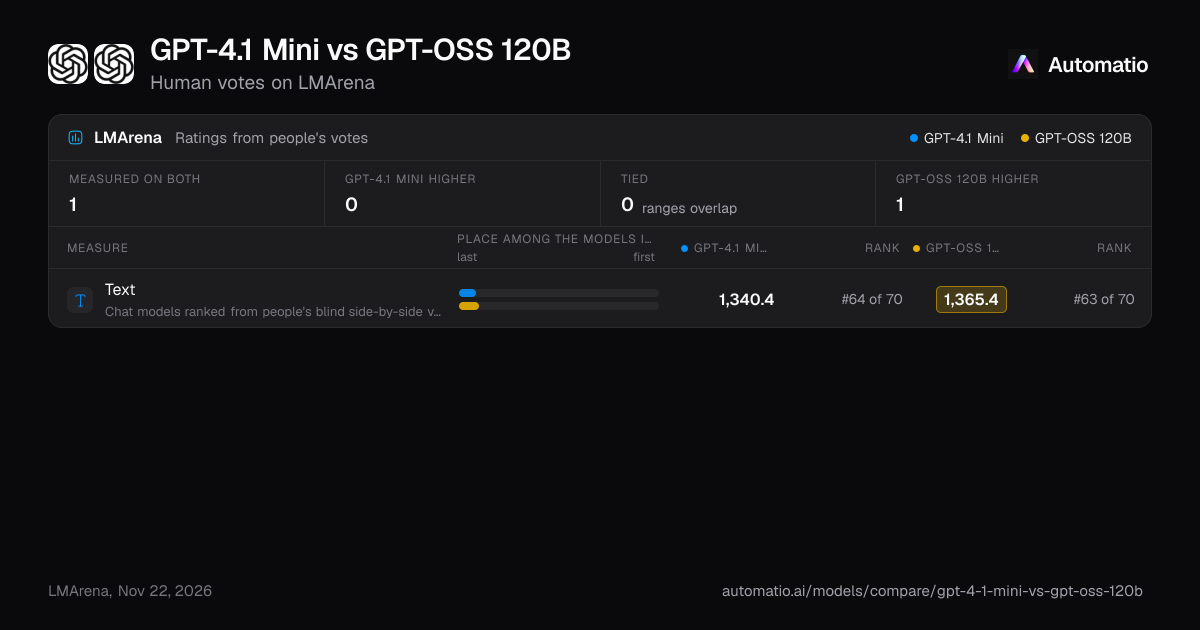
- LMArena Text#63 of 70 vs #64 of 70
Price, speed and context
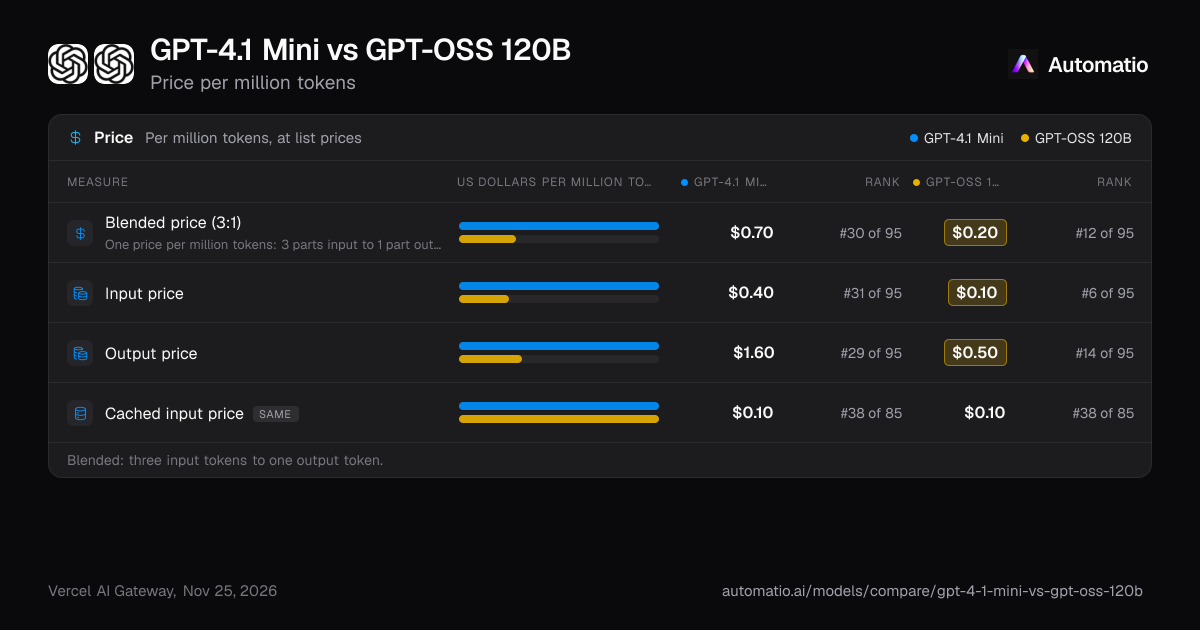
- Blended price (3:1)$0.20 vs $0.70
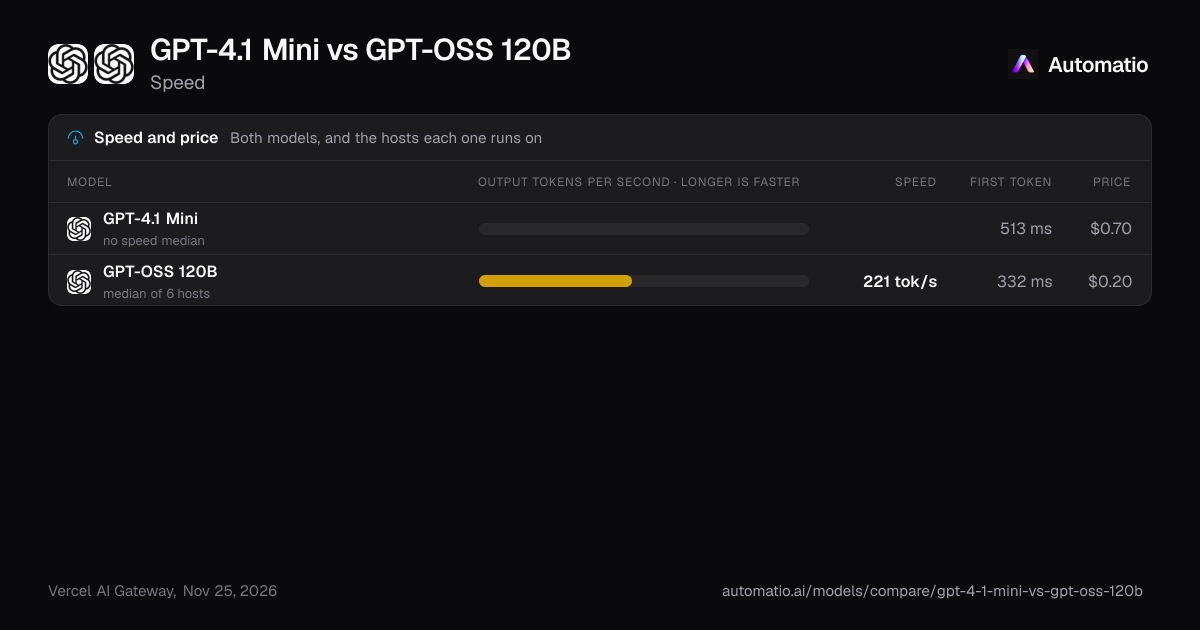
- Time to first token332 ms vs 513 ms
- Max output131K vs 32.8K
Quick tests, head to head
The same 8 questions, each asked 10 times to both models at high effort and graded by code. Every answer is kept.
GPT-4.1 Mini got 31 of 80 answers right, GPT-OSS 120B 44 of 80. They part most on Walk or drive to the car wash (GPT-4.1 Mini 0/10, GPT-OSS 120B 4/10), Letters in “Zermmmmmmat” (GPT-4.1 Mini 7/10, GPT-OSS 120B 10/10), and A decimal equation (GPT-4.1 Mini 7/10, GPT-OSS 120B 10/10). The runs cost us $0.0206 on GPT-4.1 Mini and $0.0909 on GPT-OSS 120B, as billed; a median answer took 0.7 s and 2.7 s.
| Question | GPT-4.1 Mini | GPT-OSS 120B |
|---|---|---|
| Walk or drive to the car washRight answer: drive | 0/100.7 sFirst answer: Walk. | 4/101.5 sFirst answer: Drive |
| Letters in “Zermmmmmmat”Right answer: 6 | 7/100.7 sFirst answer: 6 | 10/104.6 sFirst answer: 6 |
| A decimal equationRight answer: 0.79 | 7/100.7 sFirst answer: x = 0.79 | 10/102.7 sFirst answer: 0.79 |
| Socks in a dark roomRight answer: 2 | 0/100.7 sFirst answer: 4 | 0/101.9 sFirst answer: 4 |
| The largest shapeRight answer: the large rectangle | 10/100.7 sFirst answer: a large rectangle | 10/101 sFirst answer: large rectangle |
| Three doorsRight answer: 1 | 0/100.7 sFirst answer: 3 | 0/102.3 sFirst answer: 3 |
| Repeat a number 31 timesRight answer: 248 characters | 0/101.1 sFirst answer: 128 characters | 0/1061.8 sFirst answer: 188 characters |
| A sentence ending in “m”Right answer: m | 7/100.7 sFirst answer: I found a hidden poem inside the old book's margin. | 10/103.8 sFirst answer: The kingdom's anthem ended with an unexpected drum |
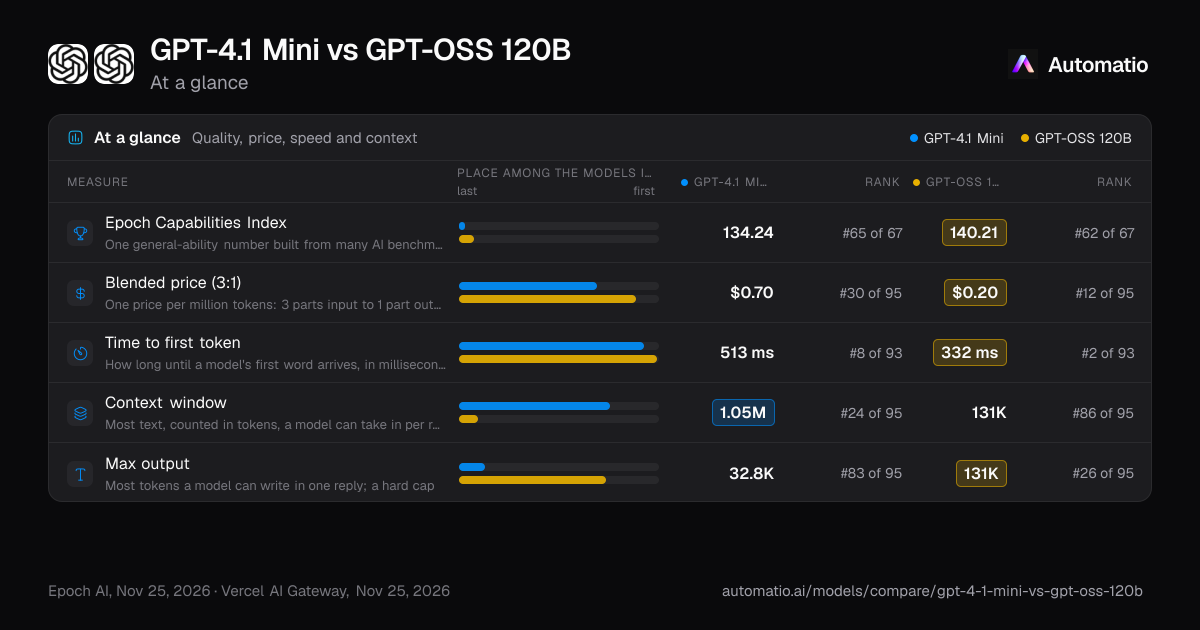
At a glance
The headline figures both have, side by side. Each bar is the place among the models in Automatio measured, so longer is better on every row, and a figure is marked better only where the gap is outside the published ranges.
Epoch AI's index combines scores from over 50 benchmarks into one general-capability number: a model scores higher if it does better on harder benchmarks, and each benchmark's difficulty is inferred statistically from models that took several of them. The scale is arbitrary, set so that Claude 3.5 Sonnet = 130 and GPT-5 = 150, and as with Elo scores there is no maximum, so only comparisons between models mean something. Each model's score is the mean of an estimated distribution and comes with a 90% credible interval (5th to 95th percentile); Epoch notes that the intervals of top models often overlap.
Automatio computes it from the AI Gateway's list prices: three input tokens for every output token, at the base rate (no cached-input or long-prompt rate). The gateway's pricing page says a request's charge depends on the model and on the number of input and output tokens processed, at rates based on the provider's list price, so what you pay follows your own mix of input and output.
Vercel's AI Gateway defines latency as time to first token (TTFT), measured in milliseconds: the duration between the request reaching the provider and the first response token arriving, where lower latency means a faster perceived response. It is measured from live AI Gateway traffic for each model and provider (requests that use your own provider key are excluded) and published as a median (P50) and a 95th percentile (P95) over the last hour; the model catalog row shows the best value across providers.
Vercel's AI Gateway lists a model's context window as its maximum context length in tokens (for each provider endpoint, the maximum context window in tokens). On Vercel's model pages the prompt and the response share this window.
Vercel's AI Gateway lists a model's max output as the maximum number of output tokens (per provider endpoint, max_completion_tokens). On Vercel's model pages this is described as a hard cap on generated tokens, and for reasoning models the reasoning tokens count toward it.
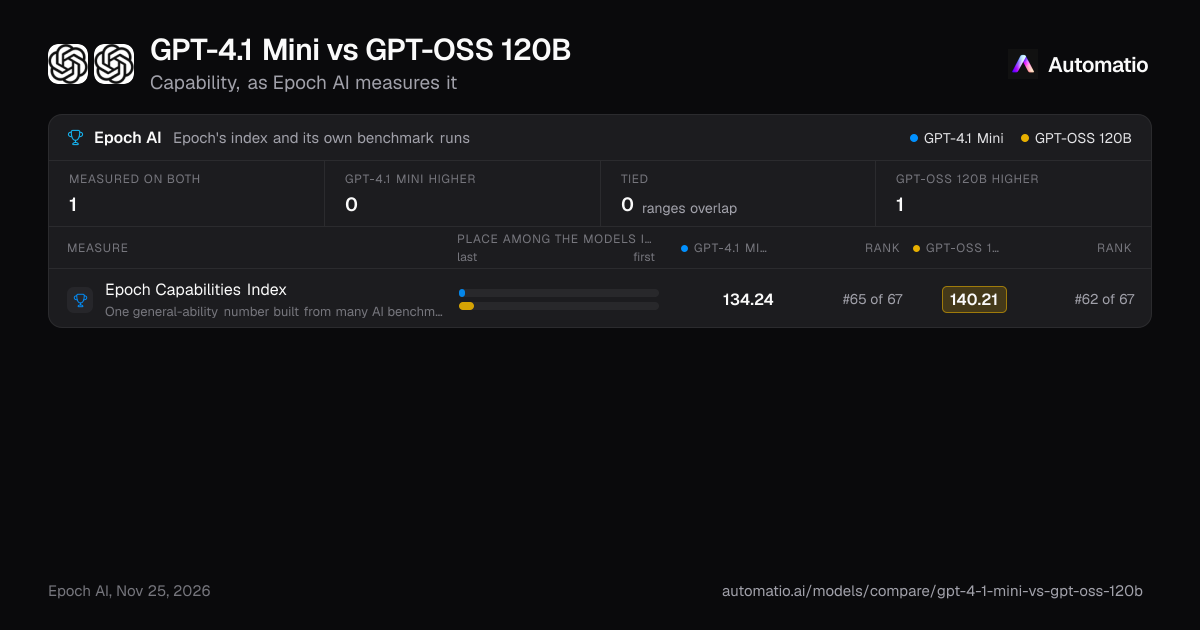
Capability, as Epoch AI measures it
Epoch's index and every benchmark Epoch ran on both: what each one tests, and each model's place among the models in Automatio measured on it. Open a row for what the benchmark is.
- Measured on both
- 1
- GPT-4.1 Mini higher
- 0
- Tied
- 0ranges overlap
- GPT-OSS 120B higher
- 1
Epoch AI's index combines scores from over 50 benchmarks into one general-capability number: a model scores higher if it does better on harder benchmarks, and each benchmark's difficulty is inferred statistically from models that took several of them. The scale is arbitrary, set so that Claude 3.5 Sonnet = 130 and GPT-5 = 150, and as with Elo scores there is no maximum, so only comparisons between models mean something. Each model's score is the mean of an estimated distribution and comes with a 90% credible interval (5th to 95th percentile); Epoch notes that the intervals of top models often overlap.
Human votes on LMArena
The arenas both are ranked in: people compare two answers side by side and vote, and each score is a rating from those votes.
- Measured on both
- 1
- GPT-4.1 Mini higher
- 0
- Tied
- 0ranges overlap
- GPT-OSS 120B higher
- 1
In Arena's battle mode a person types a prompt, is served two anonymous models and decides which answer best fits their needs; names are revealed only after the vote, and only votes cast while the models are anonymous count toward the official rankings. The ratings come from a Bradley-Terry model fitted to these votes, which Arena says is similar to the Elo rating system used in chess. The Arena score measures model strength, and 400 is an arbitrary scaling factor chosen to show scores as whole numbers.
Price per million tokens
List prices per million tokens on Vercel AI Gateway. Each bar is the price, the dearer of the two full, so shorter is cheaper.
Automatio computes it from the AI Gateway's list prices: three input tokens for every output token, at the base rate (no cached-input or long-prompt rate). The gateway's pricing page says a request's charge depends on the model and on the number of input and output tokens processed, at rates based on the provider's list price, so what you pay follows your own mix of input and output.
Output speed, the wait for the first token and the price of both, host by host, then the same answer from each, simulated from those medians.
- GPT-OSS 120B
- 221 tok/s#10 of 81
GPT-4.1 Minino speed medianGPT-OSS 120Bmedian of 6 hostsContext, and what each one reads
When each came out, how much it takes in and gives back, and what our model list says each can read and do.
GPT-4.1 Mini
- Released
- May 14, 2025knows up to Jun 2024
- Context window
- 1.05M tokensup to 32.8K out
- Reads
- Can
GPT-OSS 120B
- Released
- Aug 5, 2025the newer one · knows up to Jun 2024
- Context window
- 131K tokensup to 131K out
- Reads
- Can
Call both through our API
The same OpenAI-compatible endpoint for both: only the model id changes.
- Make a key with the AI models permission on the Integrations page.
- Each call is billed in credits from your account.
import OpenAI from "openai";

const client = new OpenAI({
  baseURL: "https://automatio.ai/api/v1",
  apiKey: process.env.AUTOMATIO_API_KEY,
});

for (const model of ["openai/gpt-4.1-mini","openai/gpt-oss-120b"]) {
  const res = await client.chat.completions.create({
    model,
    messages: [{ role: "user", content: "Hello" }],
  });
  console.log(model, res.choices[0].message.content);
}
curl https://automatio.ai/api/v1/chat/completions \
-H "Authorization: Bearer $AUTOMATIO_API_KEY" \
-H "Content-Type: application/json" \
-d '{"model":"openai/gpt-4.1-mini","messages":[{"role":"user","content":"Hello"}]}'Which is cheaper, GPT-4.1 Mini or GPT-OSS 120B?
GPT-OSS 120B: $0.20 against $0.70 per million tokens, blended three input tokens to one output token, at Vercel AI Gateway's list prices of Nov 25, 2026.
Which scores higher on Epoch's Capabilities Index?
GPT-OSS 120B: 140.21 against 134.24, outside each other's published ranges.
Which has the larger context window?
GPT-4.1 Mini: 1,047,576 tokens against 131,072.
Can I use both GPT-4.1 Mini and GPT-OSS 120B in Automatio?
Yes. Pick either one in a chat's model menu, or call both through our API with the model ids openai/gpt-4.1-mini and openai/gpt-oss-120b.
More comparisons
Other pairs among the models nearest to these two.


Where the numbers come from
Every number on this page comes from one of these: public sources first, then what we measured and collected ourselves.
Vercel AI Gateway1
Prices, context windows, and each host's speed and time to first token.
Prices, context and speed via Vercel AI Gateway, 2026-11-25
Epoch AI2
Its own benchmark runs and the Epoch Capabilities Index.
Source: Epoch AI (epoch.ai), CC BY 4.0, 2026-11-25
LMArena3
Leaderboards of people voting between two anonymous answers.
Source: LMArena (arena.ai), leaderboard of 2026-11-23, CC BY 4.0
Try them on your own request
Type it in the box at the top of the page, then pick either model in the chat.
A task can repeat on a schedule, as often as every 5 minutes.
How schedules workResults can also come to you in Discord or Telegram.