

Free to start: 1,000 credits, no card, nothing to install.


GPT-5.2 Pro vs Grok 4.6
Capability, human votes, price, speed and context, side by side, each with its source and date.
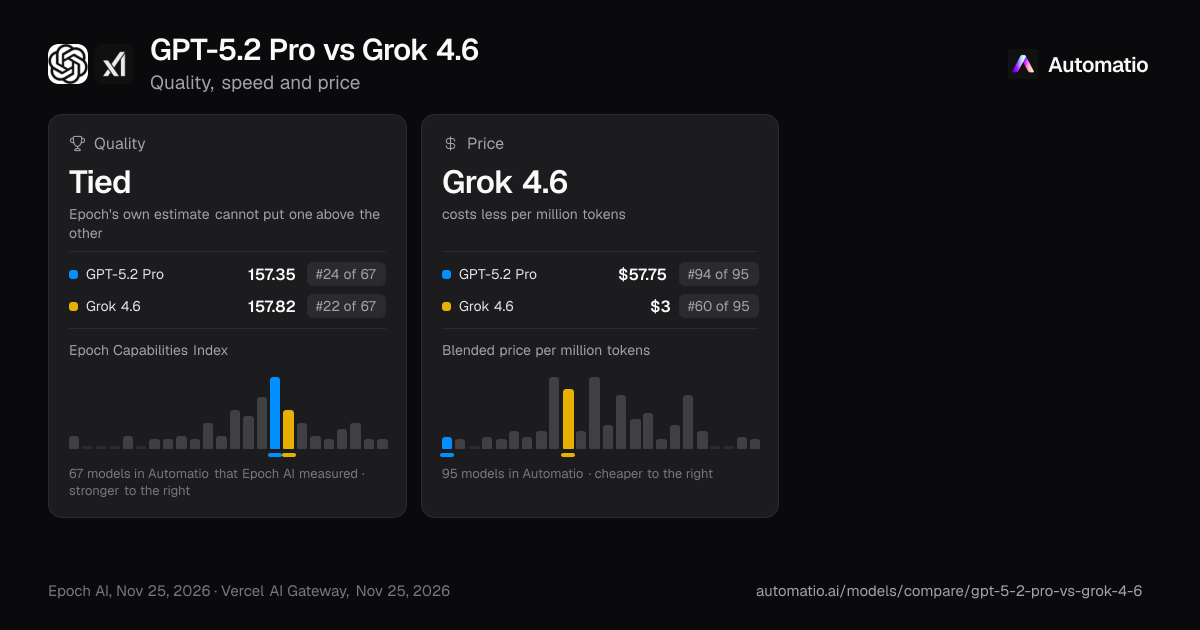
Quality, speed and price
The three figures people check first, for both models. A rank counts the models in Automatio that the source measured.
Quality
Tied
Epoch Capabilities Index
67 models in Automatio that Epoch AI measured · stronger to the right
Price
Grok 4.6
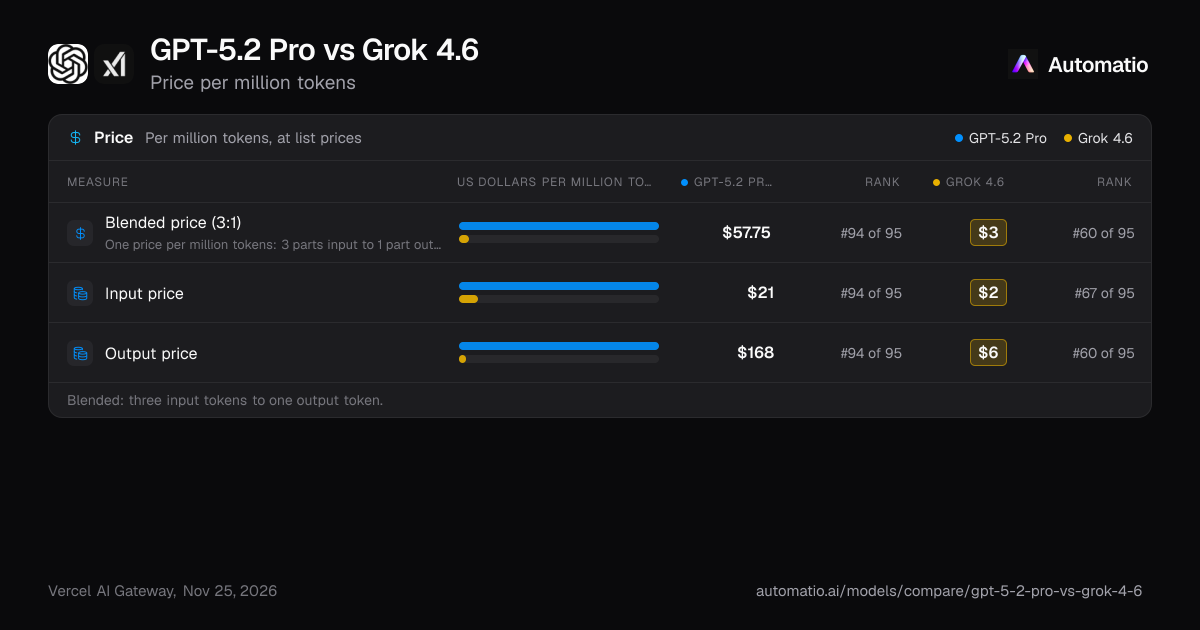
Blended price per million tokens
95 models in Automatio · cheaper to the right
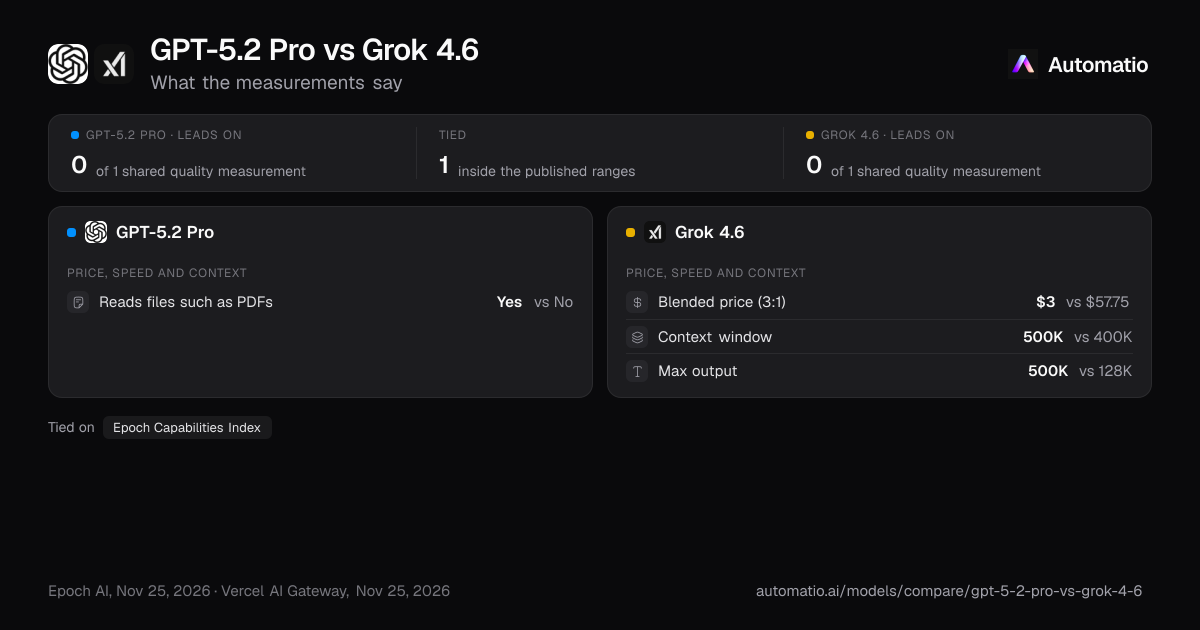
What the measurements say
Where each one leads, measure by measure. A quality lead counts only when the two published ranges do not overlap.
- GPT-5.2 Pro · leads on
- 0of 1 shared quality measurement
- Tied
- 1inside the published ranges
- Grok 4.6 · leads on
- 0of 1 shared quality measurement
GPT-5.2 Pro
Price, speed and context
- Reads files such as PDFsYes vs No
Grok 4.6
Price, speed and context
- Blended price (3:1)$3 vs $57.75
- Context window500K vs 400K
- Max output500K vs 128K
Tied onEpoch Capabilities Index
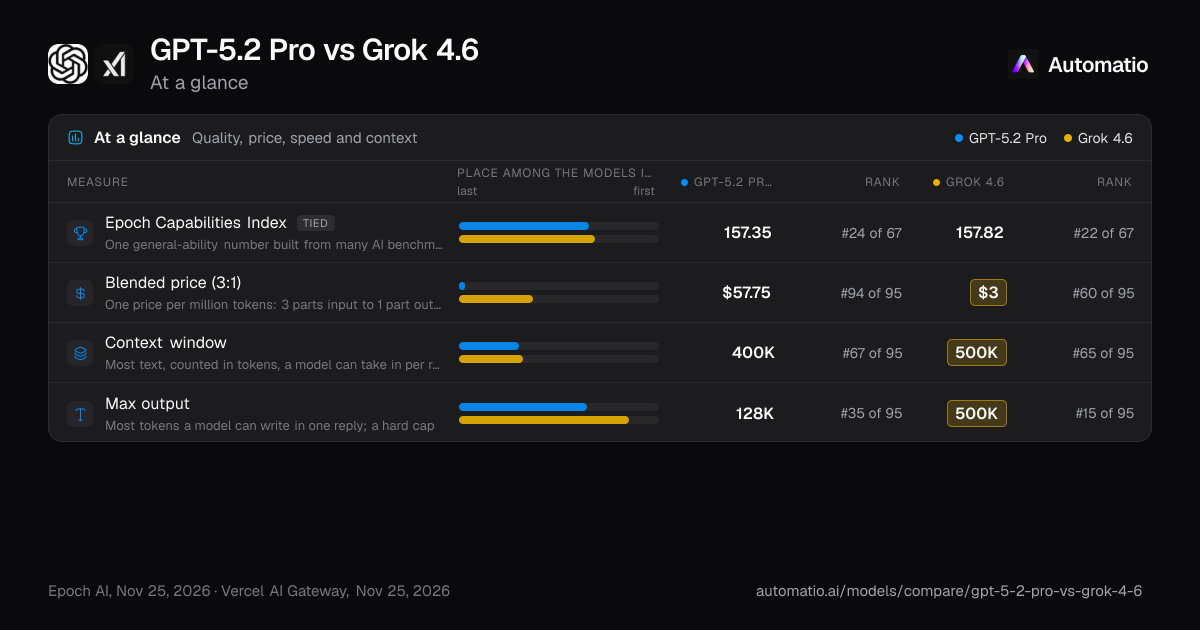
At a glance
The headline figures both have, side by side. Each bar is the place among the models in Automatio measured, so longer is better on every row, and a figure is marked better only where the gap is outside the published ranges.
Epoch AI's index combines scores from over 50 benchmarks into one general-capability number: a model scores higher if it does better on harder benchmarks, and each benchmark's difficulty is inferred statistically from models that took several of them. The scale is arbitrary, set so that Claude 3.5 Sonnet = 130 and GPT-5 = 150, and as with Elo scores there is no maximum, so only comparisons between models mean something. Each model's score is the mean of an estimated distribution and comes with a 90% credible interval (5th to 95th percentile); Epoch notes that the intervals of top models often overlap.
Automatio computes it from the AI Gateway's list prices: three input tokens for every output token, at the base rate (no cached-input or long-prompt rate). The gateway's pricing page says a request's charge depends on the model and on the number of input and output tokens processed, at rates based on the provider's list price, so what you pay follows your own mix of input and output.
Vercel's AI Gateway lists a model's context window as its maximum context length in tokens (for each provider endpoint, the maximum context window in tokens). On Vercel's model pages the prompt and the response share this window.
Vercel's AI Gateway lists a model's max output as the maximum number of output tokens (per provider endpoint, max_completion_tokens). On Vercel's model pages this is described as a hard cap on generated tokens, and for reasoning models the reasoning tokens count toward it.
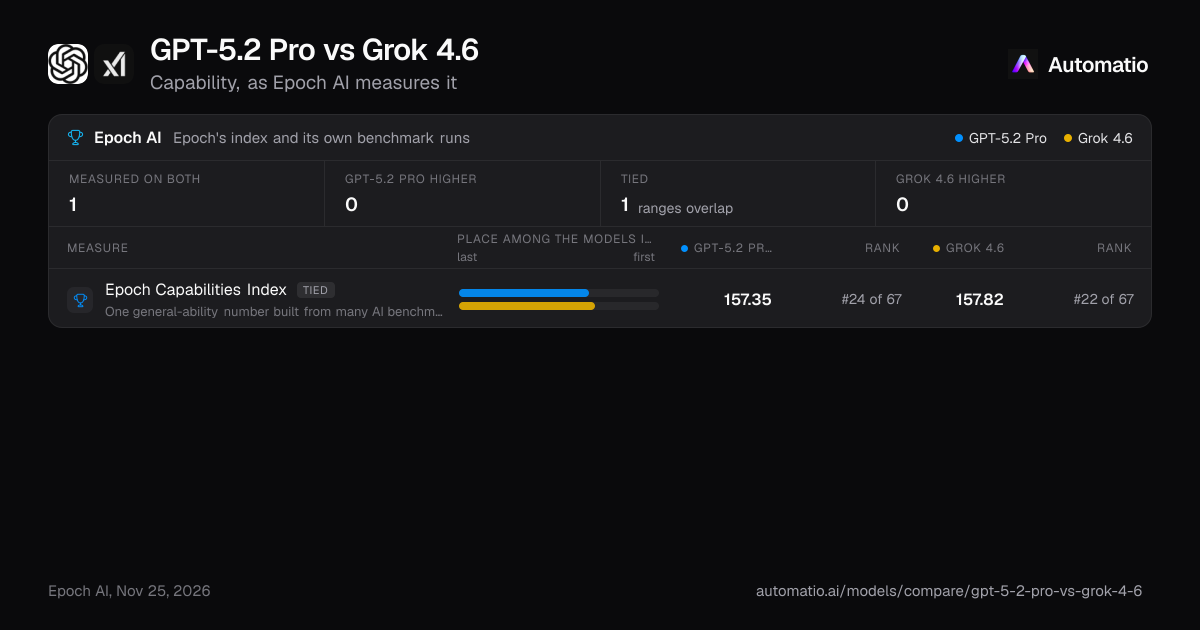
Capability, as Epoch AI measures it
Epoch's index and every benchmark Epoch ran on both: what each one tests, and each model's place among the models in Automatio measured on it. Open a row for what the benchmark is.
- Measured on both
- 1
- GPT-5.2 Pro higher
- 0
- Tied
- 1ranges overlap
- Grok 4.6 higher
- 0
Epoch AI's index combines scores from over 50 benchmarks into one general-capability number: a model scores higher if it does better on harder benchmarks, and each benchmark's difficulty is inferred statistically from models that took several of them. The scale is arbitrary, set so that Claude 3.5 Sonnet = 130 and GPT-5 = 150, and as with Elo scores there is no maximum, so only comparisons between models mean something. Each model's score is the mean of an estimated distribution and comes with a 90% credible interval (5th to 95th percentile); Epoch notes that the intervals of top models often overlap.
Price per million tokens
List prices per million tokens on Vercel AI Gateway. Each bar is the price, the dearer of the two full, so shorter is cheaper.
Automatio computes it from the AI Gateway's list prices: three input tokens for every output token, at the base rate (no cached-input or long-prompt rate). The gateway's pricing page says a request's charge depends on the model and on the number of input and output tokens processed, at rates based on the provider's list price, so what you pay follows your own mix of input and output.
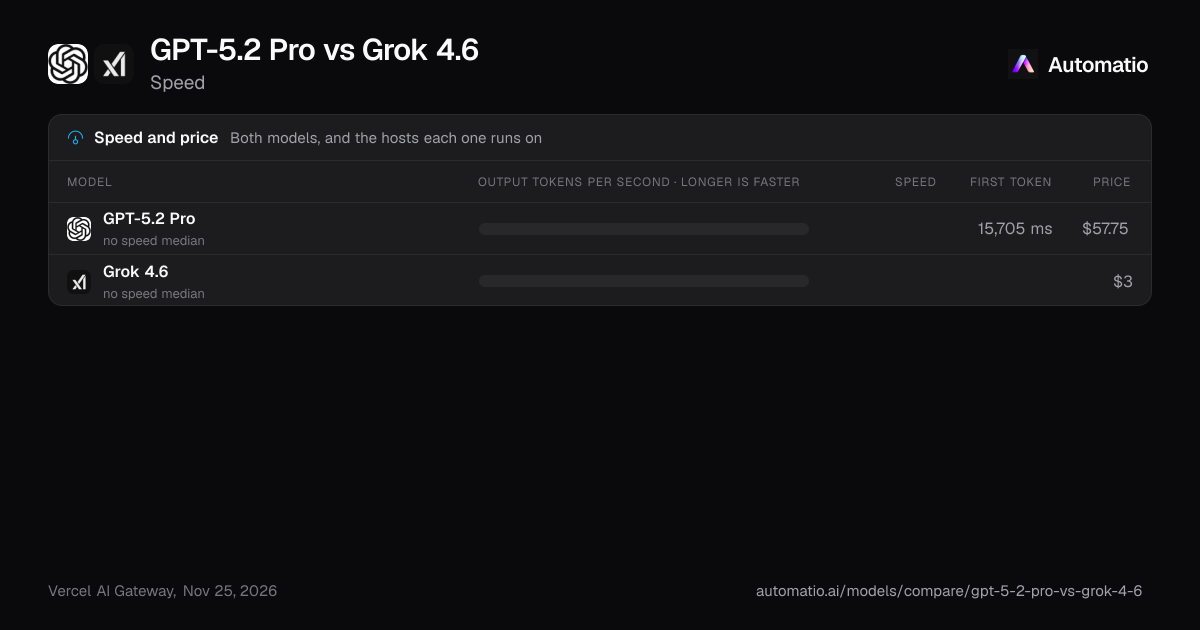
Output speed, the wait for the first token and the price of both, host by host, then the same answer from each, simulated from those medians.
GPT-5.2 Prono speed medianGrok 4.6no speed medianContext, and what each one reads
When each came out, how much it takes in and gives back, and what our model list says each can read and do.
GPT-5.2 Pro
- Released
- Dec 11, 2025knows up to Aug 2025
- Context window
- 400K tokensup to 128K out
- Reads
- Can
Grok 4.6
- Released
- Aug 12, 2026the newer one · knows up to Feb 2026
- Context window
- 500K tokensup to 500K out
- Reads
- Can
Call both through our API
The same OpenAI-compatible endpoint for both: only the model id changes.
- Make a key with the AI models permission on the Integrations page.
- Each call is billed in credits from your account.
import OpenAI from "openai";

const client = new OpenAI({
  baseURL: "https://automatio.ai/api/v1",
  apiKey: process.env.AUTOMATIO_API_KEY,
});

for (const model of ["openai/gpt-5.2-pro","spacexai/grok-4.6"]) {
  const res = await client.chat.completions.create({
    model,
    messages: [{ role: "user", content: "Hello" }],
  });
  console.log(model, res.choices[0].message.content);
}
curl https://automatio.ai/api/v1/chat/completions \
-H "Authorization: Bearer $AUTOMATIO_API_KEY" \
-H "Content-Type: application/json" \
-d '{"model":"openai/gpt-5.2-pro","messages":[{"role":"user","content":"Hello"}]}'Which is cheaper, GPT-5.2 Pro or Grok 4.6?
Grok 4.6: $3 against $57.75 per million tokens, blended three input tokens to one output token, at Vercel AI Gateway's list prices of Nov 25, 2026.
Which scores higher on Epoch's Capabilities Index?
Neither: 157.35 and 157.82 sit inside each other's published ranges, so they are statistically tied.
Which has the larger context window?
Grok 4.6: 500,000 tokens against 400,000.
Can I use both GPT-5.2 Pro and Grok 4.6 in Automatio?
Yes. Pick either one in a chat's model menu, or call both through our API with the model ids openai/gpt-5.2-pro and spacexai/grok-4.6.
More comparisons
Other pairs among the models nearest to these two.




Where the numbers come from
Every number on this page comes from one of these: public sources first, then what we measured and collected ourselves.
Vercel AI Gateway1
Prices, context windows, and each host's speed and time to first token.
Prices, context and speed via Vercel AI Gateway, 2026-11-25
Epoch AI2
Its own benchmark runs and the Epoch Capabilities Index.
Source: Epoch AI (epoch.ai), CC BY 4.0, 2026-11-25
Try them on your own request
Type it in the box at the top of the page, then pick either model in the chat.
A task can repeat on a schedule, as often as every 5 minutes.
How schedules workResults can also come to you in Discord or Telegram.