

Skip to content

Free to start: 1,000 credits, no card, nothing to install.

GPT-5.6 Terra vs Kimi K3.1 Pro

Capability, human votes, price, speed and context, side by side, each with its source and date.

Quality, speed and price

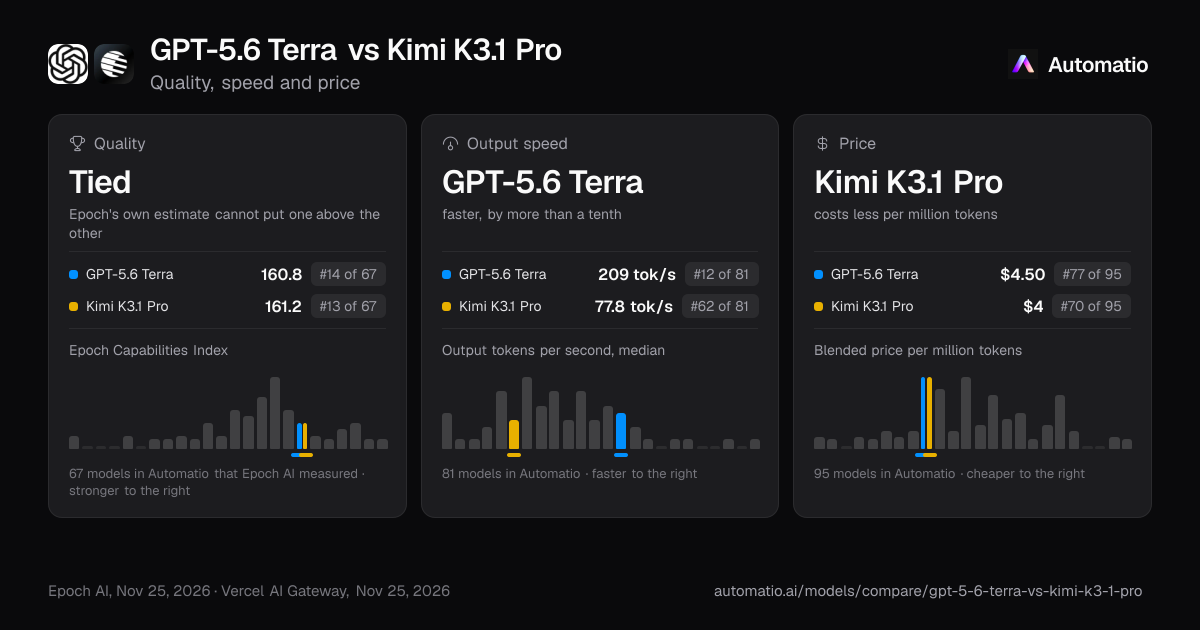
The three figures people check first, for both models. A rank counts the models in Automatio that the source measured.

Quality

Tied

Epoch's own estimate cannot put one above the other

GPT-5.6 Terra160.8#14 of 67
Kimi K3.1 Pro161.2#13 of 67

Epoch Capabilities Index

67 models in Automatio that Epoch AI measured · stronger to the right

Output speed

GPT-5.6 Terra

faster, by more than a tenth

GPT-5.6 Terra209 tok/s#12 of 81
Kimi K3.1 Pro77.8 tok/s#62 of 81

Output tokens per second, median

81 models in Automatio · faster to the right

Price

Kimi K3.1 Pro

costs less per million tokens

GPT-5.6 Terra$4.50#77 of 95
Kimi K3.1 Pro$4#70 of 95

Blended price per million tokens

95 models in Automatio · cheaper to the right

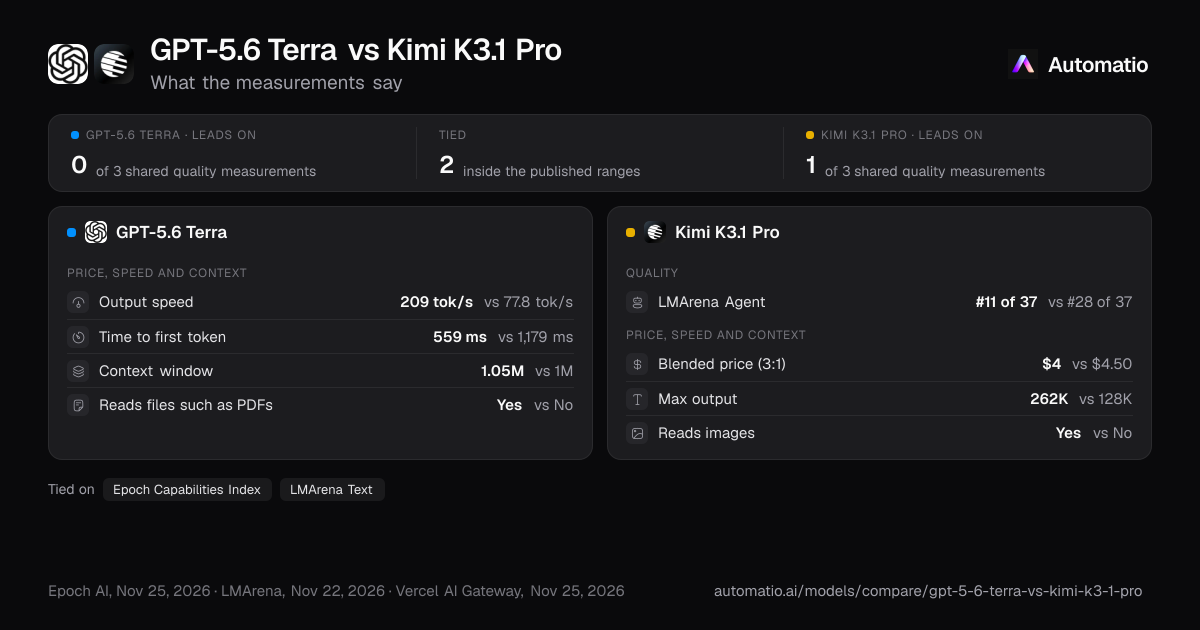
What the measurements say

Where each one leads, measure by measure. A quality lead counts only when the two published ranges do not overlap.

GPT-5.6 Terra · leads on
0of 3 shared quality measurements
Tied
2inside the published ranges
Kimi K3.1 Pro · leads on
1of 3 shared quality measurements

GPT-5.6 Terra

Price, speed and context

  • Output speed209 tok/s vs 77.8 tok/s
  • Time to first token559 ms vs 1,179 ms
  • Context window1.05M vs 1M
  • Reads files such as PDFsYes vs No

Kimi K3.1 Pro

Quality

  • LMArena Agent#11 of 37 vs #28 of 37

Price, speed and context

  • Blended price (3:1)$4 vs $4.50
  • Max output262K vs 128K
  • Reads imagesYes vs No

Tied onEpoch Capabilities IndexLMArena Text

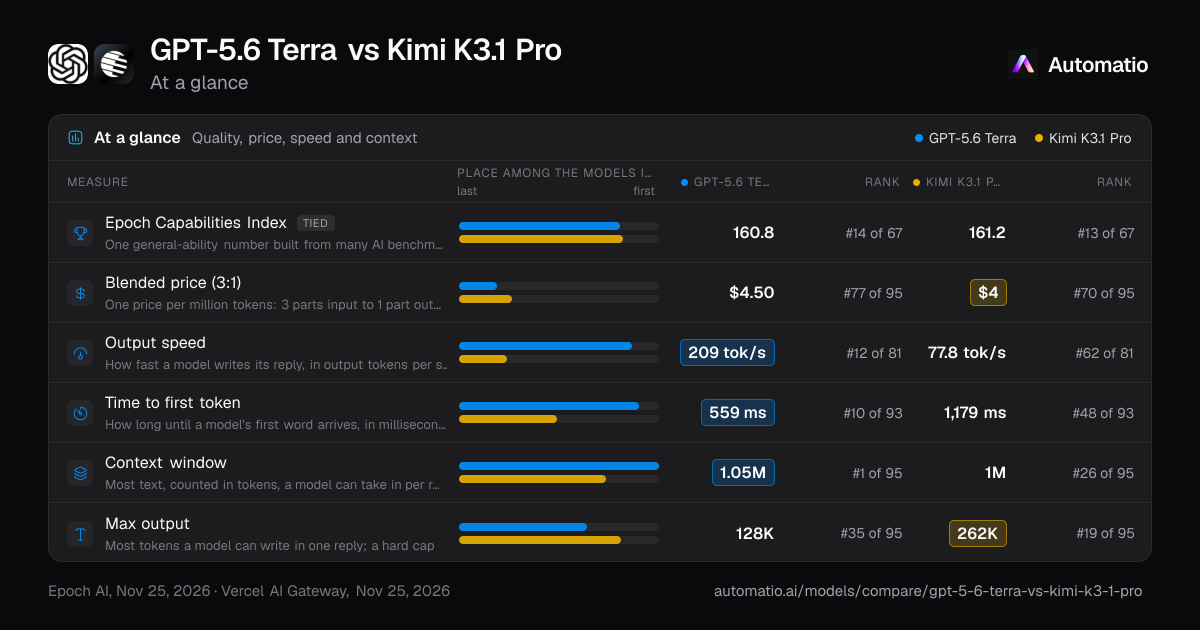
At a glance

The headline figures both have, side by side. Each bar is the place among the models in Automatio measured, so longer is better on every row, and a figure is marked better only where the gap is outside the published ranges.

At a glanceQuality, price, speed and contextGPT-5.6 TerraKimi K3.1 Pro

Epoch AI's index combines scores from over 50 benchmarks into one general-capability number: a model scores higher if it does better on harder benchmarks, and each benchmark's difficulty is inferred statistically from models that took several of them. The scale is arbitrary, set so that Claude 3.5 Sonnet = 130 and GPT-5 = 150, and as with Elo scores there is no maximum, so only comparisons between models mean something. Each model's score is the mean of an estimated distribution and comes with a 90% credible interval (5th to 95th percentile); Epoch notes that the intervals of top models often overlap.

Scale: Index; higher is better; no fixed maximum; anchored at Claude 3.5 Sonnet = 130 and GPT-5 = 150; each score has a 90% credible interval (5th to 95th percentile).

Automatio computes it from the AI Gateway's list prices: three input tokens for every output token, at the base rate (no cached-input or long-prompt rate). The gateway's pricing page says a request's charge depends on the model and on the number of input and output tokens processed, at rates based on the provider's list price, so what you pay follows your own mix of input and output.

Scale: US dollars per 1 million tokens; lower is cheaper.

Vercel's AI Gateway defines throughput as the rate at which a provider returns output tokens, measured in tokens per second, where higher throughput means a provider returns output tokens faster. It is measured from live AI Gateway traffic for each model and provider (requests that use your own provider key are excluded) and published as a median (P50) and a 95th percentile (P95) over the last hour; the model catalog row shows the best value across providers.

Scale: output tokens per second; P50 (median) and P95 over the last hour per provider; higher is better.

Vercel's AI Gateway defines latency as time to first token (TTFT), measured in milliseconds: the duration between the request reaching the provider and the first response token arriving, where lower latency means a faster perceived response. It is measured from live AI Gateway traffic for each model and provider (requests that use your own provider key are excluded) and published as a median (P50) and a 95th percentile (P95) over the last hour; the model catalog row shows the best value across providers.

Scale: milliseconds; P50 (median) and P95 over the last hour per provider; lower is better.

Vercel's AI Gateway lists a model's context window as its maximum context length in tokens (for each provider endpoint, the maximum context window in tokens). On Vercel's model pages the prompt and the response share this window.

Scale: tokens (for example a 1M-token or 128K-token window).

Vercel's AI Gateway lists a model's max output as the maximum number of output tokens (per provider endpoint, max_completion_tokens). On Vercel's model pages this is described as a hard cap on generated tokens, and for reasoning models the reasoning tokens count toward it.

Scale: tokens (for example 16,384 for GPT-4o, 128,000 for Claude Opus 5, as listed on Vercel's model pages).

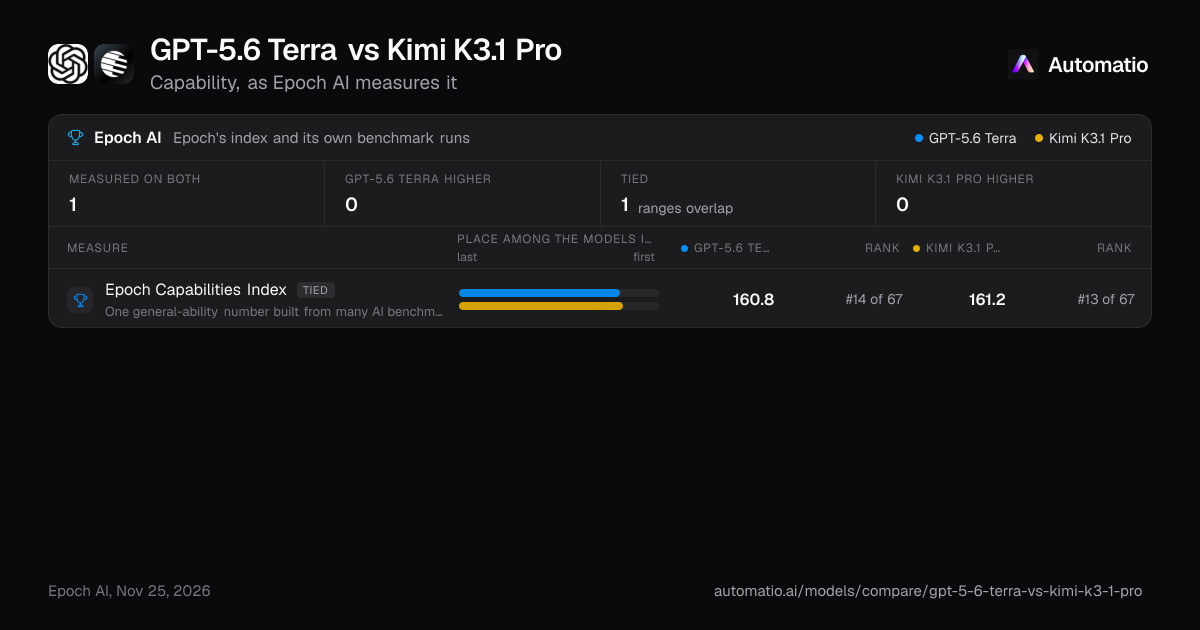
Capability, as Epoch AI measures it

Epoch's index and every benchmark Epoch ran on both: what each one tests, and each model's place among the models in Automatio measured on it. Open a row for what the benchmark is.

Epoch AIEpoch's index and its own benchmark runsGPT-5.6 TerraKimi K3.1 Pro
Measured on both
1
GPT-5.6 Terra higher
0
Tied
1ranges overlap
Kimi K3.1 Pro higher
0

Epoch AI's index combines scores from over 50 benchmarks into one general-capability number: a model scores higher if it does better on harder benchmarks, and each benchmark's difficulty is inferred statistically from models that took several of them. The scale is arbitrary, set so that Claude 3.5 Sonnet = 130 and GPT-5 = 150, and as with Elo scores there is no maximum, so only comparisons between models mean something. Each model's score is the mean of an estimated distribution and comes with a 90% credible interval (5th to 95th percentile); Epoch notes that the intervals of top models often overlap.

Scale: Index; higher is better; no fixed maximum; anchored at Claude 3.5 Sonnet = 130 and GPT-5 = 150; each score has a 90% credible interval (5th to 95th percentile).

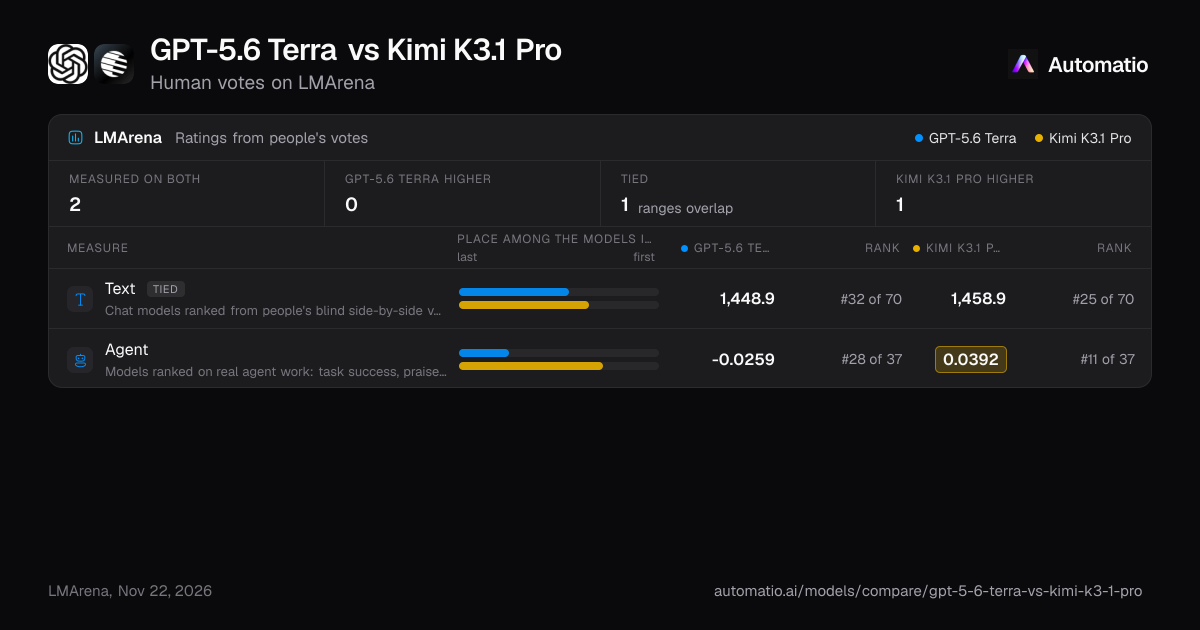
Human votes on LMArena

The arenas both are ranked in: people compare two answers side by side and vote, and each score is a rating from those votes.

LMArenaRatings from people's votesGPT-5.6 TerraKimi K3.1 Pro
Measured on both
2
GPT-5.6 Terra higher
0
Tied
1ranges overlap
Kimi K3.1 Pro higher
1

In Arena's battle mode a person types a prompt, is served two anonymous models and decides which answer best fits their needs; names are revealed only after the vote, and only votes cast while the models are anonymous count toward the official rankings. The ratings come from a Bradley-Terry model fitted to these votes, which Arena says is similar to the Elo rating system used in chess. The Arena score measures model strength, and 400 is an arbitrary scaling factor chosen to show scores as whole numbers.

Scale: Arena score (Bradley-Terry, Elo-like); higher is better. Arena states no fixed minimum or maximum.

Agent Arena is not a pairwise vote: people do real work in Agent Mode, each session goes to a randomly chosen orchestrator model, and Arena measures signals from the session (in the index: Task Completion, Praise vs Complaint, Steerability and Bash Reliability) and treats the random assignment like a randomized trial to estimate each model's effect. Until 18 Nov 2026 the score was a net improvement, a model's average signal minus the average over all active models with each signal z-score normalized, which is why scores were small numbers around zero; the Agent Arena Index now shows 1000 times that score plus an anchor offset, one point being 1/1000th of a standard deviation of the signal. The leaderboard also plots each score against the model's measured median cost per task.

Scale: Before 2026-11-18: net improvement in standard deviations of the signals (0 = average active model). Since: index points, 1 point = 1/1000 SD, anchored so established models' scores stay stable (July average about 1000). Cost: median cost per task (P50).

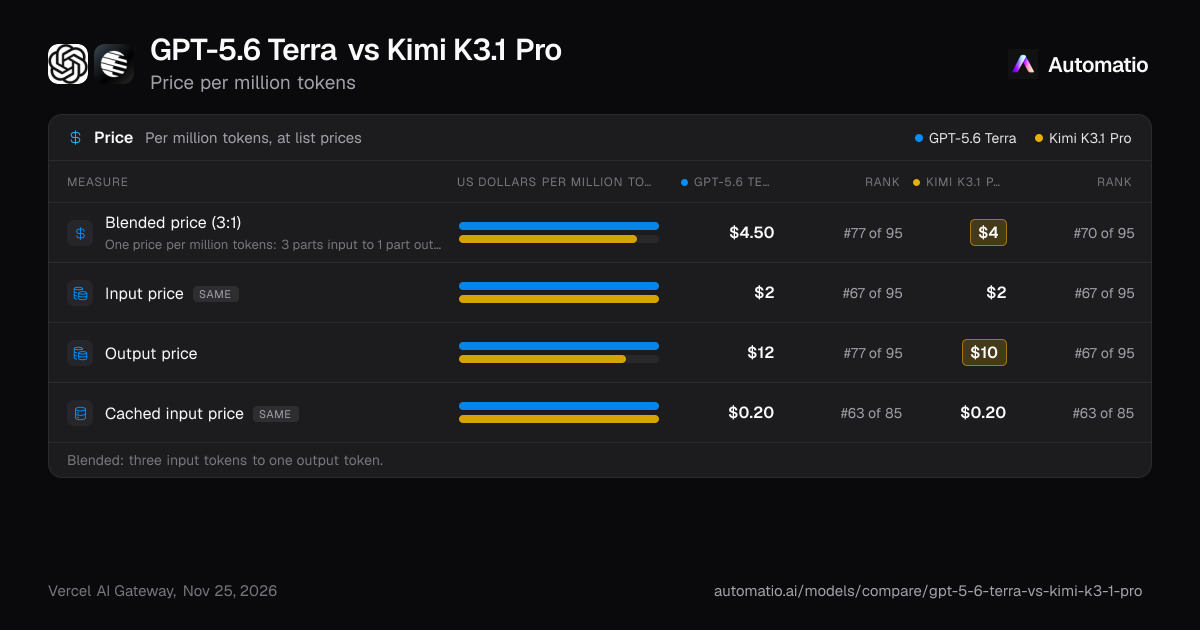
Price per million tokens

List prices per million tokens on Vercel AI Gateway. Each bar is the price, the dearer of the two full, so shorter is cheaper.

PricePer million tokens, at list pricesGPT-5.6 TerraKimi K3.1 Pro

Automatio computes it from the AI Gateway's list prices: three input tokens for every output token, at the base rate (no cached-input or long-prompt rate). The gateway's pricing page says a request's charge depends on the model and on the number of input and output tokens processed, at rates based on the provider's list price, so what you pay follows your own mix of input and output.

Scale: US dollars per 1 million tokens; lower is cheaper.

Input priceSame
$2#67 of 95$2#67 of 95
Output price
$12#77 of 95$10the better of the two#67 of 95
Cached input priceSame
$0.20#63 of 85$0.20#63 of 85

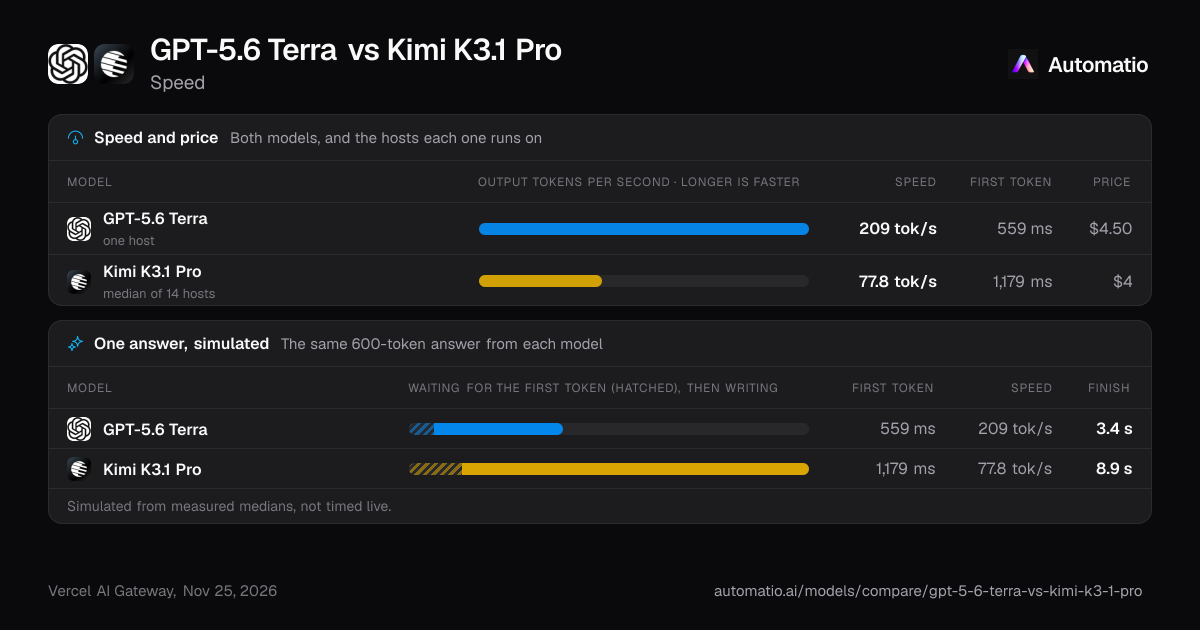
Output speed, the wait for the first token and the price of both, host by host, then the same answer from each, simulated from those medians.

Speed and priceBoth models, and the hosts each one runs on
GPT-5.6 Terra
209 tok/s#12 of 81
Kimi K3.1 Pro
77.8 tok/s#62 of 81
One answer, simulatedThe same 600-token answer from each model
Fastest to finish
GPT-5.6 Terra3.4 s
Kimi K3.1 Pro finishes in
8.9 s
Answer
600 tokens
GPT-5.6 Terra
559 ms209 tok/s3.4 s
Kimi K3.1 Pro
1,179 ms77.8 tok/s8.9 s

Context, and what each one reads

When each came out, how much it takes in and gives back, and what our model list says each can read and do.

GPT-5.6 Terra

Released
Jul 9, 2026knows up to Feb 2026
Context window
1.05M tokensup to 128K out
Reads
Can

Kimi K3.1 Pro

Released
Oct 23, 2026the newer one
Context window
1M tokensup to 262K out
Reads
Can

Vercel AI Gateway · Nov 25, 2026

Creative tests

The same prompt to both, one run each, the first output as it came back.

Kimi K3.1 Pro has not been run on these prompts yet.

A boat at sunset, as an animated SVG

GPT-5.6 Terra

A boat at sunset, as an animated SVG: a frame of the first output from GPT-5.6 Terra
RenderedFirst output, not pickedNov 26, 2026high effort$0.096184.1 s7,970 tokens out
The prompt and our note

Flat sunset with a cream-sailed boat and a red flag on wave lines, a glowing sun, clouds and a few birds; between the frames the sun sinks behind the boat, the birds and clouds move and the boat tilts. No reflection shows on the water.

The prompt, version 1

Create one self-contained animated SVG, 800×600 pixels (width="800" height="600" viewBox="0 0 800 600"). Scene: a sailing boat rocking on rolling ocean waves at sunset, with the sun slowly sinking toward the horizon, its reflection shimmering on the water, and a few birds flying across the sky. Everything should move, and the animation should loop smoothly. Animate with SMIL or CSS inside the SVG only: no JavaScript, no external images, fonts or links. Keep it under 30 KB. Reply with only the SVG code, from <svg to </svg>, with no explanation and no Markdown fences.
A black hole, rendered live with WebGL

GPT-5.6 Terra

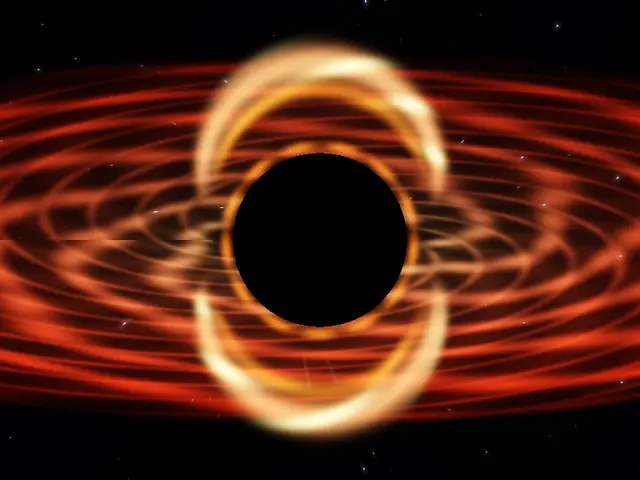
A black hole, rendered live with WebGL: a frame of the first output from GPT-5.6 Terra
RenderedFirst output, not pickedNov 26, 2026high effort$0.072969.7 s6,028 tokens out
The prompt and our note

Raw-WebGL black hole: a black shadow ringed in orange, a flat red-orange disk of streaks across it and a bright lensed arc above and below, turning between frames; the starfield is faint.

The prompt, version 1

Create one self-contained HTML file that renders an animated black hole in real time with WebGL. Show a black event horizon, a bright accretion disk that rotates, and gravitational lensing that visibly bends the light of the disk and of a starfield behind the hole (the far side of the disk should appear to arch over and under the hole). Fill the browser window, handle resizing, and animate continuously. Use raw WebGL, or three.js loaded exactly as <script src="https://cdnjs.cloudflare.com/ajax/libs/three.js/r128/three.min.js"></script>. No other external resources: no other scripts, fonts, images, textures or network requests. Reply with only the HTML, from <!DOCTYPE html> to </html>, with no explanation and no Markdown fences.

Blackjack, playable, in one page

GPT-5.6 Terra

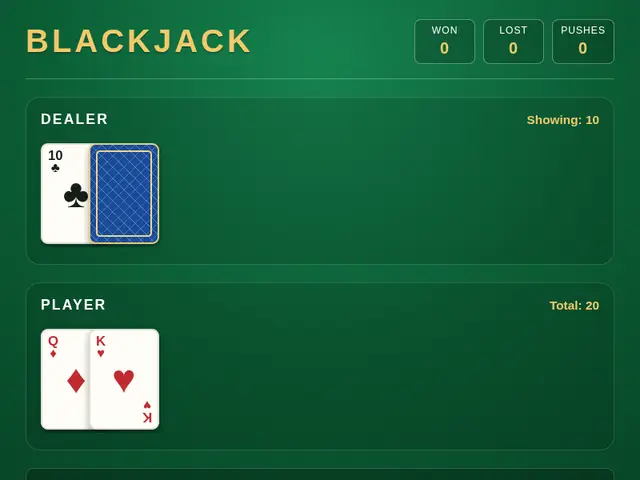
Blackjack, playable, in one page: a frame of the first output from GPT-5.6 Terra
RenderedFirst output, not pickedNov 26, 2026high effort$0.074855.7 s6,184 tokens out
The prompt and our note

Green table with Won, Lost and Pushes counters, the dealer's second card face down and the player's total. After Hit the player went bust at 23 (Q, K, 3), the dealer's cards were shown and the page says 'Bust! Your total is 23. Dealer wins the round.'

The prompt, version 1

Create one self-contained HTML file with a playable game of blackjack: one player against the dealer. Use a shuffled 52-card deck, deal two cards each with the dealer's second card face down, count aces as 1 or 11, let the player Hit or Stand, then reveal the dealer's card and have the dealer draw until 17 or more. Show both hands as drawn cards with their totals, say who won the round (blackjack, bust, push), keep a running score of rounds won and lost, and offer a New round button. Draw the cards with HTML and CSS or a canvas. No external resources: no scripts, fonts, images or network requests. Reply with only the HTML, from <!DOCTYPE html> to </html>, with no explanation and no Markdown fences.
Call both through our API

The same OpenAI-compatible endpoint for both: only the model id changes.

  • Make a key with the AI models permission on the Integrations page.
  • Each call is billed in credits from your account.

Read the API docs

JavaScript, OpenAI SDK
import OpenAI from "openai";

const client = new OpenAI({
  baseURL: "https://automatio.ai/api/v1",
  apiKey: process.env.AUTOMATIO_API_KEY,
});

for (const model of ["openai/gpt-5.6-terra","moonshotai/kimi-k3.1-pro"]) {
  const res = await client.chat.completions.create({
    model,
    messages: [{ role: "user", content: "Hello" }],
  });
  console.log(model, res.choices[0].message.content);
}
curl
curl https://automatio.ai/api/v1/chat/completions \
  -H "Authorization: Bearer $AUTOMATIO_API_KEY" \
  -H "Content-Type: application/json" \
  -d '{"model":"openai/gpt-5.6-terra","messages":[{"role":"user","content":"Hello"}]}'

Questions

Still have a question?

Ask us on Discord
Which is cheaper, GPT-5.6 Terra or Kimi K3.1 Pro?

Kimi K3.1 Pro: $4 against $4.50 per million tokens, blended three input tokens to one output token, at Vercel AI Gateway's list prices of Nov 25, 2026.

Which scores higher on Epoch's Capabilities Index?

Neither: 160.8 and 161.2 sit inside each other's published ranges, so they are statistically tied.

Which has the larger context window?

GPT-5.6 Terra: 1,050,000 tokens against 1,000,000.

Which one is faster?

GPT-5.6 Terra: 209 tok/s against 77.8 tok/s, medians over the hour before Nov 25, 2026, each on its own host.

Can I use both GPT-5.6 Terra and Kimi K3.1 Pro in Automatio?

Yes. Pick either one in a chat's model menu, or call both through our API with the model ids openai/gpt-5.6-terra and moonshotai/kimi-k3.1-pro.

Where the numbers come from

Every number on this page comes from one of these: public sources first, then what we measured and collected ourselves.

  1. Vercel AI Gateway1

    Prices, context windows, and each host's speed and time to first token.

    Prices, context and speed via Vercel AI Gateway, 2026-11-25
    As of Nov 25, 2026Public model catalogueOpen source
  2. Epoch AI2

    Its own benchmark runs and the Epoch Capabilities Index.

    Source: Epoch AI (epoch.ai), CC BY 4.0, 2026-11-25
    As of Nov 25, 2026CC BY 4.0Open source
  3. LMArena3

    Leaderboards of people voting between two anonymous answers.

    Source: LMArena (arena.ai), leaderboard of 2026-11-23, CC BY 4.0
    As of Nov 23, 2026CC BY 4.0Open source

Try them on your own request

Type it in the box at the top of the page, then pick either model in the chat.

  • A task can repeat on a schedule, as often as every 5 minutes.

    How schedules work
  • Results can also come to you in Discord or Telegram.