
How to Scrape Good Books | Good Books Web Scraper
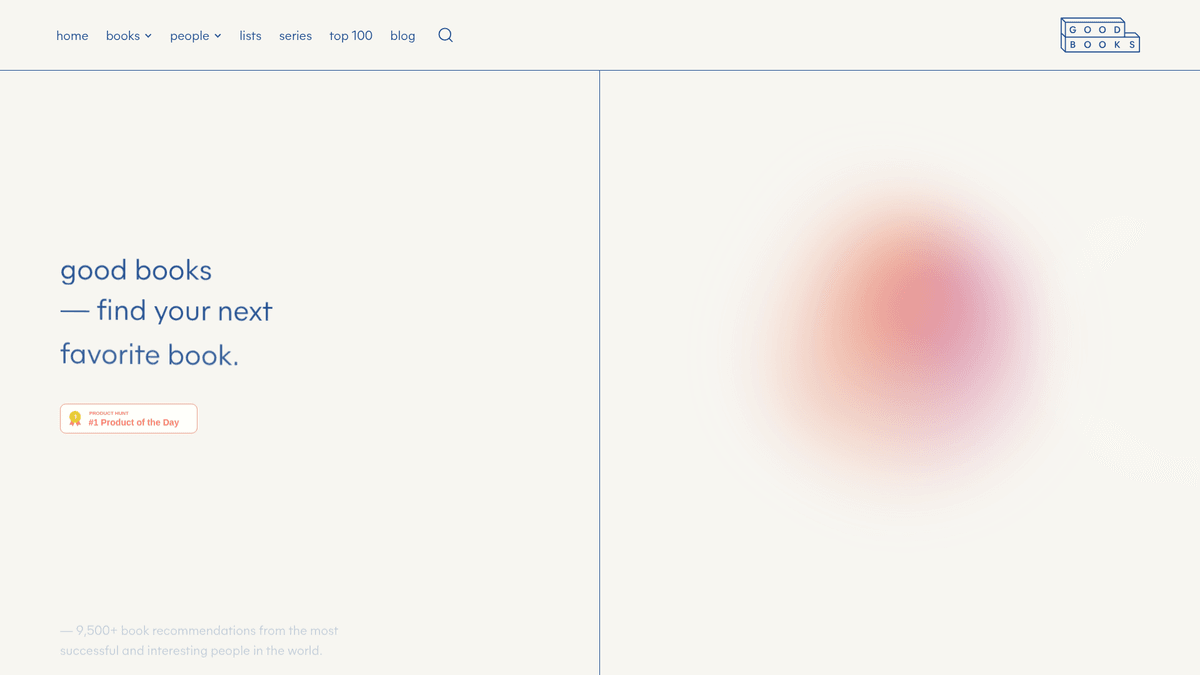
Learn how to scrape Good Books (goodbooks.io) to extract over 9,500 expert book recommendations. Get titles, authors, and influencer lists for market research.
Anti-Bot Protection Detected
- Rate Limiting
- Limits requests per IP/session over time. Can be bypassed with rotating proxies, request delays, and distributed scraping.
- None detected
About Good Books
Learn what Good Books offers and what valuable data can be extracted from it.
The Authority on Expert Recommendations
Good Books is a curated digital platform that aggregates book recommendations from some of the world's most successful and influential individuals. Founded with the mission to help people discover quality literature, it features reading lists from entrepreneurs like Elon Musk, activists like Oprah Winfrey, and authors like James Clear. The platform serves as a massive repository of expert-approved knowledge, spanning thousands of titles across diverse genres.
Structured Intellectual Data
The website organizes its data into four main pillars: books, people, industries, and curated lists. Users can explore specific categories such as business, science, or fiction, or browse the reading habits of individuals in specific sectors like venture capital or media. Each book entry typically includes the title, author, and a list of specific individuals who have endorsed it, often with links to major retailers like Amazon and Apple Books.
Why Scrape Good Books?
Scraping Good Books is highly valuable for building recommendation engines, performing competitive research on intellectual trends, or creating niche content for bibliophiles. Since the data is tied to high-profile figures, it provides a unique layer of social proof and authority that standard bookstore metadata lacks. Aggregating this information allows for deep analysis into what the world's thinkers are reading and recommending.
Why Scrape Good Books?
Discover the business value and use cases for extracting data from Good Books.
Build Authority-Driven Affiliate Sites
Extract over 9,500 book recommendations with Amazon and Apple Books links to create a niche affiliate store backed by the credibility of global influencers.
Map Influencer Intellectual Foundations
Analyze the reading habits of high-profile figures like Elon Musk or Bill Gates to understand the philosophical and business frameworks that shaped their success.
Develop Smart Recommendation Engines
Use the relational data between influential people and books to build high-signal recommendation algorithms for literary apps or personal growth platforms.
Identify Global Literary Trends
Perform sentiment and trend analysis to see which books are gaining traction across specific industries like Venture Capital, Philanthropy, or Tech.
Create Curated Newsletter Content
Automatically gather new book suggestions to fuel weekly newsletters focused on executive education and personal development for niche audiences.
Scraping Challenges
Technical challenges you may encounter when scraping Good Books.
Parsing Affiliate Tracking Links
The purchase buttons are often wrapped in affiliate redirects that require careful extraction to reach the final product URL or identifier.
Managing Complex Relational Data
Mapping a single book to multiple recommenders—each with their own industry tags—requires a scraper that can handle many-to-many relationships across different page types.
Navigating Webflow-Specific Patterns
As the site is built on Webflow, selectors can sometimes change during site updates, requiring robust CSS or XPath selectors to maintain long-term reliability.
Scaling Beyond Rate Limits
While the site is generally accessible, scraping the entire database of 9,500+ items in a single session can trigger security flags or temporary IP bans without proper throttling.
Scrape Good Books with AI
No coding required. Extract data in minutes with AI-powered automation.
How It Works
Describe What You Need
Tell the AI what data you want to extract from Good Books. Just type it in plain language — no coding or selectors needed.
AI Extracts the Data
Our artificial intelligence navigates Good Books, handles dynamic content, and extracts exactly what you asked for.
Get Your Data
Receive clean, structured data ready to export as CSV, JSON, or send directly to your apps and workflows.
Why Use AI for Scraping
AI makes it easy to scrape Good Books without writing any code. Our AI-powered platform uses artificial intelligence to understand what data you want — just describe it in plain language and the AI extracts it automatically.
How to scrape with AI:
- Describe What You Need: Tell the AI what data you want to extract from Good Books. Just type it in plain language — no coding or selectors needed.
- AI Extracts the Data: Our artificial intelligence navigates Good Books, handles dynamic content, and extracts exactly what you asked for.
- Get Your Data: Receive clean, structured data ready to export as CSV, JSON, or send directly to your apps and workflows.
Why use AI for scraping:
- Visual No-Code Selection: Select book titles, authors, and recommender images directly on the screen without needing to inspect complex HTML source code or write scripts.
- Automated List Traversal: Easily configure Automatio to handle 'View More' buttons and paginated navigation to ensure every book in a category is captured automatically.
- Seamless Data Export: Send your scraped book lists directly to Google Sheets, JSON, or CSV, making it simple to populate your own CMS or research database.
- Reliable Schedule Monitoring: Set the scraper to run once a week to automatically detect and extract new book recommendations as they are added to the platform.
No-Code Web Scrapers for Good Books
Point-and-click alternatives to AI-powered scraping
Several no-code tools like Browse.ai, Octoparse, Axiom, and ParseHub can help you scrape Good Books. These tools use visual interfaces to select elements, but they come with trade-offs compared to AI-powered solutions.
Typical Workflow with No-Code Tools
Common Challenges
Learning curve
Understanding selectors and extraction logic takes time
Selectors break
Website changes can break your entire workflow
Dynamic content issues
JavaScript-heavy sites often require complex workarounds
CAPTCHA limitations
Most tools require manual intervention for CAPTCHAs
IP blocking
Aggressive scraping can get your IP banned
No-Code Web Scrapers for Good Books
Several no-code tools like Browse.ai, Octoparse, Axiom, and ParseHub can help you scrape Good Books. These tools use visual interfaces to select elements, but they come with trade-offs compared to AI-powered solutions.
Typical Workflow with No-Code Tools
- Install browser extension or sign up for the platform
- Navigate to the target website and open the tool
- Point-and-click to select data elements you want to extract
- Configure CSS selectors for each data field
- Set up pagination rules to scrape multiple pages
- Handle CAPTCHAs (often requires manual solving)
- Configure scheduling for automated runs
- Export data to CSV, JSON, or connect via API
Common Challenges
- Learning curve: Understanding selectors and extraction logic takes time
- Selectors break: Website changes can break your entire workflow
- Dynamic content issues: JavaScript-heavy sites often require complex workarounds
- CAPTCHA limitations: Most tools require manual intervention for CAPTCHAs
- IP blocking: Aggressive scraping can get your IP banned
Code Examples
import requests
from bs4 import BeautifulSoup

# Set headers to mimic a browser
headers = {
    'User-Agent': 'Mozilla/5.0 (Windows NT 10.0; Win64; x64) AppleWebKit/537.36 (KHTML, like Gecko) Chrome/91.0.4472.124 Safari/537.36'
}

def scrape_goodbooks_home():
    url = 'https://goodbooks.io/'
    try:
        response = requests.get(url, headers=headers)
        response.raise_for_status()

        soup = BeautifulSoup(response.text, 'html.parser')

        # Find featured books
        books = soup.find_all('div', class_='book-card-featured')

        for book in books:
            title = book.find('h5').get_text(strip=True) if book.find('h5') else 'N/A'
            author = book.find('h6').get_text(strip=True) if book.find('h6') else 'N/A'
            print(f'Book: {title} | Author: {author}')

    except requests.exceptions.RequestException as e:
        print(f'Error occurred: {e}')

if __name__ == '__main__':
    scrape_goodbooks_home()
When to Use
Best for static HTML pages where content is loaded server-side. The fastest and simplest approach when JavaScript rendering isn't required.
Advantages
- ●Fastest execution (no browser overhead)
- ●Lowest resource consumption
- ●Easy to parallelize with asyncio
- ●Great for APIs and static pages
Limitations
- ●Cannot execute JavaScript
- ●Fails on SPAs and dynamic content
- ●May struggle with complex anti-bot systems
How to Scrape Good Books with Code
Python + Requests
import requests
from bs4 import BeautifulSoup
# Set headers to mimic a browser
headers = {
'User-Agent': 'Mozilla/5.0 (Windows NT 10.0; Win64; x64) AppleWebKit/537.36 (KHTML, like Gecko) Chrome/91.0.4472.124 Safari/537.36'
}
def scrape_goodbooks_home():
url = 'https://goodbooks.io/'
try:
response = requests.get(url, headers=headers)
response.raise_for_status()
soup = BeautifulSoup(response.text, 'html.parser')
# Find featured books
books = soup.find_all('div', class_='book-card-featured')
for book in books:
title = book.find('h5').get_text(strip=True) if book.find('h5') else 'N/A'
author = book.find('h6').get_text(strip=True) if book.find('h6') else 'N/A'
print(f'Book: {title} | Author: {author}')
except requests.exceptions.RequestException as e:
print(f'Error occurred: {e}')
if __name__ == '__main__':
scrape_goodbooks_home()Python + Playwright
from playwright.sync_api import sync_playwright

def run(playwright):
    # Launch browser
    browser = playwright.chromium.launch(headless=True)
    page = browser.new_page()

    # Navigate to Good Books listings
    page.goto('https://goodbooks.io/books')

    # Wait for the book items to load
    page.wait_for_selector('.book-item')

    # Extract book data from the page
    books = page.query_selector_all('.book-item')
    for book in books:
        title = book.query_selector('h5').inner_text()
        author = book.query_selector('h6').inner_text()
        print(f'Scraped: {title} by {author}')

    # Close connection
    browser.close()

with sync_playwright() as playwright:
run(playwright)Python + Scrapy
import scrapy

class GoodbooksSpider(scrapy.Spider):
    name = 'goodbooks'
    allowed_domains = ['goodbooks.io']
    start_urls = ['https://goodbooks.io/books']

    def parse(self, response):
        # Extract details for each book item
        for book in response.css('.book-item-class'):
            yield {
                'title': book.css('h5::text').get(),
                'author': book.css('h6::text').get(),
                'url': response.urljoin(book.css('a::attr(href)').get()),
            }

        # Handle simple pagination link
        next_page = response.css('a.next-page-selector::attr(href)').get()
        if next_page:
yield response.follow(next_page, self.parse)Node.js + Puppeteer
const puppeteer = require('puppeteer');

(async () => {
  const browser = await puppeteer.launch();
  const page = await browser.newPage();

  await page.goto('https://goodbooks.io/top-100/all-books');

  // Ensure cards are rendered
  await page.waitForSelector('.book-card');

  const data = await page.evaluate(() => {
    const items = Array.from(document.querySelectorAll('.book-card'));
    return items.map(item => ({
      title: item.querySelector('h5') ? item.querySelector('h5').innerText : 'N/A',
      author: item.querySelector('h6') ? item.querySelector('h6').innerText : 'N/A'
    }));
  });

  console.log(data);
  await browser.close();
})();What You Can Do With Good Books Data
Explore practical applications and insights from Good Books data.
Curated Book Subscription Service
Startups can use the data to create a niche book-of-the-month club based on successful people's reading habits.
How to implement:
- 1Scrape top-recommended books in 'Business' and 'Self-Improvement'.
- 2Cross-reference books that appear in multiple high-profile reading lists.
- 3Set up a monthly subscription providing the most-recommended book of that period.
- 4Include digital summaries highlighting why billionaires recommended it.
Use Automatio to extract data from Good Books and build these applications without writing code.
What You Can Do With Good Books Data
- Curated Book Subscription Service
Startups can use the data to create a niche book-of-the-month club based on successful people's reading habits.
- Scrape top-recommended books in 'Business' and 'Self-Improvement'.
- Cross-reference books that appear in multiple high-profile reading lists.
- Set up a monthly subscription providing the most-recommended book of that period.
- Include digital summaries highlighting why billionaires recommended it.
- AI Recommendation Engine
Developers can feed the data into a machine learning model to predict what a user might like based on which leaders they admire.
- Extract lists of books recommended by individuals across different industries.
- Train a model to identify patterns between specific recommenders and book genres.
- Create an interface where users select influencers to get a composite reading list.
- Integrate affiliate links for monetization.
- Content Strategy for Thought Leaders
Writers and influencers can use the data to write 'Deep Dive' articles into the most influential books of a decade.
- Identify the most recommended books across all categories on Good Books.
- Extract the quotes or contexts for the recommendations where available.
- Write comparative essays on how these books shaped specific industries.
- Use the 'recommendation count' as a quantitative metric for the book's impact.
- Affiliate Niche Website
Create a high-traffic review site that aggregates recommendations from famous people with Amazon affiliate links.
- Scrape book titles, authors, and the specific influencers who recommended them.
- Build SEO-optimized pages for queries like 'Elon Musk Reading List' or 'Oprah's Favorite Books'.
- Automate the insertion of affiliate links for each book title.
- Regularly update the data to include new influencer recommendations.
- Market Trend Analysis
Publishers can analyze which genres or specific topics are gaining traction among industry leaders.
- Scrape the 'Industries' section to see which books are trending in Venture Capital vs Media.
- Track the addition of new books over time to see shifts in intellectual interest.
- Identify gaps in the market where influencers recommend old classics but few new books exist.
- Use data to pitch new book ideas to authors based on current influencer reading trends.
Supercharge your workflow with AI Automation
Automatio combines the power of AI agents, web automation, and smart integrations to help you accomplish more in less time.
What to get right first
Expert advice for successfully extracting data from Good Books.
Prioritize the Top 100 List
Start your scraping project with the 'Top 100' page, as it contains the most densely linked data and provides the highest value for initial research.
Capture the Industry Metadata
Always extract the industry tags (e.g., 'Entrepreneurship', 'Philosophy') associated with each person to enable multi-dimensional filtering in your own database.
Use URL Slugs as Unique IDs
Since book titles can be similar, use the URL slug of the book page as the unique identifier to avoid duplicating records when scraping different categories.
Mimic Real Browser Behavior
Configure your scraper to use a modern browser User-Agent and include random delays between page loads to avoid detection by standard Webflow security measures.
Verify 'Buy Now' Link Patterns
If you need the raw Amazon ASIN, inspect the href of the purchase button; it often contains the product ID within the URL string.
Related Web Scraping
How to Scrape CSS Author: A Comprehensive Web Scraping Guide
How to Scrape The AA (theaa.com): A Technical Guide for Car & Insurance Data
How to Scrape Biluppgifter.se: Vehicle Data Extraction Guide
How to Scrape Bilregistret.ai: Swedish Vehicle Data Extraction Guide
How to Scrape Car.info | Vehicle Data & Valuation Extraction Guide
How to Scrape GoAbroad Study Abroad Programs
How to Scrape ResearchGate: Publication and Researcher Data
How to Scrape Statista: The Ultimate Guide to Market Data Extraction
Frequently Asked Questions
Find answers to common questions about Good Books