

How to Scrape jup.ag: Jupiter DEX Web Scraper Guide
Learn how to scrape jup.ag for real-time Solana token prices, swap routes, and market volumes. Discover Jupiter's official APIs and bypass Cloudflare anti-bot.
Free to start: 1,000 credits, no card, nothing to install.
About Jupiter
Learn what Jupiter offers and what valuable data can be extracted from it.
The Hub of Solana DeFi
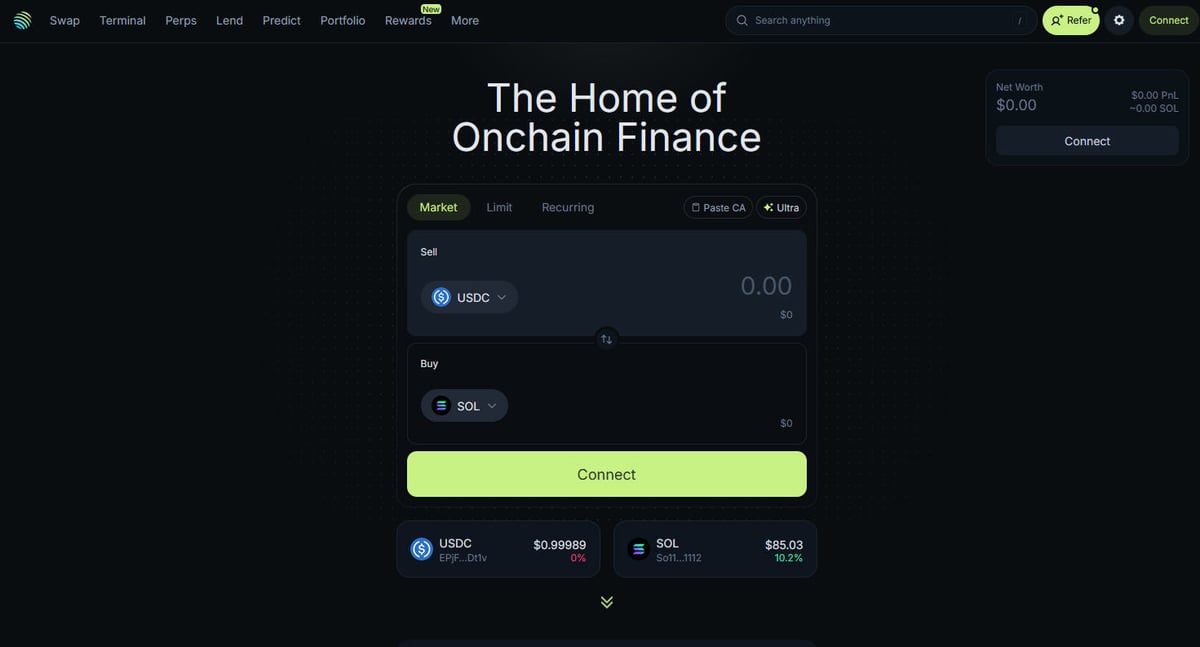
Jupiter is the primary liquidity aggregator for the Solana blockchain, acting as a "DeFi Superapp" that optimizes trade routing across hundreds of liquidity pools to provide users with the best prices and minimal slippage. It is the central hub for Solana's on-chain finance, offering services ranging from simple token swaps to advanced features like perpetual trading with up to 250x leverage, limit orders, and dollar-cost averaging (DCA). The platform provides critical data for the ecosystem, including real-time pricing, liquidity depth, and comprehensive market metrics for thousands of assets.
Technical Architecture
The website is built on a modern technical stack using Next.js and React, making it a highly dynamic single-page application (SPA). Because prices and routes are calculated in real-time based on current blockchain state, the frontend is constantly updating via WebSockets and high-frequency API calls. For data scientists, developers, and traders, Jupiter's data is considered the gold standard for tracking Solana market sentiment and liquidity shift across the entire ecosystem.
Why the Data Matters
Accessing this data is essential for building trading bots, market dashboards, and conducting historical analysis on one of the fastest-growing blockchain networks. Scrapers often target Jupiter to monitor new token listings, track "whale" movements in perpetual markets, or identify price discrepancies for arbitrage. While the platform offers official APIs, direct web scraping is frequently used to capture the exact UI state and specific routing data that may not be fully exposed in public endpoints.
Why Scrape Jupiter?
Discover the business value and use cases for extracting data from Jupiter.
Real-Time Price Tracking
Monitor Solana token prices in real-time to gain an edge in the highly volatile DeFi market. Jupiter aggregates liquidity across the entire ecosystem, providing the most accurate market rates available.
Trading Bot Optimization
Feed high-frequency swap route and price impact data into automated trading bots for arbitrage or sniping. This allows for faster execution and better price discovery compared to manual trading.
Market Sentiment Analysis
Track the addition of new tokens to the Jupiter 'Strict' list to identify trending projects and community trust. Analyzing volume shifts across different assets helps in predicting broader market movements.
Liquidity Depth Monitoring
Scrape liquidity data to determine the market depth of specific SPL tokens and assess the potential for slippage. This is critical for large-scale traders and institutional liquidity providers.
Historical Performance Data
Collect daily volume and price history for tokens that may not be listed on centralized exchanges. This data is essential for backtesting trading strategies and conducting long-term market research.
Ecosystem Growth Metrics
Measure the total volume and transaction count across the Solana network by using Jupiter as a proxy. This helps developers and investors understand the adoption rate of Solana DeFi over time.
Scraping Challenges
Technical challenges you may encounter when scraping Jupiter.
JavaScript Rendering Dependency
Jupiter is built as a complex Single Page Application (SPA) using React, meaning data is not present in the initial HTML. You must use a tool that can fully render JavaScript to access prices and token lists.
Aggressive Cloudflare Protection
The site uses Cloudflare's Web Application Firewall (WAF) to block non-browser traffic and automated scripts. Bypassing these challenges requires advanced browser fingerprinting and header management.
Dynamic Data Stream
Prices and swap routes update multiple times per second via WebSockets and high-frequency API calls. Capturing consistent snapshots of this data requires low-latency scraping infrastructure and precise timing.
Rate Limiting on Public Endpoints
Public-facing API endpoints and web routes are strictly rate-limited to prevent abuse. Exceeding these limits often results in temporary or permanent IP bans, making residential proxies a necessity.
UI Selector Volatility
Frequent updates to the Jupiter frontend can cause CSS classes and DOM structures to change without notice. This requires scrapers to have robust, flexible selectors or frequent maintenance to avoid breakage.
Scrape Jupiter with AI
No coding required. Extract data in minutes with AI-powered automation.
How It Works
Describe What You Need
Tell the AI what data you want to extract from Jupiter. Just type it in plain language — no coding or selectors needed.
AI Extracts the Data
Our artificial intelligence navigates Jupiter, handles dynamic content, and extracts exactly what you asked for.
Get Your Data
Receive clean, structured data ready to export as CSV, JSON, or send directly to your apps and workflows.
Why Use AI for Scraping
No-Code Web Scrapers for Jupiter
Point-and-click alternatives to AI-powered scraping
Several no-code tools like Browse.ai, Octoparse, Axiom, and ParseHub can help you scrape Jupiter. These tools use visual interfaces to select elements, but they come with trade-offs compared to AI-powered solutions.
Typical Workflow with No-Code Tools
Common Challenges
Learning curve
Understanding selectors and extraction logic takes time
Selectors break
Website changes can break your entire workflow
Dynamic content issues
JavaScript-heavy sites often require complex workarounds
CAPTCHA limitations
Most tools require manual intervention for CAPTCHAs
IP blocking
Aggressive scraping can get your IP banned
Code Examples
import requests

def get_jupiter_price(token_address):
    # Using the official Jupiter Price API V2 is the most reliable method
    url = f"https://api.jup.ag/price/v2?ids={token_address}"
    headers = {
        "User-Agent": "Mozilla/5.0 (Windows NT 10.0; Win64; x64) AppleWebKit/537.36 (KHTML, like Gecko) Chrome/120.0.0.0 Safari/537.36",
        "Accept": "application/json"
    }
    try:
        response = requests.get(url, headers=headers)
        response.raise_for_status()
        data = response.json()
        price_info = data['data'].get(token_address)
        if price_info:
            print(f"Token: {token_address} | Price: ${price_info['price']}")
    except Exception as e:
        print(f"An error occurred: {e}")

# Example: Fetching SOL price
get_jupiter_price("So11111111111111111111111111111111111111112")
When to Use
Best for static HTML pages where content is loaded server-side. The fastest and simplest approach when JavaScript rendering isn't required.
Advantages
- ●Fastest execution (no browser overhead)
- ●Lowest resource consumption
- ●Easy to parallelize with asyncio
- ●Great for APIs and static pages
Limitations
- ●Cannot execute JavaScript
- ●Fails on SPAs and dynamic content
- ●May struggle with complex anti-bot systems
from playwright.sync_api import sync_playwright

def scrape_jupiter_tokens():
    with sync_playwright() as p:
        # Launch a browser that can render the Next.js frontend
        browser = p.chromium.launch(headless=True)
        context = browser.new_context(
            user_agent="Mozilla/5.0 (Windows NT 10.0; Win64; x64) AppleWebKit/537.36 (KHTML, like Gecko) Chrome/120.0.0.0 Safari/537.36"
        )
        page = context.new_page()
        page.goto("https://jup.ag/tokens", wait_until="networkidle")

        # Wait for the token list items to render in the DOM
        # Note: Selectors must be updated based on the current UI build
        page.wait_for_selector(".token-item")
        tokens = page.query_selector_all(".token-item")

        for token in tokens[:10]:
            name = token.query_selector(".token-name").inner_text()
            price = token.query_selector(".token-price").inner_text()
            print(f"{name}: {price}")

        browser.close()

scrape_jupiter_tokens()
When to Use
Use when content loads dynamically via JavaScript, or when you need to interact with the page (clicks, scrolls, form fills). Handles modern anti-bot detection better.
Advantages
- ●Executes JavaScript like a real browser
- ●Handles SPAs and dynamic content
- ●Better anti-bot evasion with stealth plugins
- ●Can take screenshots and PDFs
Limitations
- ●Slower than HTTP requests
- ●Higher memory/CPU usage
- ●More complex to set up
import scrapy
import json

class JupiterTokenSpider(scrapy.Spider):
    name = 'jupiter_tokens'
    # Directly hitting the token list JSON endpoint used by the frontend
    start_urls = ['https://token.jup.ag/all']

    def parse(self, response):
        # The response is a raw JSON list of all verified tokens
        tokens = json.loads(response.text)
        for token in tokens[:100]:
            yield {
                'symbol': token.get('symbol'),
                'name': token.get('name'),
                'address': token.get('address'),
                'decimals': token.get('decimals'),
                'logoURI': token.get('logoURI')
            }
When to Use
Ideal for large-scale crawling projects that need to scrape thousands of pages. Built-in support for rate limiting, retries, and data pipelines.
Advantages
- ●Built for scale (millions of pages)
- ●Automatic request throttling
- ●Built-in data export pipelines
- ●Middleware system for proxies/headers
Limitations
- ●Steeper learning curve
- ●Overkill for small projects
- ●No native JavaScript rendering
const puppeteer = require('puppeteer');

(async () => {
  const browser = await puppeteer.launch({ headless: true });
  const page = await browser.newPage();

  // Set a realistic User-Agent to help bypass basic filters
  await page.setUserAgent('Mozilla/5.0 (Windows NT 10.0; Win64; x64) AppleWebKit/537.36 (KHTML, like Gecko) Chrome/120.0.0.0 Safari/537.36');

  // Navigate to the main swap page
  await page.goto('https://jup.ag/', { waitUntil: 'networkidle2' });

  // Example of extracting a price element using a partial selector
  const solPrice = await page.evaluate(() => {
    const element = document.querySelector('div[class*="price"]');
    return element ? element.innerText : 'Price not found';
  });

  console.log(`Live SOL Price observed in UI: ${solPrice}`);
  await browser.close();
})();
When to Use
Choose this if you're in a Node.js/JavaScript ecosystem or need tight integration with frontend tools. Similar capabilities to Playwright.
Advantages
- ●Native JavaScript/TypeScript support
- ●Chrome DevTools Protocol access
- ●Large ecosystem and community
- ●Good for JS-heavy projects
Limitations
- ●Chrome-only (vs Playwright's multi-browser)
- ●Similar overhead to Playwright
- ●Less mature stealth options
What You Can Do With Jupiter Data
Explore practical applications and insights from Jupiter data.
Price Arbitrage Alert System
Identify price differences between Jupiter and other Solana DEXs to execute profitable trades.
How to implement:
- 1Scrape real-time swap rates from Jupiter's Price API.
- 2Compare rates with Orca and Raydium liquidity pools.
- 3Set up automated alerts or execution hooks for arbitrage opportunities.
Use Automatio to extract data from Jupiter and build these applications without writing code.
Solana Market Health Dashboard
Build a macro-level view of Solana DeFi activity for investors.
How to implement:
- 1Aggregate 24h volume and TVL data for top tokens.
- 2Categorize tokens by sectors (Meme, AI, RWA).
- 3Visualize liquidity shifts across different asset classes over time.
Use Automatio to extract data from Jupiter and build these applications without writing code.
New Token Listing Sniper
Detect and analyze new tokens appearing on Jupiter's verified list immediately.
How to implement:
- 1Regularly scrape the token list endpoint.
- 2Diff the new results against a local database to find new additions.
- 3Analyze initial liquidity and volume to assess token potential.
Use Automatio to extract data from Jupiter and build these applications without writing code.
Whale and Perps Tracker
Monitor large positions and funding rates in the Jupiter Perpetuals market.
How to implement:
- 1Scrape open interest and funding rate data from the Perps section.
- 2Track large transaction logs to identify wallet behavior.
- 3Build sentiment models based on long/short ratios of major assets.
Use Automatio to extract data from Jupiter and build these applications without writing code.
Yield Aggregation Service
Provide users with the best lending rates available across Jupiter Lend vaults.
How to implement:
- 1Scrape APY data for various stablecoins and SOL pairs.
- 2Calculate net yield after estimated platform fees.
- 3Automate rebalancing recommendations for portfolio optimization.
Use Automatio to extract data from Jupiter and build these applications without writing code.
Supercharge your workflow with AI Automation
Automatio combines the power of AI agents, web automation, and smart integrations to help you accomplish more in less time.
What to get right first
Expert advice for successfully extracting data from Jupiter.
Prioritize Official API Endpoints
Whenever possible, use Jupiter's official V6 Quote or Price APIs instead of scraping the UI. These endpoints are designed for high-performance programmatic access and are generally more stable.
Implement Exponential Backoff
When your requests hit a rate limit, use a strategy that progressively increases the wait time between retries. This helps prevent your IP from being flagged as malicious by Jupiter's security layer.
Filter via the Strict List
Scrape the Jupiter 'Strict' token list to ensure you are only monitoring verified assets. This is the best way to filter out low-liquidity rugpulls and scam tokens that appear in the 'All' list.
Use High-Quality Residential Proxies
Avoid using datacenter proxies as they are often pre-blacklisted by Cloudflare. Residential or mobile proxies carry more trust and are less likely to trigger CAPTCHAs or 403 Forbidden errors.
Monitor WebSocket Traffic
Use your browser's network inspector to find the WebSocket connections Jupiter uses for live updates. Emulating these connections can be more efficient than reloading the page for real-time price feeds.
Account for Token Decimals
Always extract the 'decimals' field from token metadata when scraping mint addresses. This is crucial for correctly converting raw on-chain integers into human-readable currency amounts.
Related Web Scraping

Yahoo Finance Scraper: Prices, Change and Volume in a table

How to Scrape Rocket Mortgage: A Comprehensive Guide
How to Scrape Open Collective: Financial and Contributor Data Guide
How to Scrape Indiegogo: The Ultimate Crowdfunding Data Extraction Guide
How to Scrape ICO Drops: Comprehensive Crypto Data Guide

How to Scrape Crypto.com: Comprehensive Market Data Guide
How to Scrape Coinpaprika: Crypto Market Data Extraction Guide
How to Scrape CoinMarketCap: A Complete Web Scraping Guide
Frequently Asked Questions
Find answers to common questions about Jupiter
Is it legal to scrape Jupiter?
Scraping public market data such as token prices and trading volumes is generally legal for personal or research purposes. However, you must ensure your activities do not disrupt the site's functionality and that you comply with their terms of service regarding automated access.
Does Jupiter have an official API?
Yes, Jupiter provides a comprehensive set of developer APIs, including a Price API, Swap API, and Token List API. These are documented at dev.jup.ag and are the recommended way to access data without needing to scrape the frontend UI.
How to avoid getting blocked by Jupiter?
To avoid blocks, use rotating residential proxies and mimic a real browser's headers and TLS fingerprints. It is also important to respect rate limits and implement delays between your requests to avoid appearing as a denial-of-service attack.
What format is the scraped data available in?
Data scraped from Jupiter can be exported in various structured formats, including JSON, CSV, and XML. JSON is typically preferred for DeFi data because it can easily represent the complex, nested structures of swap routes and token properties.
How often should I scrape Jupiter for prices?
For real-time trading bots, you may need to scrape every 10 to 30 seconds to capture market volatility. For general analytics or portfolio tracking, a frequency of once every 5 to 15 minutes is usually sufficient and less likely to trigger rate limits.
What proxies work best for scraping jup.ag?
Residential proxies are the most effective because they use IP addresses assigned to home users, which are rarely blocked by Cloudflare. Datacenter proxies should be avoided as they are easily identified as bots and are often blocked immediately.
Do I need a Solana wallet to scrape data from Jupiter?
No, you do not need to connect a wallet or have an on-chain identity to scrape public market information. A wallet is only required if you intend to perform transactions or access private account-related data through the platform.
Can I scrape the Jupiter Perpetual market data?
Yes, you can scrape data from the Perpetuals section, including funding rates and open interest. This data is highly dynamic, so you will need a scraping setup that can handle high-frequency updates and JavaScript rendering.