



Skip to content

Free to start: 1,000 credits, no card, nothing to install.

Anthropic

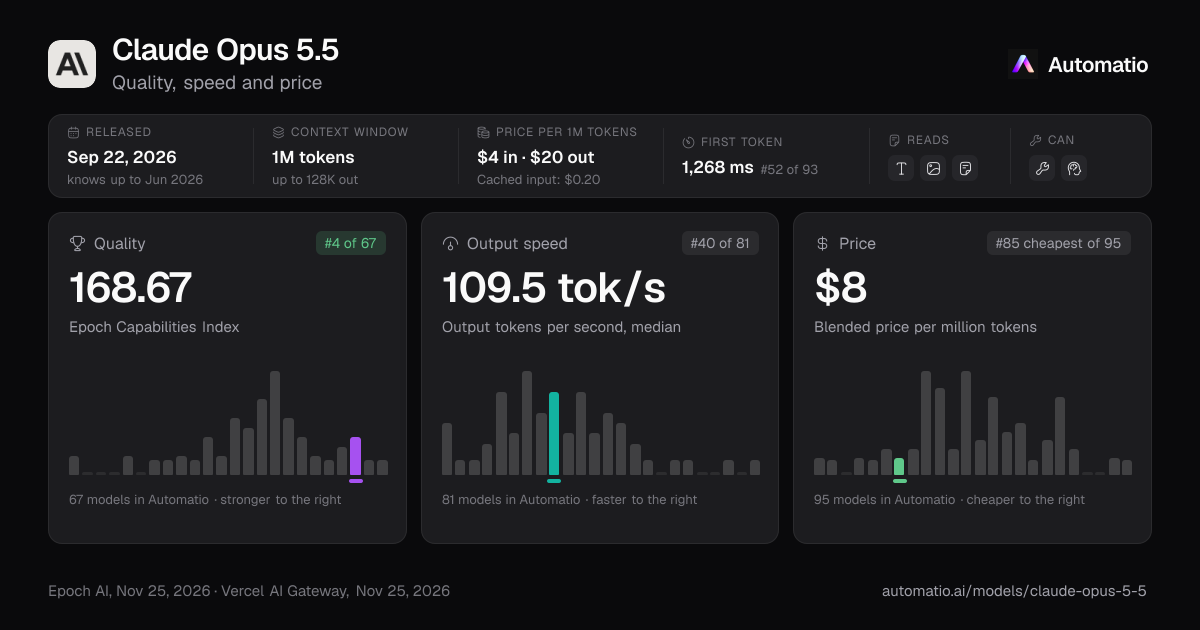
Claude Opus 5.5

Anthropic's model, ready to try in a chat here and to call through our API.

Quality, speed and price

A rank counts the models in Automatio that the source measured.

Released
Sep 22, 2026knows up to Jun 2026
Context window
1M tokensup to 128K out
Price per 1M tokens
$4 in · $20 outCached input: $0.20
First token
1,268 ms#52 of 93
Reads
Can

Vercel AI Gateway · Nov 25, 2026

#4 of 67

Quality

168.67

Epoch Capabilities Index

67 models in Automatio · stronger to the right

#40 of 81

Output speed

109.5 tok/s

Output tokens per second, median

81 models in Automatio · faster to the right

#85 cheapest of 95

Price

$8

Blended price per million tokens

95 models in Automatio · cheaper to the right

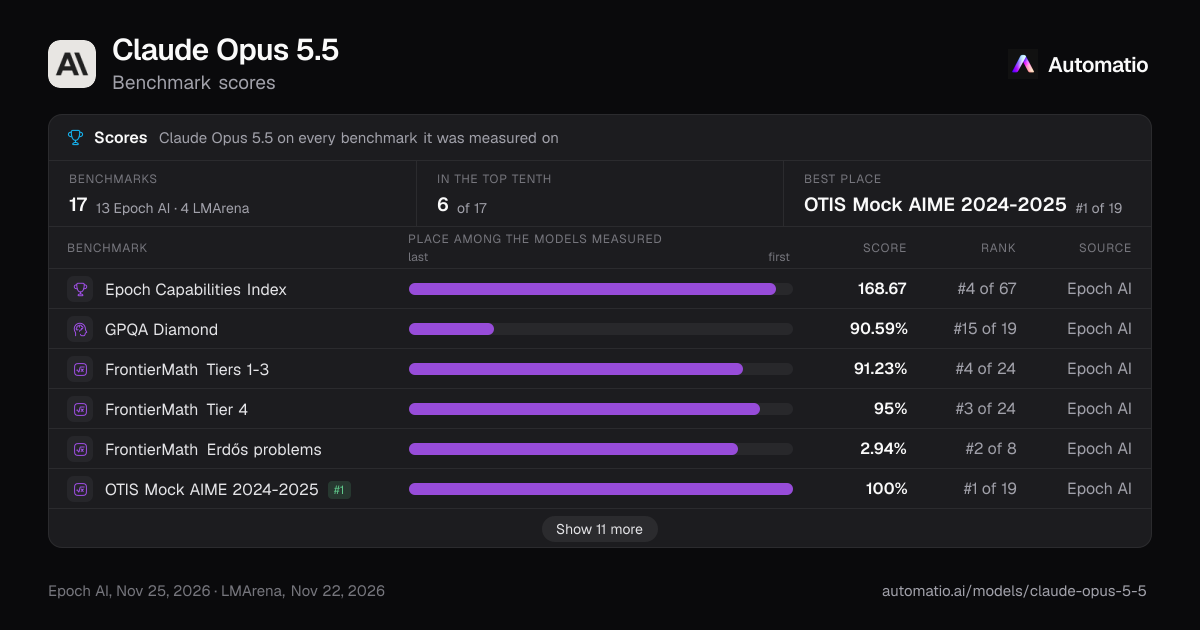
Benchmark scores

Every score it has from Epoch AI and LMArena, what each one tests, and its place among the models in Automatio measured on the same benchmark. Open a row to see who leads it.

ScoresClaude Opus 5.5 on every benchmark it was measured on
Benchmarks
1713 Epoch AI · 4 LMArena
In the top tenth
6of 17
Best place

Epoch AI's index combines scores from over 50 benchmarks into one general-capability number: a model scores higher if it does better on harder benchmarks, and each benchmark's difficulty is inferred statistically from models that took several of them. The scale is arbitrary, set so that Claude 3.5 Sonnet = 130 and GPT-5 = 150, and as with Elo scores there is no maximum, so only comparisons between models mean something. Each model's score is the mean of an estimated distribution and comes with a 90% credible interval (5th to 95th percentile); Epoch notes that the intervals of top models often overlap. Measured: mostly max effort · Nov 25, 2026. Published range: 165.92–171.96.

Scale: Index; higher is better; no fixed maximum; anchored at Claude 3.5 Sonnet = 130 and GPT-5 = 150; each score has a 90% credible interval (5th to 95th percentile).

Each question is a four-option multiple-choice problem in biology, chemistry or physics, written by people with or pursuing PhDs and designed to be very hard for non-experts even with unrestricted internet access; the Diamond subset is the 198 questions that both expert annotators got right but most non-experts got wrong. GPQA was introduced in a 2023 paper by David Rein and colleagues. Epoch scores the share answered correctly (a reply not in the form 'ANSWER: LETTER' gets no points); random guessing scores 25%, and PhD-level experts recruited by OpenAI scored 69.7%. Measured: max effort · Sep 22, 2026. Published range: 88.65%–92.53%.

Scale: Percent of 198 questions answered correctly (mean over repeated runs); random guessing = 25%; PhD-level expert result = 69.7%.

Each problem is an original math question written and vetted by expert mathematicians; a typical one takes a researcher in that field multiple hours, and the hardest take multiple days. The model can reason and run Python, then submits a Python function answer() that returns its answer, and gets 1 point if it is correct and 0 if it is wrong or nothing is submitted. This is Epoch AI's FrontierMath, which was developed with funding from OpenAI; Tiers 1-3 are the 295-problem base set of the 338-problem v2 dataset (released 2026-06-12), and the numbers on Epoch's hub are for the private set. Measured: max effort · Sep 22, 2026. Published range: 89.55%–92.91%.

Scale: Percent of the 295 Tiers 1-3 problems answered correctly (1 point each).

Tier 4 is the 43-problem expansion set of exceptionally difficult problems in FrontierMath's 338-problem v2 dataset; the problems are original and were written and vetted by expert mathematicians, and solving a typical FrontierMath problem takes a researcher multiple hours and, for the upper end, multiple days. The model can reason and run Python, then submits a Python function answer() that returns its answer, and gets 1 point if it is correct and 0 if it is wrong or nothing is submitted. FrontierMath was developed with funding from OpenAI, and the numbers on Epoch's hub are for the private set. Measured: max effort · Sep 22, 2026. Published range: 90.88%–99.12%.

Scale: Percent of the 43 Tier 4 problems answered correctly (1 point each).

Each task is a conjecture written in Lean 4 that was unsolved in August 2026; mathematician Thomas Bloom, who maintains erdosproblems.com, picked the 68 as the most apparently difficult and interesting open Erdős problems. A model resolves one only if it submits a proof or disproof that passes Comparator, a proof checker maintained by the Lean FRO. Each problem gets one attempt with up to $300 of spend and 72 hours of working time, and the score is the fraction of the 68 conjectures resolved. Measured: max effort · Sep 24, 2026. Published range: 0.88%–5%.

Scale: Percent of 68 conjectures resolved (one attempt each, limits of $300 and 72 hours).

Each task is a problem from an OTIS Mock AIME exam (2024, 2025 I or 2025 II), written by students of the Olympiad Training for Individual Study (OTIS) program as an unofficial exam that emulates the American Invitational Mathematics Exam. The model solves it step by step and ends with 'ANSWER: X', an integer from 000 to 999; a model-based extractor pulls out the final answer, and it is compared for an exact match with the answer key. Epoch says the problems are harder than MATH Level 5 but easier than FrontierMath. Measured: max effort · Sep 22, 2026.

Scale: Percent of 45 problems answered correctly (mean over repeated runs).

Each task is a short factual question asked with no answer options, followed by a prompt telling the model to give its best guess rather than decline. A grader model labels each answer correct, incorrect or not attempted, and Epoch reports the simple proportion answered correctly. The benchmark was created by Google, building on OpenAI's SimpleQA; Epoch notes that this differs from Google's own score, which is an F1-style harmonic mean. Measured: max effort · Sep 22, 2026. Published range: 70.78%–73.62%.

Scale: Percent of 1,000 questions answered correctly.

Each task shows a chess position as FEN text and asks for the best next move, submitted as a four-character string such as b1c3 and compared for an exact match with the answer key. Epoch generated the 100 positions programmatically, and the best move in each is the single one found by the Stockfish chess engine; positions are filtered out where the best move is simply capturing an undefended piece, or a higher-value piece with a lower-value one. Five human players (ratings from 1700 to 2400) answered samples of 20 puzzles without AI or an engine, and the two best got 75% right; Epoch says the sampled puzzles are harder than the full set on average. Measured: max effort · Oct 13, 2026. Published range: 62.27%–71.73%.

Scale: Percent of 100 puzzles answered with the single best move; human sample: best two of five players scored 75%.

Each task asks the model to reimplement an entire command-line program (Unix utilities, bioinformatics tools, interpreters, cryptography, compression and more) in a given language, with only execute-only access to the original, its documentation and example tests. The solution must produce exactly the same output as the original on end-to-end tests, including held-out ones, and a task counts as solved only if 100% of tests pass. Epoch AI co-developed it with METR; the score is the average rate of fully solved target programs across the 15 programs of the leaderboard set (30 tasks, three runs each). Measured: high effort · Sep 22, 2026. Published range: 71.01%–86.77%.

Scale: Percent of target programs solved with 100% of tests passing (average over 15 programs, two languages each, three runs per task).

Each task gives a game state as text and asks for the single best next move, submitted through a tool; the move is normalized into the game's standard notation and compared with the answer key. Epoch made it like its Chess Puzzles benchmark but keeps the game's identity secret to reduce the risk of benchmark-specific preparation, so the prompt and example positions are not published. A response with no valid move gets no credit and is recorded as unanswered, and a response naming an illegal move is marked incorrect. Measured: max effort · Sep 29, 2026. Published range: 66.44%–75.56%.

Scale: Percent of 100 positions where the chosen move matches the answer key.

Models play the first five in-game days of Earthborne Rangers, a campaign-style card game, ten times in a row, keeping notes as their only memory across context compactions; only the final two playthroughs are scored. A playthrough can earn up to 21 distinct objectives (missions completed, rewards unlocked, notable events recorded), and a model's topline score is the better of its two scored playthroughs, shown as a share of the 21. The benchmark is Epoch's, and the top human score so far is 21 out of 21. Measured: max effort · Sep 22, 2026. Published range: 64.37%–78.49%.

Scale: Percent of 21 possible objectives (best of the two scored playthroughs); top human score so far = 21 of 21.

Each task shows a photo of a partly or fully assembled IKEA product (a shoe cabinet, bed frame or dresser) and the official assembly manual; the model must say whether the build is correct so far and, if not, name the step where the mistake was made and describe it. There are 60 photos, some of correct builds and some with a deliberate, clearly visible mistake, often with assembly continued past it; credit needs the right step and a rough description, checked by an LLM grader prompted to be lenient. Epoch AI made it; 15 volunteers averaged 63% (graded on the steps alone, a slightly easier task), and combining the best human on each product gives 84%. Measured: max effort · Sep 22, 2026. Published range: 78.63%–88.03%.

Scale: Percent of 60 photos answered correctly; human average 63%, best-human combination 84% (humans were graded on steps only).

Each task is a full run of Slay the Spire (Ascension 20 with the final boss, 60 runs over four characters) or Slay the Spire 2 (Ascension 10, 75 runs over five characters), played from screenshots with mouse and keyboard actions through a computer-use harness. The score is the share of runs won in each game, averaged with equal weight across the two games, with every model playing the same seeds. Epoch says top human players win roughly 85% of their runs at maximum difficulty in the first game and roughly 95% in the second. Measured: max effort · Nov 4, 2026. Published range: 3.8%–7.86%.

Scale: Percent of runs won, average of the two games' win rates; top human players: roughly 85% (Slay the Spire) and roughly 95% (Slay the Spire 2).

In Arena's battle mode a person types a prompt, is served two anonymous models and decides which answer best fits their needs; names are revealed only after the vote, and only votes cast while the models are anonymous count toward the official rankings. The ratings come from a Bradley-Terry model fitted to these votes, which Arena says is similar to the Elo rating system used in chess. The Arena score measures model strength, and 400 is an arbitrary scaling factor chosen to show scores as whole numbers. Measured: 18,959 votes · Nov 22, 2026. Published range: 1,508.5–1,519.8.

Scale: Arena score (Bradley-Terry, Elo-like); higher is better. Arena states no fixed minimum or maximum.

Users submit a prompt such as “Build a simple chess game”, two LLMs generate competing web apps, and users interact with both apps and vote on the better one. Arena rates models with the Bradley-Terry model on these pairwise votes and says the ranking is similar to Elo; the arena launched in December 2024. Arena's leaderboard changelog now calls it “Code Arena: WebDev”. Measured: 5,121 votes · Nov 23, 2026. Published range: 1,809.6–1,831.1.

Scale: Arena score (Bradley-Terry, Elo-like); higher is better. Arena states no fixed range.

Arena added image support to its side-by-side voting so people can chat with vision-language models, and the vision leaderboard is computed only from battles that contain an image. The rating is the same Arena score (Bradley-Terry) as in the text arena, a measure of model strength in which 400 is an arbitrary scaling factor chosen to show whole numbers. Arena lists general captioning questions, math questions, document understanding, meme explanation and story writing as common tasks it noticed. Measured: 5,903 votes · Nov 19, 2026. Published range: 1,312.7–1,331.

Scale: Arena score (Bradley-Terry, Elo-like); higher is better. Arena states no fixed range.

Agent Arena is not a pairwise vote: people do real work in Agent Mode, each session goes to a randomly chosen orchestrator model, and Arena measures signals from the session (in the index: Task Completion, Praise vs Complaint, Steerability and Bash Reliability) and treats the random assignment like a randomized trial to estimate each model's effect. Until 18 Nov 2026 the score was a net improvement, a model's average signal minus the average over all active models with each signal z-score normalized, which is why scores were small numbers around zero; the Agent Arena Index now shows 1000 times that score plus an anchor offset, one point being 1/1000th of a standard deviation of the signal. The leaderboard also plots each score against the model's measured median cost per task. Measured: 24,506 sessions · Nov 22, 2026. Published range: 0.1279–0.1493.

Scale: Before 2026-11-18: net improvement in standard deviations of the signals (0 = average active model). Since: index points, 1 point = 1/1000 SD, anchored so established models' scores stay stable (July average about 1000). Cost: median cost per task (P50).

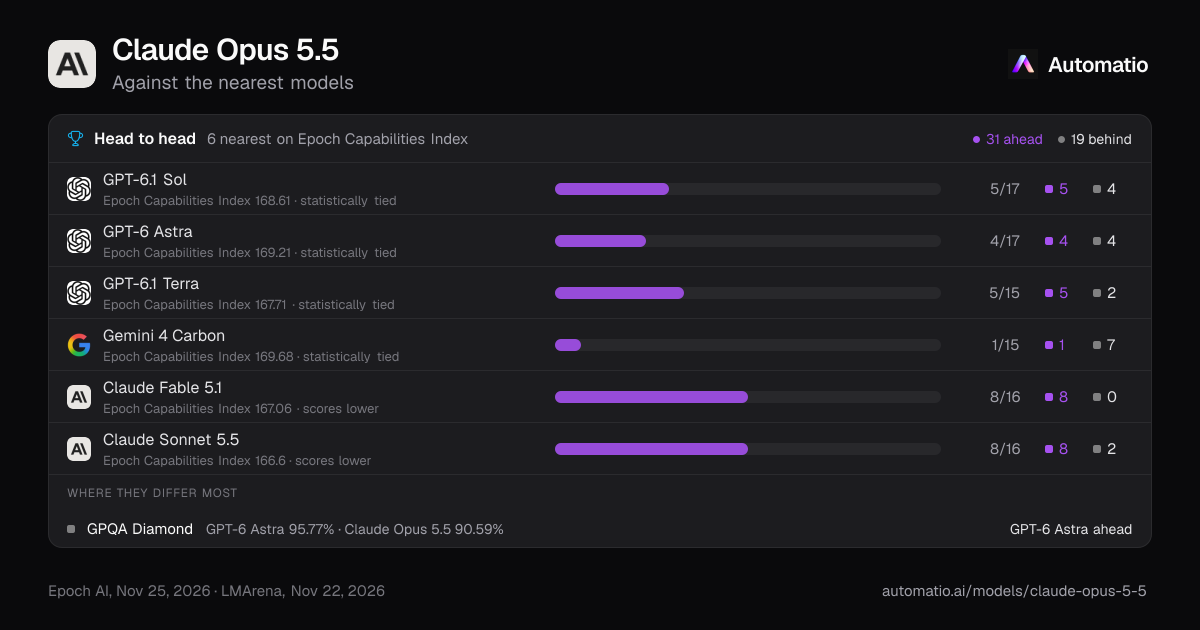
Against the nearest models

The 6 models closest to it on Epoch Capabilities Index. Each bar is the share of the quality measurements both have where Claude Opus 5.5 is ahead; open a row for the full comparison.

Head to head6 nearest on Epoch Capabilities Index31 ahead19 behind
Where they differ most
  1. GPQA DiamondGPT-6 Astra 95.77% · Claude Opus 5.5 90.59%GPT-6 Astra ahead
  2. GPQA DiamondGemini 4 Carbon 96.53% · Claude Opus 5.5 90.59%Gemini 4 Carbon ahead
  3. GPQA DiamondClaude Sonnet 5.5 95.58% · Claude Opus 5.5 90.59%Claude Sonnet 5.5 ahead
  4. LMArena VisionGPT-6.1 Terra 1,246.9 · Claude Opus 5.5 1,321.8Claude Opus 5.5 ahead
  5. GPQA DiamondGPT-6.1 Sol 95.39% · Claude Opus 5.5 90.59%GPT-6.1 Sol ahead
  6. FrontierMath Erdős problemsClaude Fable 5.1 0% · Claude Opus 5.5 2.94%Claude Opus 5.5 ahead

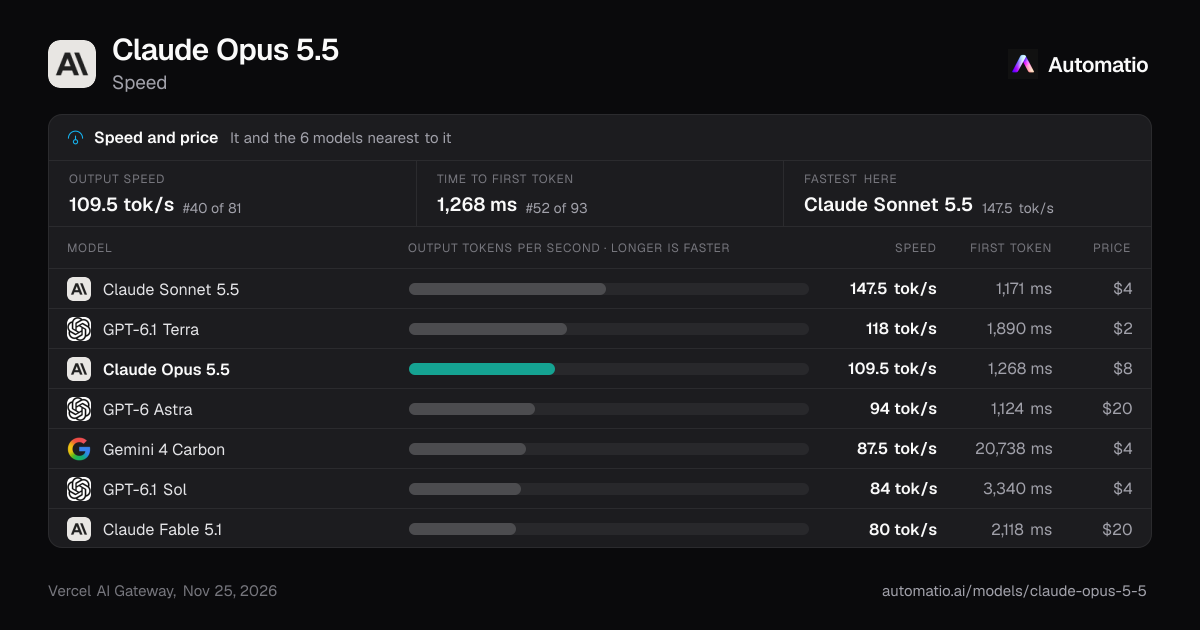
How fast it answers next to the models nearest to it: output speed, the wait for the first token and the price, model by model and host by host.

Speed and priceIt and the 6 models nearest to it
Output speed
109.5 tok/s#40 of 81
Time to first token
1,268 ms#52 of 93
Fastest here
One answer, simulatedThe same 600-token answer from each model
Fastest to finish
Claude Sonnet 5.55.2 s
Claude Opus 5.5 finishes in
6.7 s
Answer
600 tokens
Claude Sonnet 5.5
1,171 ms147.5 tok/s5.2 s
Claude Opus 5.5
1,268 ms109.5 tok/s6.7 s
GPT-6.1 Terra
1,890 ms118 tok/s7.0 s
GPT-6 Astra
1,124 ms94 tok/s7.5 s
Claude Fable 5.1
2,118 ms80 tok/s9.6 s
GPT-6.1 Sol
3,340 ms84 tok/s10.5 s
Gemini 4 Carbon
20,738 ms87.5 tok/s27.6 s

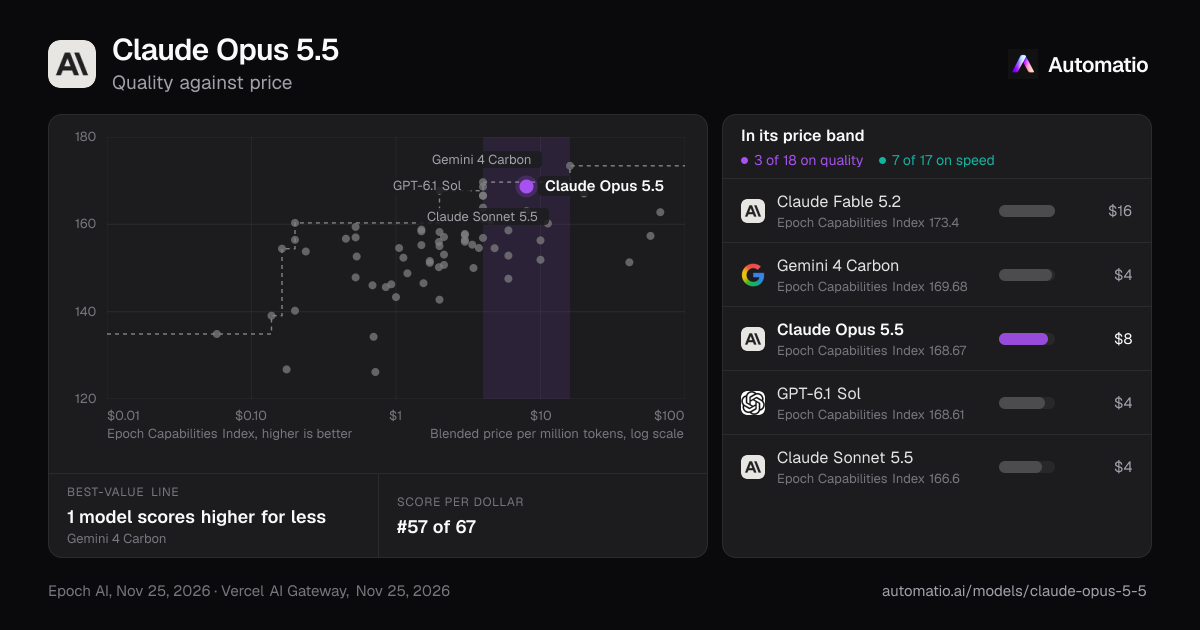
Quality against price

Every model in Automatio with both a price and a score on Epoch Capabilities Index. The dashed line joins the models nothing beats on both; the tinted strip is its price band, from half to twice its price.

Best-value line
1 model scores higher for lessGemini 4 Carbon
Score per dollar
#57 of 67
In its price band18 models priced from half to twice its blended price3 of 18 on quality7 of 17 on speed
  • Claude Fable 5.2Epoch Capabilities Index 173.4#1 of 18$16
  • Gemini 4 CarbonEpoch Capabilities Index 169.68#2 of 18$4
  • Claude Opus 5.5Epoch Capabilities Index 168.67#3 of 18$8
  • GPT-6.1 SolEpoch Capabilities Index 168.61#4 of 18$4
  • Claude Sonnet 5.5Epoch Capabilities Index 166.6#5 of 18$4

Where it ranks among the models in Automatio

Each score's place among the models in Automatio that the same source measured, from the top tenth down, and what people send it on OpenRouter.

  1. Top tenth6

  2. Top quarter8

  3. Top half1

  4. Lower half2

What people use it for on OpenRouterIts share of each task's requests, among the models OpenRouter lists for that task, over the week to Nov 24, 2026.
  • Workflow Execution#8 in this task1.8%
  • Math#9 in this task2.1%
  • Code Generation#9 in this task1.5%
  • Multi-step Planning#10 in this task1.7%

Quick tests

8 questions that still trip models up, each asked again and again at high effort and graded by code: 77 of 80 answers right.

Every run8 questions, 10 runs each, high effort77 right3 wrong
Wrong answers
  1. Repeat a number 31 timesIt answered with 244 charactersrun 2
  2. Repeat a number 31 timesIt answered with 244 charactersrun 5
  3. Repeat a number 31 timesIt answered with 244 charactersrun 8

Creative tests

One prompt, one run at high effort, the first output as it came back, failures included; beside it, the same prompt from its previous generation and two models near it.

A boat at sunset, as an animated SVG

A boat at sunset, as an animated SVG: a frame of the first output from Claude Opus 5.5
RenderedFirst output, not pickedNov 25, 2026high effort$0.15866.9 s7,848 tokens out
The prompt and our note

Polished flat sunset: a sloop with a red pennant and lit portholes on three layered wave lines under a gradient sky, with drifting clouds, a flock of gulls, a glowing sun and a striped reflection; between the frames the sun sinks, birds and clouds move and the boat tilts.

The prompt, version 1

Create one self-contained animated SVG, 800×600 pixels (width="800" height="600" viewBox="0 0 800 600"). Scene: a sailing boat rocking on rolling ocean waves at sunset, with the sun slowly sinking toward the horizon, its reflection shimmering on the water, and a few birds flying across the sky. Everything should move, and the animation should loop smoothly. Animate with SMIL or CSS inside the SVG only: no JavaScript, no external images, fonts or links. Keep it under 30 KB. Reply with only the SVG code, from <svg to </svg>, with no explanation and no Markdown fences.
The same prompt, other models

  • Claude Opus 4.6

    Previous generation

    Rendered

    $0.153 · 72.8 s

  • GPT-6.1 Sol

    Nearest

    Rendered

    $0.112 · 213.9 s

  • GPT-6 Astra

    Nearest

    Rendered

    $0.571 · 203.8 s

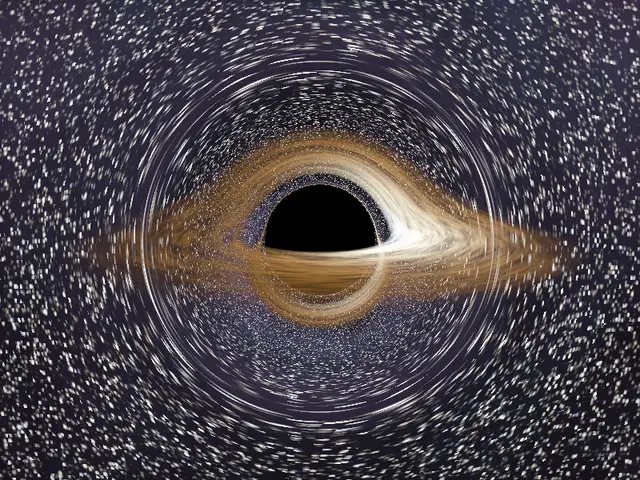
A black hole, rendered live with WebGL

A black hole, rendered live with WebGL: a frame of the first output from Claude Opus 5.5
RenderedFirst output, not pickedNov 25, 2026high effort$0.331149.9 s16,472 tokens out
The prompt and our note

Raw-WebGL lensed black hole in the Interstellar style: black shadow, the disk's far side arched over the top and imaged under the bottom, a Doppler-bright right side and a photon ring, turning between frames; the starfield is very dense and smeared into concentric streaks, which looks noisy.

The prompt, version 1

Create one self-contained HTML file that renders an animated black hole in real time with WebGL. Show a black event horizon, a bright accretion disk that rotates, and gravitational lensing that visibly bends the light of the disk and of a starfield behind the hole (the far side of the disk should appear to arch over and under the hole). Fill the browser window, handle resizing, and animate continuously. Use raw WebGL, or three.js loaded exactly as <script src="https://cdnjs.cloudflare.com/ajax/libs/three.js/r128/three.min.js"></script>. No other external resources: no other scripts, fonts, images, textures or network requests. Reply with only the HTML, from <!DOCTYPE html> to </html>, with no explanation and no Markdown fences.

The same prompt, other models

  • Claude Opus 4.6

    Previous generation

    Did not render

    $0.801 · 576.1 s

  • GPT-6.1 Sol

    Nearest

    Rendered

    $0.156 · 318 s

  • GPT-6 Astra

    Nearest

    Rendered

    $0.754 · 292.3 s

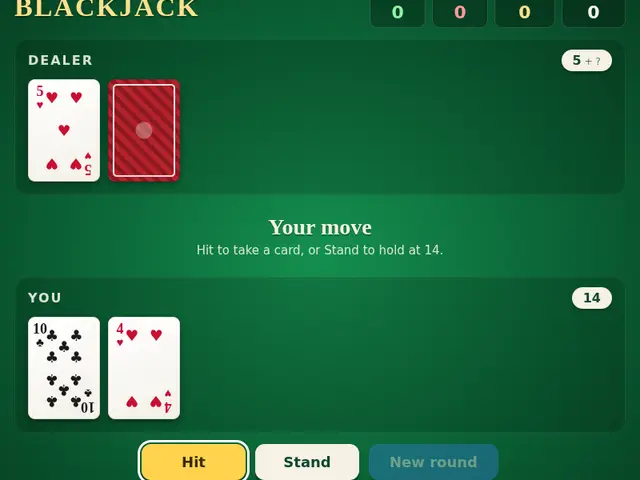
Blackjack, playable, in one page

Blackjack, playable, in one page: a frame of the first output from Claude Opus 5.5
RenderedFirst output, not pickedNov 26, 2026high effort$0.262104.9 s13,054 tokens out
The prompt and our note

Green felt table with a score row, both hands as drawn cards with their totals, and Hit, Stand and New round buttons. The render check's Hit drew an 8 on 14: bust at 22, the dealer's card turned over (12), 'Bust! You lose.' and the loss counted.

The prompt, version 1

Create one self-contained HTML file with a playable game of blackjack: one player against the dealer. Use a shuffled 52-card deck, deal two cards each with the dealer's second card face down, count aces as 1 or 11, let the player Hit or Stand, then reveal the dealer's card and have the dealer draw until 17 or more. Show both hands as drawn cards with their totals, say who won the round (blackjack, bust, push), keep a running score of rounds won and lost, and offer a New round button. Draw the cards with HTML and CSS or a canvas. No external resources: no scripts, fonts, images or network requests. Reply with only the HTML, from <!DOCTYPE html> to </html>, with no explanation and no Markdown fences.
The same prompt, other models

  • Claude Opus 4.6

    Previous generation

    Rendered

    $0.0883 · 41.7 s

  • GPT-6.1 Sol

    Nearest

    Rendered

    $0.111 · 171.4 s

  • GPT-6 Astra

    Nearest

    Rendered

    $0.322 · 111.7 s

Reported benchmark scores

Scores the makers and others published, each linked to the page it is on, with its setting. Open a row for the page's own words.

Reported7 benchmarks with a published score

What Anthropic's page says: “Opus 5.5 || Agentic coding Terminal-Bench 4.0¹ | 66.4%”

read Nov 27, 2026 · Introducing Claude Opus 5.5 \ Anthropic

What Anthropic's page says: “Opus 5.5 || Agentic scientific research Terminal-Bench-Science 0.1³ | 58.7%”

read Nov 27, 2026

What Anthropic's page says: “Opus 5.5 || Agentic coding FrontierCode v1.1 (Main) | 54.4%”

read Nov 27, 2026

What Anthropic's page says: “Opus 5.5 || Agentic coding CursorBench 4.0 | 57.8%”

read Nov 27, 2026

What Anthropic's page says: “Opus 5.5 || Business workflows AutomationBench² | 40.0%”

read Nov 27, 2026

What Anthropic's page says: “Opus 5.5 || Computer use OSWorld 2.1 | 81.8% partial”

read Nov 27, 2026

What Anthropic's page says: “Opus 5.5 || Multidisciplinary reasoning Humanity's Last Exam | 67.7% with tools”

read Nov 27, 2026

What people wrote

What people wrote about it on X, Reddit and Hacker News, and in comments under YouTube videos about it, quoted as written, each linked to its post.

X1

  • @doctorsab0Nov 26, 2026Open the post
    New benchmark REE gives AI agents 100 open research problems and 12 hours each. Claude Opus 5.5 and GPT-6.1 Sol beat the expert solution on 86% and 81% of them, within 2 hours on average. The catch: they mostly tailor or combine known methods. Fast iteration, not new ideas. Yet.

    2 likes

Hacker News4

  • chrisgarandNov 26, 2026Open the post

    GPT-6.2 Astra is the first model to beat Googlers' code golf records

    In my experience, Opus 5.5 and Fable 5.2 are significantly easier to use (the 'it just works' concept), but Astra (6, and 6.2) are better at catching issues, and providing feedback. …
  • jychangNov 26, 2026Open the post

    Much shorter version of GRH Lean verification from Anthropic

    …I found that GPT-6.2 Sol and Astra are better than Opus 5.5 for mathematics, even though I use Opus 5.5 as my main workhorse for coding. I suspect this is because 6.2 was posttrained a lot on mathematics and not coding... …
  • wat10000Nov 25, 2026Open the post

    I've been drinking wine in my kitchen

    Opus 5.5 will absolutely destroy me at things like disassembly analysis. Give it a crash caused by a suspected compiler bug and it will pinpoint the bad codegen in 10 minutes when it would take me hours, and I’m pretty good at this sort of thing. …
  • sick_of_slopNov 24, 2026Open the post

    Fable 5.2 tries less on some hard tasks when a shortcut is available

    Ever since Fable 5.2 dropped Opus 5.5 has been dumb as a rock for me. I used to run medium all day with no issues, now I need to use xhigh to get anything close the quality I could get before. …

YouTube4

  • @vodkaman19701 month agoOpen the post

    This Is What Opus 5.5 Max Built in 36 Hours for 2,175 USD

    It's really impressive but I do think some people are going to burned thinking that they can now make high end games and pour thousands into tokens not realizing how much extra work there is going from this to a fully tested polished, mostly bug-free game. …

    6 likes

  • @derekb1171 month agoOpen the post

    Can an Army of Claude Haiku 5.5 Subagents Beat Opus 5.5?

    I noticed this, I did multiple workflows with multiple haikus that gather information for Opus versus just one Opus. And the one Opus always ended up being cheaper and quicker.

    2 likes

  • @FireBean85041 month agoOpen the post

    Can an Army of Claude Haiku 5.5 Subagents Beat Opus 5.5?

    In my testing, Opus 5.5 on low effort outperformed Haiku 5.5 on max effort on every task I ran. It produced better results, finished faster, and used fewer total tokens. Even with Opus’s higher per-token price, it cost less per completed task. …

    25 likes

  • @AllGloryToGOD772 months agoOpen the post

    Introducing Claude Opus 5.5

    …Opus 5.5 is very nice to work with so far! I couldn't afford to use Fable but Opus 5.5 feels just as good as the Fable trial I got to use before, and is included with my plan. And I'm very happy that it is more efficient so that I can get more done with my account limits. …

    19 likes

Use it through our API

Our OpenAI-compatible endpoint, with this model's id filled in. Any OpenAI SDK works with its base URL set to ours.

  • Make a key with the AI models permission on the Integrations page.
  • Each call is billed in credits from your account.

Read the API docs

curl
curl https://automatio.ai/api/v1/chat/completions \
  -H "Authorization: Bearer $AUTOMATIO_API_KEY" \
  -H "Content-Type: application/json" \
  -d '{"model":"anthropic/claude-opus-5.5","messages":[{"role":"user","content":"Hello"}]}'
JavaScript, OpenAI SDK
import OpenAI from "openai";

const client = new OpenAI({
  baseURL: "https://automatio.ai/api/v1",
  apiKey: process.env.AUTOMATIO_API_KEY,
});

const res = await client.chat.completions.create({
  model: "anthropic/claude-opus-5.5",
  messages: [{ role: "user", content: "Hello" }],
});
console.log(res.choices[0].message.content);

Questions

Still have a question?

Ask us on Discord
How much does Claude Opus 5.5 cost?

$4 per million input tokens and $20 per million output tokens, on Vercel AI Gateway's list as of Nov 25, 2026.

How long a prompt can Claude Opus 5.5 take?

1,000,000 tokens of context, with up to 128,000 tokens of output.

How fast is Claude Opus 5.5?

109.5 tok/s and 1,268 ms to the first token: medians over the hour before Nov 25, 2026, the median across the 4 hosts our requests can reach.

Where does Claude Opus 5.5 rank on Epoch's Capabilities Index?

#4 of the 67 models we serve that Epoch AI has scored, at 168.67 (mostly max effort). Its score is inside the published range of 4 other models, so they are statistically tied.

How does Claude Opus 5.5 do on LMArena?

#3 of the 70 models we serve that Text ranks (High); #2 of the 62 models we serve that WebDev ranks (Max); #2 of the 47 models we serve that Vision ranks (High); #4 of the 37 models we serve that Agent ranks (High), on the leaderboards of Nov 22, 2026.

Can I call Claude Opus 5.5 through an API?

Yes: send the model id anthropic/claude-opus-5.5 to Automatio's OpenAI-compatible chat completions endpoint with an Automatio API key. The API docs list every option.

What can Claude Opus 5.5 read and do?

It reads images. It reads files such as PDFs. It calls tools. It can reason before it answers.

When did Claude Opus 5.5 come out?

Sep 22, 2026, as Vercel AI Gateway's catalogue lists it. Its knowledge cutoff is Jun 2026.

Where the numbers come from

Every number on this page comes from one of these: public sources first, then what we measured and collected ourselves.

  1. Vercel AI Gateway1

    Prices, context windows, and each host's speed and time to first token.

    Prices, context and speed via Vercel AI Gateway, 2026-11-25
    As of Nov 25, 2026Public model catalogueOpen source
  2. Epoch AI2

    Its own benchmark runs and the Epoch Capabilities Index.

    Source: Epoch AI (epoch.ai), CC BY 4.0, 2026-11-25
    As of Nov 25, 2026CC BY 4.0Open source
  3. LMArena3

    Leaderboards of people voting between two anonymous answers.

    Source: LMArena (arena.ai), leaderboard of 2026-11-23, CC BY 4.0
    As of Nov 23, 2026CC BY 4.0Open source
  4. OpenRouter4

    Which models people send each kind of task to.

    Source: OpenRouter (openrouter.ai/rankings), as of 2026-11-25
    As of Nov 25, 2026CC BY 4.0Open source
  5. Automatio's own tests

    Quick tests: 80 runs of short questions with one right answer, graded by code.

    Creative tests: 3 prompts run once at high effort through the AI Gateway, the first output kept, with the cost it billed.

Ask it something

Type a request in the box at the top of the page and it answers in a chat.

  • A task can repeat on a schedule, as often as every 5 minutes.

    How schedules work
  • Results can also come to you in Discord or Telegram.