

How to Scrape Airbnb Listings and Prices (2025 Guide)
Learn how to scrape Airbnb listings, prices, and reviews for market research and competitive analysis. Extract vacation rental data efficiently in 2024-2025.
Free to start: 1,000 credits, no card, nothing to install.
About Airbnb
Learn what Airbnb offers and what valuable data can be extracted from it.
About Airbnb
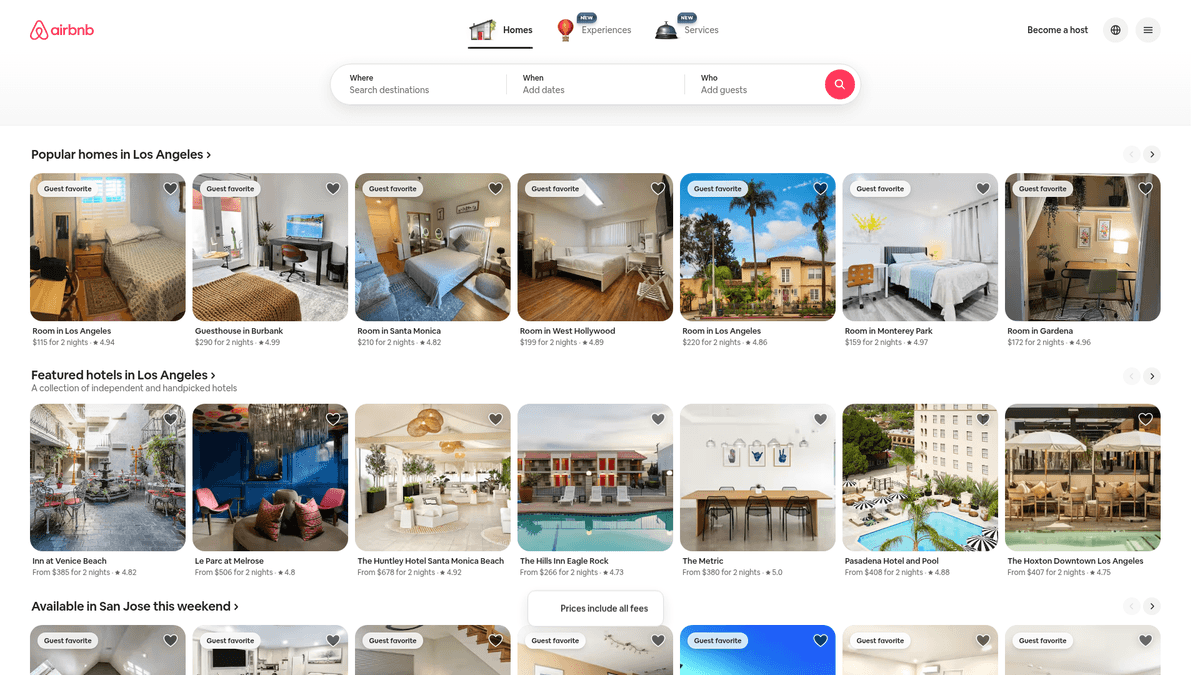
Airbnb is a global online marketplace that connects travelers looking for unique accommodations with hosts offering short-term stays, vacation rentals, and tourism experiences. Founded in 2008, it has grown from a single room rental in San Francisco to a massive platform with millions of listings across nearly every country in the world, including apartments, cabins, castles, and boats.
Available Data Elements
The website contains a wealth of structured and unstructured data, including property details, nightly pricing, availability calendars, and detailed guest reviews. This data is essential for real estate investors and travel analysts who need to monitor market health and trends. By scraping Airbnb, users can gain insights into occupancy rates, regional demand, and competitive pricing strategies in the rapidly evolving travel industry.
Why Scrape Airbnb?
Discover the business value and use cases for extracting data from Airbnb.
Competitive Price Benchmarking
Monitor nightly rates across different regions and seasons to optimize your own pricing strategy and maintain a competitive edge in the market.
Real Estate Investment Analysis
Evaluate the potential ROI of investment properties by analyzing historical occupancy rates and average rental income in specific neighborhoods.
Travel Trend Tracking
Identify emerging travel destinations and popular property types by tracking listing growth and guest booking frequency across global markets.
Review Sentiment Analysis
Extract guest feedback to understand what travelers value most, helping property managers improve amenities and service quality based on aggregated reviews.
Market Saturation Studies
Assess the density of short-term rentals in specific urban centers to understand the impact on local housing supplies and regulatory compliance.
Lead Generation for Services
Identify high-volume hosts and property management companies that may need professional services like cleaning, photography, or maintenance.
Scraping Challenges
Technical challenges you may encounter when scraping Airbnb.
Advanced Akamai Bot Manager
Airbnb utilizes sophisticated perimeter security that detects non-human TLS fingerprints and behavioral patterns, leading to immediate IP blacklisting.
Dynamic React Rendering
The platform is built as a single-page application where content is loaded via background API calls, requiring full JavaScript execution to see any listing data.
Obfuscated HTML Structure
CSS class names are often randomized or obfuscated, making standard selectors brittle and necessitating the use of more stable data-testid attributes.
Geographic Content Gating
Pricing, availability, and currency often change based on the requester's IP location, requiring localized residential proxies for accurate data extraction.
Complex GraphQL Integration
Much of the listing data is wrapped in complex GraphQL responses which can be difficult to parse compared to traditional flat HTML tables.
Scrape Airbnb with AI
No coding required. Extract data in minutes with AI-powered automation.
How It Works
Describe What You Need
Tell the AI what data you want to extract from Airbnb. Just type it in plain language — no coding or selectors needed.
AI Extracts the Data
Our artificial intelligence navigates Airbnb, handles dynamic content, and extracts exactly what you asked for.
Get Your Data
Receive clean, structured data ready to export as CSV, JSON, or send directly to your apps and workflows.
Why Use AI for Scraping
No-Code Web Scrapers for Airbnb
Point-and-click alternatives to AI-powered scraping
Several no-code tools like Browse.ai, Octoparse, Axiom, and ParseHub can help you scrape Airbnb. These tools use visual interfaces to select elements, but they come with trade-offs compared to AI-powered solutions.
Typical Workflow with No-Code Tools
Common Challenges
Learning curve
Understanding selectors and extraction logic takes time
Selectors break
Website changes can break your entire workflow
Dynamic content issues
JavaScript-heavy sites often require complex workarounds
CAPTCHA limitations
Most tools require manual intervention for CAPTCHAs
IP blocking
Aggressive scraping can get your IP banned
Code Examples
import requests
from bs4 import BeautifulSoup

# Note: Airbnb usually blocks basic requests unless using stealth proxies
headers = {
    'User-Agent': 'Mozilla/5.0 (Windows NT 10.0; Win64; x64) AppleWebKit/537.36 (KHTML, like Gecko) Chrome/120.0.0.0 Safari/537.36',
    'Accept-Language': 'en-US,en;q=0.9'
}

url = 'https://www.airbnb.com/s/homes'
try:
    response = requests.get(url, headers=headers, timeout=10)
    soup = BeautifulSoup(response.content, 'html.parser')
    # Attempting to find listing prices
    prices = soup.find_all('span', string=lambda x: x and '$' in x)
    for price in prices:
        print(f'Found price: {price.text}')
except Exception as e:
    print(f'Request blocked or failed: {e}')
When to Use
Best for static HTML pages where content is loaded server-side. The fastest and simplest approach when JavaScript rendering isn't required.
Advantages
- ●Fastest execution (no browser overhead)
- ●Lowest resource consumption
- ●Easy to parallelize with asyncio
- ●Great for APIs and static pages
Limitations
- ●Cannot execute JavaScript
- ●Fails on SPAs and dynamic content
- ●May struggle with complex anti-bot systems
import asyncio
from playwright.async_api import async_playwright

async def scrape_airbnb():
    async with async_playwright() as p:
        # Launching browser with a real user profile to bypass bot detection
        browser = await p.chromium.launch(headless=True)
        page = await browser.new_page()
        await page.goto('https://www.airbnb.com/s/homes')

        # Wait for listings to render via React
        await page.wait_for_selector('[data-testid="card-container"]')

        listings = await page.query_selector_all('[data-testid="card-container"]')
        for item in listings:
            title = await item.query_selector('[data-testid="listing-card-title"]')
            price = await item.query_selector('span._1y74zay')
            if title and price:
                print(f'{await title.inner_text()}: {await price.inner_text()}')

        await browser.close()

asyncio.run(scrape_airbnb())
When to Use
Use when content loads dynamically via JavaScript, or when you need to interact with the page (clicks, scrolls, form fills). Handles modern anti-bot detection better.
Advantages
- ●Executes JavaScript like a real browser
- ●Handles SPAs and dynamic content
- ●Better anti-bot evasion with stealth plugins
- ●Can take screenshots and PDFs
Limitations
- ●Slower than HTTP requests
- ●Higher memory/CPU usage
- ●More complex to set up
import scrapy

class AirbnbSpider(scrapy.Spider):
    name = 'airbnb'
    start_urls = ['https://www.airbnb.com/s/homes']

    def parse(self, response):
        for listing in response.css('[data-testid="card-container"]'):
            yield {
                'title': listing.css('[data-testid="listing-card-title"]::text').get(),
                'price': listing.css('span._1y74zay::text').get(),
                'rating': listing.css('span[aria-label*="rating"]::text').get()
            }

        next_page = response.css('a[aria-label="Next"]::attr(href)').get()
        if next_page:
            yield response.follow(next_page, self.parse)
When to Use
Ideal for large-scale crawling projects that need to scrape thousands of pages. Built-in support for rate limiting, retries, and data pipelines.
Advantages
- ●Built for scale (millions of pages)
- ●Automatic request throttling
- ●Built-in data export pipelines
- ●Middleware system for proxies/headers
Limitations
- ●Steeper learning curve
- ●Overkill for small projects
- ●No native JavaScript rendering
const puppeteer = require('puppeteer');

(async () => {
  const browser = await puppeteer.launch({ headless: true });
  const page = await browser.newPage();
  await page.goto('https://www.airbnb.com/s/homes');

  // Wait for the dynamic React content
  await page.waitForSelector('[data-testid="card-container"]');

  const results = await page.evaluate(() => {
    const items = Array.from(document.querySelectorAll('[data-testid="card-container"]'));
    return items.map(el => ({
      title: el.querySelector('[data-testid="listing-card-title"]')?.innerText,
      price: el.querySelector('span._1y74zay')?.innerText
    }));
  });

  console.log(results);
  await browser.close();
})();
When to Use
Choose this if you're in a Node.js/JavaScript ecosystem or need tight integration with frontend tools. Similar capabilities to Playwright.
Advantages
- ●Native JavaScript/TypeScript support
- ●Chrome DevTools Protocol access
- ●Large ecosystem and community
- ●Good for JS-heavy projects
Limitations
- ●Chrome-only (vs Playwright's multi-browser)
- ●Similar overhead to Playwright
- ●Less mature stealth options
What You Can Do With Airbnb Data
Explore practical applications and insights from Airbnb data.
Real Estate Arbitrage Discovery
Investors can identify properties where the Airbnb revenue potential significantly exceeds the monthly mortgage or rental cost.
How to implement:
- 1Scrape nightly rates and average occupancy for a specific neighborhood.
- 2Compare the projected monthly Airbnb revenue with local long-term rental market data.
- 3Calculate the ROI for potential investment properties.
Use Automatio to extract data from Airbnb and build these applications without writing code.
Dynamic Pricing for Hosts
Property managers benefit by adjusting their nightly rates in real-time based on local demand and competitor pricing.
How to implement:
- 1Set up a daily scrape of listings in the same city with similar guest capacity.
- 2Analyze price surges during local festivals, holidays, or sporting events.
- 3Implement automated price adjustments to maximize occupancy and revenue.
Use Automatio to extract data from Airbnb and build these applications without writing code.
Niche Tourism Market Analysis
Tourism boards can use data to understand which property types are trending in their region.
How to implement:
- 1Aggregate listing counts across different Airbnb Categories.
- 2Correlate review volumes with specific property features like Beachfront or Design.
- 3Direct marketing efforts toward the most popular accommodation categories.
Use Automatio to extract data from Airbnb and build these applications without writing code.
Academic Urban Research
Researchers study the impact of short-term rentals on local housing affordability and neighborhood gentrification.
How to implement:
- 1Collect long-term data on the number of Entire Home listings versus private rooms.
- 2Map listing density against city zoning and residential areas.
- 3Analyze the correlation between Airbnb growth and local rent price increases.
Use Automatio to extract data from Airbnb and build these applications without writing code.
Supercharge your workflow with AI Automation
Automatio combines the power of AI agents, web automation, and smart integrations to help you accomplish more in less time.
What to get right first
Expert advice for successfully extracting data from Airbnb.
Target Internal GraphQL Endpoints
Monitor the network tab for requests to /api/v3/PdpPlatformSections; these often return structured JSON data that is far easier to parse than raw HTML.
Use High-Quality Residential Proxies
Avoid datacenter IPs entirely as they are flagged instantly. Residential IPs mimic real home users and significantly reduce the risk of triggering CAPTCHAs.
Implement Randomized Interaction Jitter
Add random delays between actions and vary your mouse movement patterns to avoid detection by behavioral analysis algorithms.
Utilize Data-Testid Selectors
Instead of selecting elements by class names like '_1y74z8', use attributes like data-testid='listing-card-title' which are more stable across site updates.
Rotate User-Agents Consistently
Ensure your User-Agent and browser fingerprint match perfectly to avoid being flagged for header inconsistency by modern anti-bot systems.
Limit Concurrent Requests
Avoid sending hundreds of requests simultaneously from a single session. Slow and steady scraping is more effective for long-term data collection on this platform.
Related Web Scraping
Frequently Asked Questions
Find answers to common questions about Airbnb
Is it legal to scrape data from Airbnb?
Scraping publicly accessible data like prices and listing titles for research or personal use is generally considered legal in many regions, but it may violate Airbnb's Terms of Service. You should always consult with a legal professional and ensure you are not collecting personal identifiable information or impacting the site's performance.
Does Airbnb offer a public API for developers?
Airbnb does not provide a public, free-to-use API for independent developers. They offer a restricted Partner API that is exclusively available to large property management systems and authorized corporate partners through a formal application process.
How do I prevent my scraper from getting blocked by Airbnb?
To avoid blocks, you must use high-quality residential proxies, rotate your browser fingerprints (TLS and JA3), and mimic human browsing behavior. Tools that handle JavaScript rendering and automated proxy rotation are much more successful than simple HTTP request libraries.
What is the best way to extract Airbnb reviews?
Reviews are often hidden behind dynamic 'Show all' buttons and use infinite scrolling. You should use a browser automation tool that can click these elements and wait for the content to render before capturing the text from the modal or page.
Which data format is best for Airbnb listing data?
JSON is the preferred format because Airbnb data is often deeply nested, containing lists of amenities, prices, and host details. However, CSV is also a great option if you intend to perform simple analysis in Excel or Google Sheets.
How often should I scrape Airbnb for pricing updates?
For dynamic pricing and revenue management, scraping once every 24 hours is usually sufficient. If you are tracking high-demand events like festivals or holidays, you might increase frequency to every 6 to 12 hours, provided you have adequate proxy rotation.
Can I scrape Airbnb data without a headless browser?
It is extremely difficult because Airbnb relies heavily on React for client-side rendering. Without a headless browser or a specialized tool like Automatio to execute JavaScript, you will likely receive an empty page or a security challenge page.
What are the most important data points to scrape from Airbnb?
Most researchers prioritize the nightly price, cleaning fees, total price with service fees, star ratings, review counts, property type, and neighborhood name for comprehensive market analysis.