

How to Scrape We Work Remotely: The Ultimate Guide
Learn how to scrape job listings from We Work Remotely. Extract job titles, companies, salaries, and more for market research or your own job aggregator.
Free to start: 1,000 credits, no card, nothing to install.
About We Work Remotely
Learn what We Work Remotely offers and what valuable data can be extracted from it.
The Hub for Global Remote Talent
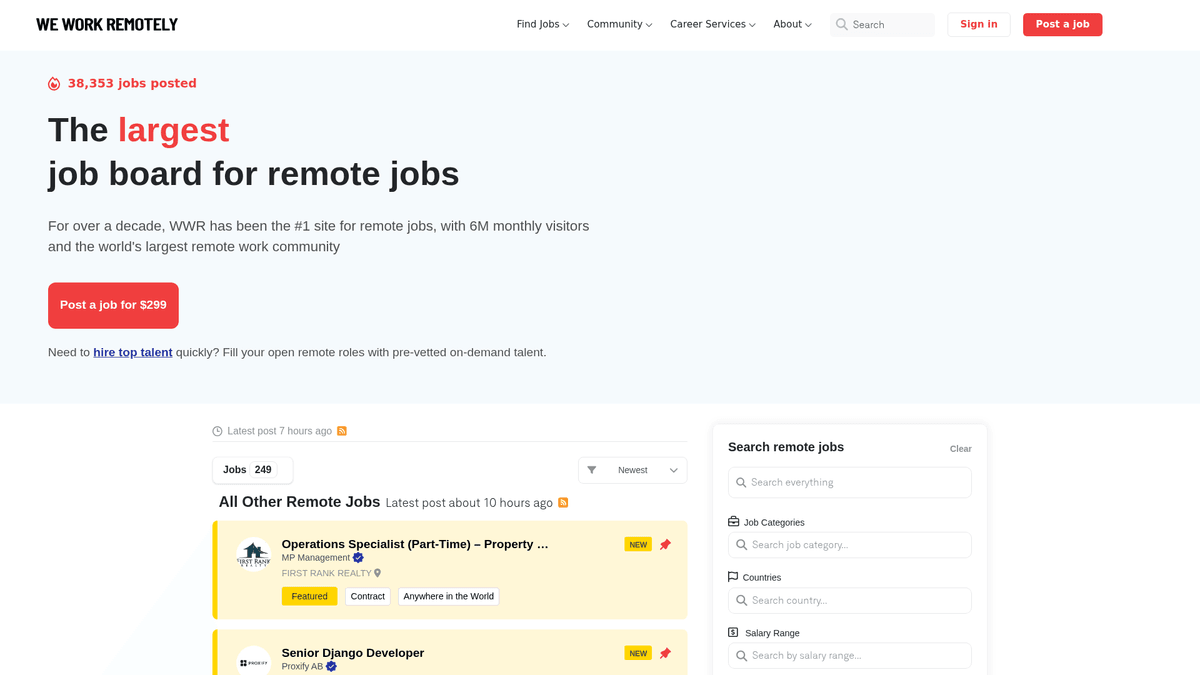
We Work Remotely (WWR) is the most established remote work community globally, boasting over 6 million monthly visitors. It serves as a primary destination for companies moving away from traditional office-based models, offering a diverse array of listings in software development, design, marketing, and customer support.
High-Quality Structured Data
The platform is known for its highly structured data. Each listing typically contains specific regional requirements, salary ranges, and detailed company profiles. This structure makes it an ideal target for web scraping, as the data is consistent and easy to categorize for secondary use cases.
Strategic Value for Data Professionals
For recruiters and market researchers, WWR is a goldmine. Scraping this site allows for real-time tracking of hiring trends, salary benchmarking across different technical sectors, and lead generation for B2B services targeting remote-first companies. It provides a transparent view of the global remote labor market.
Why Scrape We Work Remotely?
Discover the business value and use cases for extracting data from We Work Remotely.
Market Demand Analysis
Track which programming languages, frameworks, and soft skills are trending across the remote work landscape to stay ahead of market shifts.
Salary Benchmarking
Extract salary data from listings to create comprehensive compensation reports for remote-first companies across various technical and creative roles.
B2B Lead Generation
Identify companies that are actively scaling their remote teams to offer specialized services like HR tech, payroll solutions, or recruitment consulting.
Niche Job Aggregation
Power a specialized job board by filtering and aggregating high-quality remote listings into specific niches like Web3, AI, or Design.
Competitive Intelligence
Monitor your competitors' hiring velocity and geographic preferences to understand their growth strategy and potential expansion areas.
Scraping Challenges
Technical challenges you may encounter when scraping We Work Remotely.
Cloudflare Bot Detection
WWR utilizes Cloudflare's security layer, which can detect and block standard automated scripts that do not properly mimic human browser behavior.
Unstructured Salary Data
Salary information is often embedded within the text descriptions in varied formats, requiring complex regex patterns to extract and normalize into numerical values.
Dynamic Content Loading
Navigating between general listings and the 'Load More' pagination requires a scraper capable of handling asynchronous requests without losing data integrity.
Varying HTML Structures
Featured listings and standard listings sometimes use slightly different CSS classes, necessitating flexible selectors to ensure no jobs are missed.
Scrape We Work Remotely with AI
No coding required. Extract data in minutes with AI-powered automation.
How It Works
Describe What You Need
Tell the AI what data you want to extract from We Work Remotely. Just type it in plain language — no coding or selectors needed.
AI Extracts the Data
Our artificial intelligence navigates We Work Remotely, handles dynamic content, and extracts exactly what you asked for.
Get Your Data
Receive clean, structured data ready to export as CSV, JSON, or send directly to your apps and workflows.
Why Use AI for Scraping
No-Code Web Scrapers for We Work Remotely
Point-and-click alternatives to AI-powered scraping
Several no-code tools like Browse.ai, Octoparse, Axiom, and ParseHub can help you scrape We Work Remotely. These tools use visual interfaces to select elements, but they come with trade-offs compared to AI-powered solutions.
Typical Workflow with No-Code Tools
Common Challenges
Learning curve
Understanding selectors and extraction logic takes time
Selectors break
Website changes can break your entire workflow
Dynamic content issues
JavaScript-heavy sites often require complex workarounds
CAPTCHA limitations
Most tools require manual intervention for CAPTCHAs
IP blocking
Aggressive scraping can get your IP banned
Code Examples
import requests
from bs4 import BeautifulSoup

url = 'https://weworkremotely.com/'
headers = {'User-Agent': 'Mozilla/5.0'}

try:
    # Send request with custom headers
    response = requests.get(url, headers=headers)
    soup = BeautifulSoup(response.text, 'html.parser')
    # Target job listings
    jobs = soup.find_all('li', class_='feature')
    for job in jobs:
        title = job.find('span', class_='title').text.strip()
        company = job.find('span', class_='company').text.strip()
        print(f'Job: {title} | Company: {company}')
except Exception as e:
    print(f'Error: {e}')
When to Use
Best for static HTML pages where content is loaded server-side. The fastest and simplest approach when JavaScript rendering isn't required.
Advantages
- ●Fastest execution (no browser overhead)
- ●Lowest resource consumption
- ●Easy to parallelize with asyncio
- ●Great for APIs and static pages
Limitations
- ●Cannot execute JavaScript
- ●Fails on SPAs and dynamic content
- ●May struggle with complex anti-bot systems
import asyncio
from playwright.async_api import async_playwright

async def run():
    async with async_playwright() as p:
        # Launch headless browser
        browser = await p.chromium.launch(headless=True)
        page = await browser.new_page()
        await page.goto('https://weworkremotely.com/')
        # Wait for the main container to load
        await page.wait_for_selector('.jobs-container')
        jobs = await page.query_selector_all('li.feature')
        for job in jobs:
            title = await job.query_selector('.title')
            if title:
                print(await title.inner_text())
        await browser.close()

asyncio.run(run())
When to Use
Use when content loads dynamically via JavaScript, or when you need to interact with the page (clicks, scrolls, form fills). Handles modern anti-bot detection better.
Advantages
- ●Executes JavaScript like a real browser
- ●Handles SPAs and dynamic content
- ●Better anti-bot evasion with stealth plugins
- ●Can take screenshots and PDFs
Limitations
- ●Slower than HTTP requests
- ●Higher memory/CPU usage
- ●More complex to set up
import scrapy

class WwrSpider(scrapy.Spider):
    name = 'wwr_spider'
    start_urls = ['https://weworkremotely.com/']

    def parse(self, response):
        # Iterate through listing items
        for job in response.css('li.feature'):
            yield {
                'title': job.css('span.title::text').get(),
                'company': job.css('span.company::text').get(),
                'url': response.urljoin(job.css('a::attr(href)').get())
            }
When to Use
Ideal for large-scale crawling projects that need to scrape thousands of pages. Built-in support for rate limiting, retries, and data pipelines.
Advantages
- ●Built for scale (millions of pages)
- ●Automatic request throttling
- ●Built-in data export pipelines
- ●Middleware system for proxies/headers
Limitations
- ●Steeper learning curve
- ●Overkill for small projects
- ●No native JavaScript rendering
const puppeteer = require('puppeteer');

(async () => {
  const browser = await puppeteer.launch();
  const page = await browser.newPage();
  await page.goto('https://weworkremotely.com/');
  // Extract data using evaluate
  const jobs = await page.evaluate(() => {
    return Array.from(document.querySelectorAll('li.feature')).map(li => ({
      title: li.querySelector('.title')?.innerText.trim(),
      company: li.querySelector('.company')?.innerText.trim()
    }));
  });
  console.log(jobs);
  await browser.close();
})();
When to Use
Choose this if you're in a Node.js/JavaScript ecosystem or need tight integration with frontend tools. Similar capabilities to Playwright.
Advantages
- ●Native JavaScript/TypeScript support
- ●Chrome DevTools Protocol access
- ●Large ecosystem and community
- ●Good for JS-heavy projects
Limitations
- ●Chrome-only (vs Playwright's multi-browser)
- ●Similar overhead to Playwright
- ●Less mature stealth options
What You Can Do With We Work Remotely Data
Explore practical applications and insights from We Work Remotely data.
Remote Job Aggregator
Build a specialized job search platform for specific technical niches like Rust or AI.
How to implement:
- 1Scrape WWR daily for new listings
- 2Filter by specific keywords and categories
- 3Store data in a searchable database
- 4Automate social media postings for new jobs
Use Automatio to extract data from We Work Remotely and build these applications without writing code.
Salary Trend Analysis
Analyze remote salary data to determine global compensation benchmarks across roles.
How to implement:
- 1Extract salary fields from job descriptions
- 2Normalize data into a single currency
- 3Segment by job role and experience level
- 4Generate quarterly market reports
Use Automatio to extract data from We Work Remotely and build these applications without writing code.
Lead Generation for HR Tech
Identify companies aggressively hiring remote teams to sell HR, payroll, and benefit software.
How to implement:
- 1Monitor the 'Top 100 Remote Companies' list
- 2Track frequency of new job postings
- 3Identify decision-makers at hiring companies
- 4Outreach with tailored B2B solutions
Use Automatio to extract data from We Work Remotely and build these applications without writing code.
Historical Hiring Trends
Analyze long-term data to understand how remote work demand shifts seasonally or economically.
How to implement:
- 1Archive listings over 12+ months
- 2Calculate growth rates per category
- 3Visualize trends using BI tools
- 4Predict future skill demand
Use Automatio to extract data from We Work Remotely and build these applications without writing code.
Supercharge your workflow with AI Automation
Automatio combines the power of AI agents, web automation, and smart integrations to help you accomplish more in less time.
What to get right first
Expert advice for successfully extracting data from We Work Remotely.
Parse the RSS Feeds First
Check the /remote-jobs.rss endpoints for various categories; they offer structured XML that is significantly easier and faster to parse than the main HTML.
Use Category-Specific URLs
Target URLs like /categories/remote-programming-jobs to get cleaner results and avoid the noise of the main landing page.
Rotate Residential Proxies
To avoid rate limiting on detail pages, use residential proxies which are less likely to be flagged as bots compared to datacenter IPs.
Target JSON-LD Metadata
Many job pages include structured data in JSON-LD format within the HTML, which provides clean, ready-to-use data for job titles and descriptions.
Randomize Request Intervals
Implement human-like delays between clicking on different job listings to prevent the site's security from identifying a robotic pattern.
Monitor the 'Top 100' Section
Scrape the 'Top 100 Companies' page separately to identify high-value hiring targets that consistently list on the platform.
Related Web Scraping

Upwork Scraper: Jobs, Budgets and Proposals in a table
How to Scrape Freelancer.com: A Complete Technical Guide

How to Scrape Toptal | Toptal Web Scraper Guide

How to Scrape Arc.dev: The Complete Guide to Remote Job Data
How to Scrape Guru.com: A Comprehensive Web Scraping Guide
How to Scrape Fiverr | Fiverr Web Scraper Guide
Indeed Scraper: Job Titles, Pay and Companies in a Table
Frequently Asked Questions
Find answers to common questions about We Work Remotely
Is it legal to scrape We Work Remotely?
Scraping publicly available data from WWR is generally legal for research and analysis as long as you do not violate their Terms of Service. However, you should avoid scraping personal contact information or using the data in a way that creates a direct market substitute for their service.
Does We Work Remotely have an official API?
WWR does not offer a traditional REST API for public data consumption. They do provide a POST API for recruiters to list jobs and several public RSS feeds which serve as a reliable source of structured XML data.
How can I avoid getting blocked by WWR?
The best way to avoid blocks is to use a tool like Automatio that manages browser headers and proxy rotation. Additionally, maintaining a low request frequency and avoiding scraping the entire site in a single burst will help stay under their security radar.
What format can I get the data in?
When using a professional scraper, you can export the data into CSV, JSON, or Excel formats. If you are feeding the data into another app, using a Webhook or JSON export is typically the most efficient method for automation.
How often should I scrape WWR for new jobs?
Since WWR is a high-traffic job board, scraping once every 4 to 6 hours is usually sufficient to capture new listings. If you are building a real-time aggregator, you might consider checking the most recent category pages every 30 minutes.
Which proxies work best for We Work Remotely?
Residential proxies are highly recommended because they appear as regular home users to Cloudflare. Datacenter proxies are often pre-flagged and might result in frequent CAPTCHA challenges when trying to access job detail pages.
Can I scrape job descriptions and application links?
Yes, both the full job description and the external application link are accessible. You will need a multi-level scraper that first collects the job URLs from the listing page and then visits each detail page to extract the deeper information.
Does scraping WWR require a headless browser?
While much of the initial data is in the HTML, a headless browser is often necessary to bypass Cloudflare's JavaScript challenges. Using a browser-based scraper ensures that you see the same content a real human visitor would see.