

How to Scrape Chambers and Partners | Legal Rankings Guide
Learn how to scrape Chambers and Partners for legal rankings. Extract lawyer profiles, firm data, and market insights for research and recruitment.
Free to start: 1,000 credits, no card, nothing to install.
About Chambers and Partners
Learn what Chambers and Partners offers and what valuable data can be extracted from it.
The Legal Gold Standard
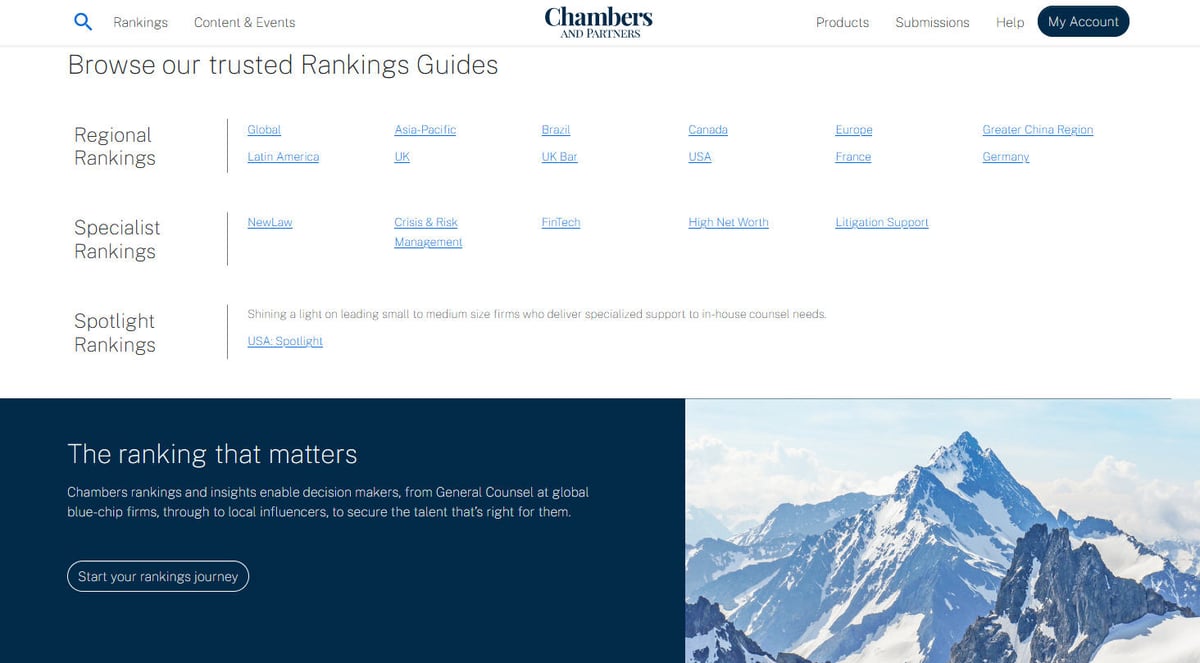
Chambers and Partners is recognized globally as the premier legal directory, ranking the most outstanding law firms and individual lawyers across more than 200 jurisdictions. Their rankings are based on thousands of in-depth interviews with clients and peers, providing a unique look into the legal market. For data scientists and legal tech companies, this website serves as a foundational source for identifying top-tier legal talent and firm prestige.
Structured Legal Data
The platform contains a wealth of structured information, including Ranking Bands (1-6), specialized practice area categories, and comprehensive editorial reviews. Every ranking is accompanied by detailed biographical data for lawyers and historical performance data for firms, making it a goldmine for longitudinal studies of the legal profession.
Strategic Scraping Value
Scraping this data allows organizations to perform competitive intelligence, track lateral lawyer movements, and benchmark firm performance against the market. Whether you are building a recruitment tool or a legal analytics platform, the data found on Chambers.com provides high-signal insights that are unavailable through standard public records.
Why Scrape Chambers and Partners?
Discover the business value and use cases for extracting data from Chambers and Partners.
Strategic Market Intelligence
Analyze the legal landscape to understand which law firms are dominating specific practice areas and how market share is shifting between global and regional players.
High-Value Talent Acquisition
Identify 'Band 1' and 'Up-and-Coming' lawyers for lateral recruitment or executive search, ensuring you target the most prestigious professionals in the industry.
Legal Tech Lead Generation
Export lists of top-ranked firms to prioritize sales outreach for litigation support software, practice management tools, and other high-end legal services.
Benchmarking and Auditing
Corporate legal departments can scrape ranking data to verify the prestige of their external counsel and compare current providers against alternative high-ranked firms.
Historical Performance Tracking
Collect data across multiple years to identify long-term trends in firm performance, growth trajectories, and the emergence of new legal niches.
Scraping Challenges
Technical challenges you may encounter when scraping Chambers and Partners.
Sophisticated Anti-Bot Barriers
Chambers employs advanced security measures like Akamai and Cloudflare that detect automated behavior through deep browser fingerprinting and TLS inspection.
Dynamic React-Based Architecture
The website is a Single Page Application (SPA), meaning rankings are loaded dynamically via JavaScript; standard scrapers often fail to see any data without full browser rendering.
Complex Navigation Structures
Data is nested deep within a hierarchy of guides, countries, and practice areas, requiring advanced recursive crawling logic to traverse the entire database effectively.
Annual URL and Selector Shifts
Every year, Chambers launches new guides that often come with structural updates or URL changes, which can break static scraping scripts that rely on fixed patterns.
Aggressive IP Rate Limiting
High-frequency requests are quickly flagged and blocked, necessitating the use of sophisticated proxy rotation and human-like request pacing.
Scrape Chambers and Partners with AI
No coding required. Extract data in minutes with AI-powered automation.
How It Works
Describe What You Need
Tell the AI what data you want to extract from Chambers and Partners. Just type it in plain language — no coding or selectors needed.
AI Extracts the Data
Our artificial intelligence navigates Chambers and Partners, handles dynamic content, and extracts exactly what you asked for.
Get Your Data
Receive clean, structured data ready to export as CSV, JSON, or send directly to your apps and workflows.
Why Use AI for Scraping
No-Code Web Scrapers for Chambers and Partners
Point-and-click alternatives to AI-powered scraping
Several no-code tools like Browse.ai, Octoparse, Axiom, and ParseHub can help you scrape Chambers and Partners. These tools use visual interfaces to select elements, but they come with trade-offs compared to AI-powered solutions.
Typical Workflow with No-Code Tools
Common Challenges
Learning curve
Understanding selectors and extraction logic takes time
Selectors break
Website changes can break your entire workflow
Dynamic content issues
JavaScript-heavy sites often require complex workarounds
CAPTCHA limitations
Most tools require manual intervention for CAPTCHAs
IP blocking
Aggressive scraping can get your IP banned
Code Examples
import requests
from bs4 import BeautifulSoup

# Note: Chambers uses Cloudflare; standard requests may be blocked.
headers = {
    'User-Agent': 'Mozilla/5.0 (Windows NT 10.0; Win64; x64) AppleWebKit/537.36 (KHTML, like Gecko) Chrome/119.0.0.0 Safari/537.36'
}

def scrape_chambers_firm(url):
    try:
        response = requests.get(url, headers=headers, timeout=15)
        response.raise_for_status()
        soup = BeautifulSoup(response.text, 'html.parser')
        # Simplified selector - actual selectors may vary due to JS rendering
        firms = soup.find_all('h3', class_='firm-name')
        for firm in firms:
            print(firm.get_text(strip=True))
    except Exception as e:
        print(f'Blocked or error: {e}')

scrape_chambers_firm('https://chambers.com/legal-guide/usa-5')
When to Use
Best for static HTML pages where content is loaded server-side. The fastest and simplest approach when JavaScript rendering isn't required.
Advantages
- ●Fastest execution (no browser overhead)
- ●Lowest resource consumption
- ●Easy to parallelize with asyncio
- ●Great for APIs and static pages
Limitations
- ●Cannot execute JavaScript
- ●Fails on SPAs and dynamic content
- ●May struggle with complex anti-bot systems
from playwright.sync_api import sync_playwright

def run():
    with sync_playwright() as p:
        browser = p.chromium.launch(headless=True)
        page = browser.new_page()
        # Using a mobile user agent or stealth can help avoid detection
        page.goto('https://chambers.com/legal-guide/uk-1', wait_until='networkidle')

        # Wait for ranking cards to load via JavaScript
        page.wait_for_selector('.ranking-card')

        rankings = page.eval_on_selector_all('.ranking-card', "cards => cards.map(c => c.innerText)")
        for info in rankings:
            print(info)

        browser.close()

run()
When to Use
Use when content loads dynamically via JavaScript, or when you need to interact with the page (clicks, scrolls, form fills). Handles modern anti-bot detection better.
Advantages
- ●Executes JavaScript like a real browser
- ●Handles SPAs and dynamic content
- ●Better anti-bot evasion with stealth plugins
- ●Can take screenshots and PDFs
Limitations
- ●Slower than HTTP requests
- ●Higher memory/CPU usage
- ●More complex to set up
import scrapy

class ChambersRankingSpider(scrapy.Spider):
    name = 'chambers_spider'
    start_urls = ['https://chambers.com/search?q=litigation']

    custom_settings = {
        'DOWNLOAD_DELAY': 3,
        'CONCURRENT_REQUESTS': 1,
        'USER_AGENT': 'Mozilla/5.0 (Windows NT 10.0; Win64; x64) Chrome/118.0.0.0 Safari/537.36'
    }

    def parse(self, response):
        for item in response.css('.search-result-item'):
            yield {
                'name': item.css('.title-link::text').get(),
                'firm': item.css('.firm-link::text').get(),
                'url': response.urljoin(item.css('a::attr(href)').get())
            }

        next_page = response.css('a.pagination-next::attr(href)').get()
        if next_page:
            yield response.follow(next_page, self.parse)
When to Use
Ideal for large-scale crawling projects that need to scrape thousands of pages. Built-in support for rate limiting, retries, and data pipelines.
Advantages
- ●Built for scale (millions of pages)
- ●Automatic request throttling
- ●Built-in data export pipelines
- ●Middleware system for proxies/headers
Limitations
- ●Steeper learning curve
- ●Overkill for small projects
- ●No native JavaScript rendering
const puppeteer = require('puppeteer');

(async () => {
  const browser = await puppeteer.launch({ headless: true });
  const page = await browser.newPage();
  await page.setViewport({ width: 1280, height: 800 });

  // Navigate to a specific jurisdiction ranking
  await page.goto('https://chambers.com/legal-guide/global-2', { waitUntil: 'networkidle2' });

  const data = await page.evaluate(() => {
    const items = Array.from(document.querySelectorAll('.ranking-row'));
    return items.map(item => ({
      name: item.querySelector('.name')?.innerText,
      band: item.querySelector('.band-indicator')?.innerText
    }));
  });

  console.log(data);
  await browser.close();
})();
When to Use
Choose this if you're in a Node.js/JavaScript ecosystem or need tight integration with frontend tools. Similar capabilities to Playwright.
Advantages
- ●Native JavaScript/TypeScript support
- ●Chrome DevTools Protocol access
- ●Large ecosystem and community
- ●Good for JS-heavy projects
Limitations
- ●Chrome-only (vs Playwright's multi-browser)
- ●Similar overhead to Playwright
- ●Less mature stealth options
What You Can Do With Chambers and Partners Data
Explore practical applications and insights from Chambers and Partners data.
Legal Talent Mapping
Recruitment agencies use this data to identify top-performing lawyers for lateral placement opportunities.
How to implement:
- 1Scrape Band 1 and 'Up and Coming' lawyers in specific jurisdictions.
- 2Extract current firm affiliation and historical ranking stability.
- 3Cross-reference data with professional social networks for contact outreach.
Use Automatio to extract data from Chambers and Partners and build these applications without writing code.
Competitive Benchmarking
Law firms analyze their rankings against peer firms to identify market strengths and weaknesses.
How to implement:
- 1Extract ranking data for the firm and its top 5 competitors across all practice areas.
- 2Calculate the percentage of 'Band 1' rankings vs competitors.
- 3Visualize the data in a dashboard to track market position year-over-year.
Use Automatio to extract data from Chambers and Partners and build these applications without writing code.
Legal Tech Lead Generation
SaaS companies targeting specific legal niches use the rankings to find firms with high-value clients.
How to implement:
- 1Identify firms ranked in niche categories like Fintech, Cybersecurity, or Energy.
- 2Scrape office locations and department head contact details.
- 3Segment marketing campaigns based on the firm's specific ranking tier.
Use Automatio to extract data from Chambers and Partners and build these applications without writing code.
Academic Market Research
Researchers study the concentration of legal expertise and the evolution of legal categories over decades.
How to implement:
- 1Scrape archived ranking editions to build a historical dataset.
- 2Analyze the correlation between law school prestige and high Chambers rankings.
- 3Map the globalization of legal services by tracking international firm rankings.
Use Automatio to extract data from Chambers and Partners and build these applications without writing code.
B2B Service Targeting
Financial service providers use ranking data to find stable, high-revenue firms for partnerships.
How to implement:
- 1Filter firms that have maintained Band 1 status for over 5 years.
- 2Extract key managing partner information from editorial reviews.
- 3Tailor outreach based on the firm's described growth trajectory in the editorial text.
Use Automatio to extract data from Chambers and Partners and build these applications without writing code.
Supercharge your workflow with AI Automation
Automatio combines the power of AI agents, web automation, and smart integrations to help you accomplish more in less time.
What to get right first
Expert advice for successfully extracting data from Chambers and Partners.
Use Residential Proxies
Because Chambers uses strict reputation-based blocking, residential proxies are essential to avoid the immediate bans associated with datacenter IP ranges.
Monitor Backend JSON Requests
Inspect the network traffic to find the internal API endpoints that populate the ranking tables; scraping these directly is often faster and more reliable than HTML parsing.
Incorporate Human Delays
Simulate a real researcher by adding random pauses between page loads and mimicking mouse movements to reduce the likelihood of triggering behavioral anti-bot alerts.
Capture the Chambers Unique ID
Always extract the internal unique ID for lawyers and firms; this allows you to track entities accurately even if their names or firm affiliations change over time.
Implement Incremental Crawling
Since rankings only update annually, set your scraper to skip URLs that have already been successfully processed to save on proxy costs and bandwidth.
Related Web Scraping
How to Scrape CSS Author: A Comprehensive Web Scraping Guide
How to Scrape Bilregistret.ai: Swedish Vehicle Data Extraction Guide
How to Scrape Biluppgifter.se: Vehicle Data Extraction Guide

How to Scrape The AA (theaa.com): A Technical Guide for Car & Insurance Data
How to Scrape GoAbroad Study Abroad Programs
How to Scrape Car.info | Vehicle Data & Valuation Extraction Guide
How to Scrape ResearchGate: Publication and Researcher Data
Statista Scraper: Titles, Regions and Dates in a table
Frequently Asked Questions
Find answers to common questions about Chambers and Partners
Is it legal to scrape Chambers and Partners?
Scraping public ranking data from Chambers.com is generally permissible for legitimate research or competitive analysis. However, you should always review their Terms of Service and ensure compliance with regional data privacy laws like GDPR when handling personal lawyer information.
Does Chambers and Partners have an official API?
Yes, Chambers offers a paid enterprise API and a 'Rankings Data Hub' for law firms and researchers who need stable, high-volume access to their datasets. This is often the best route for organizations that require 100% uptime without the complexity of managing scrapers.
How do I bypass the Akamai or Cloudflare blocks?
The most effective method is using a browser-based scraping tool like Automatio that handles TLS fingerprinting and integrates high-quality residential proxies. Avoiding high-frequency scraping and using stealth browser drivers are also critical components for success.
What data formats can I export from Chambers?
Using modern automation tools, you can extract legal data directly into structured formats like CSV or JSON. You can also sync the data directly to Google Sheets or a SQL database for easier integration into your CRM or analytics dashboard.
How often does the data update on the website?
Chambers rankings are typically updated once a year per guide. However, different regional guides (e.g., USA, UK, Global) are released at different times throughout the year, so it is best to monitor their release calendar for scheduled updates.
Which proxies work best for scraping Chambers?
Residential proxies are highly recommended because they appear as regular home users to Chambers' security filters. Datacenter proxies are usually flagged and blocked almost immediately due to their association with automated scraping activity.
Can I scrape lawyer contact information directly?
While Chambers provides office locations and firm names, they rarely list direct email addresses publicly to protect lawyers from spam. To build a full contact list, you may need to perform a secondary scrape of the law firm's official website using the names found on Chambers.
What are Ranking Bands 1 through 6?
Chambers categorizes lawyers and firms into 'Bands' based on their research, with Band 1 being the highest level of prestige. Scraping this specific field is vital for any project focused on ranking-based benchmarking or talent scoring.