

How to Scrape ResearchGate: Publication and Researcher Data
Learn how to scrape ResearchGate for scientific publications, researcher profiles, and citation metrics.
Free to start: 1,000 credits, no card, nothing to install.
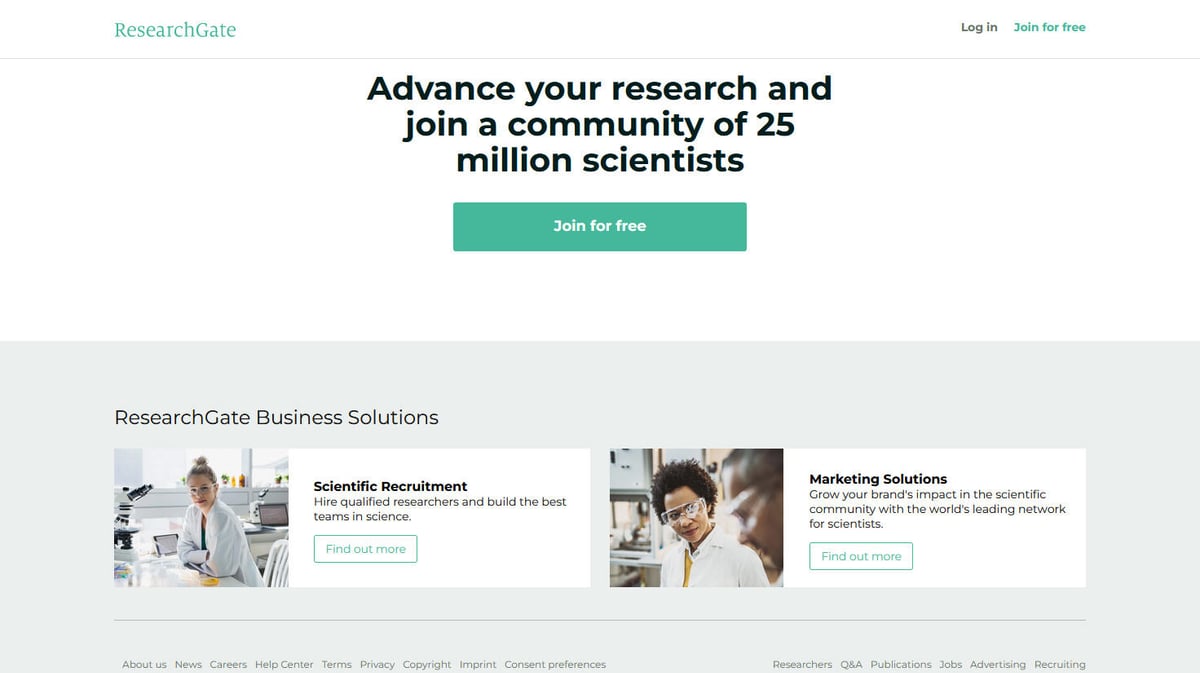
About ResearchGate
Learn what ResearchGate offers and what valuable data can be extracted from it.
ResearchGate is the world's leading professional social networking site for scientists and researchers. It serves as a massive repository for sharing academic papers, pre-prints, and collaborative discussions. With millions of members across every scientific discipline, it functions as a primary source for the latest discoveries and peer-reviewed content.
The platform contains highly structured data including publication titles, abstracts, citation counts, and researcher metrics like the h-index and RG Score. This makes it an invaluable asset for anyone involved in academic research, bibliometrics, or scientific market analysis.
Scraping ResearchGate allows institutions and corporations to track emerging scientific trends, identify subject matter experts, and map global research networks. By aggregating this data, users can gain insights into institutional output and the competitive landscape of various R&D sectors.
Why Scrape ResearchGate?
Discover the business value and use cases for extracting data from ResearchGate.
Scientific Talent Acquisition
Recruiters can identify specialized PhD candidates and researchers by analyzing their h-index, publication frequency, and listed skills.
Market Research for Lab Tech
Identify laboratories and departments that are actively publishing in specific fields like biotechnology or nanotechnology to target with specialized equipment.
Academic Trend Forecasting
Analyze the growth or decline of specific scientific keywords and topics over time to predict the next big breakthrough in R&D.
Bibliometric Data Aggregation
Build comprehensive scholarly databases by extracting metadata, abstracts, and citation counts for millions of research papers.
Competitive R&D Monitoring
Track the research output of corporate competitors to understand their technical focus and stay ahead in the patent and innovation race.
Scraping Challenges
Technical challenges you may encounter when scraping ResearchGate.
Hardcore Cloudflare Challenges
ResearchGate uses aggressive Cloudflare and DataDome protection that instantly detects and blocks standard automated scripts or headless browsers.
Asynchronous Data Loading
Most valuable data, including citation counts and researcher metrics, is loaded dynamically via JavaScript, requiring a browser-based extraction approach.
Severe Rate Limiting
The platform monitors request patterns heavily; exceeding a very low threshold of requests per minute will lead to temporary or permanent IP bans.
Login Wall Restrictions
Granular data like detailed citation lists and specific member activities are often hidden behind a login wall, making anonymous scraping difficult.
Scrape ResearchGate with AI
No coding required. Extract data in minutes with AI-powered automation.
How It Works
Describe What You Need
Tell the AI what data you want to extract from ResearchGate. Just type it in plain language — no coding or selectors needed.
AI Extracts the Data
Our artificial intelligence navigates ResearchGate, handles dynamic content, and extracts exactly what you asked for.
Get Your Data
Receive clean, structured data ready to export as CSV, JSON, or send directly to your apps and workflows.
Why Use AI for Scraping
No-Code Web Scrapers for ResearchGate
Point-and-click alternatives to AI-powered scraping
Several no-code tools like Browse.ai, Octoparse, Axiom, and ParseHub can help you scrape ResearchGate. These tools use visual interfaces to select elements, but they come with trade-offs compared to AI-powered solutions.
Typical Workflow with No-Code Tools
Common Challenges
Learning curve
Understanding selectors and extraction logic takes time
Selectors break
Website changes can break your entire workflow
Dynamic content issues
JavaScript-heavy sites often require complex workarounds
CAPTCHA limitations
Most tools require manual intervention for CAPTCHAs
IP blocking
Aggressive scraping can get your IP banned
Code Examples
import requests
from bs4 import BeautifulSoup

# ResearchGate uses aggressive bot protection.
# Realistic headers and proxies are required for any success.
headers = {
    'User-Agent': 'Mozilla/5.0 (Windows NT 10.0; Win64; x64) AppleWebKit/537.36 (KHTML, like Gecko) Chrome/91.0.4472.124 Safari/537.36',
    'Accept-Language': 'en-US,en;q=0.9'
}

def scrape_publication(url):
    try:
        response = requests.get(url, headers=headers, timeout=10)
        response.raise_for_status()
        soup = BeautifulSoup(response.text, 'html.parser')

        # Example selector for publication title
        title = soup.find('h1', class_='research-detail-header-section__title')
        if title:
            print(f'Scraped Title: {title.text.strip()}')

    except Exception as e:
        print(f'Request failed: {e}')

scrape_publication('https://www.researchgate.net/publication/345678910_Example')
When to Use
Best for static HTML pages where content is loaded server-side. The fastest and simplest approach when JavaScript rendering isn't required.
Advantages
- ●Fastest execution (no browser overhead)
- ●Lowest resource consumption
- ●Easy to parallelize with asyncio
- ●Great for APIs and static pages
Limitations
- ●Cannot execute JavaScript
- ●Fails on SPAs and dynamic content
- ●May struggle with complex anti-bot systems
import asyncio
from playwright.async_api import async_playwright

async def scrape_researchgate_search(query):
    async with async_playwright() as p:
        # Launching with stealth-like settings
        browser = await p.chromium.launch(headless=True)
        page = await browser.new_page(user_agent='Mozilla/5.0 (Windows NT 10.0; Win64; x64) AppleWebKit/537.36')

        search_url = f'https://www.researchgate.net/search/publication?q={query}'
        await page.goto(search_url)

        # Wait for dynamic results to load
        await page.wait_for_selector('.nova-legacy-v-publication-item__title')

        # Extract titles
        titles = await page.eval_on_selector_all('.nova-legacy-v-publication-item__title a', 'nodes => nodes.map(n => n.innerText)')

        for i, title in enumerate(titles[:10]):
            print(f'{i+1}. {title}')

        await browser.close()

asyncio.run(scrape_researchgate_search('machine learning'))
When to Use
Use when content loads dynamically via JavaScript, or when you need to interact with the page (clicks, scrolls, form fills). Handles modern anti-bot detection better.
Advantages
- ●Executes JavaScript like a real browser
- ●Handles SPAs and dynamic content
- ●Better anti-bot evasion with stealth plugins
- ●Can take screenshots and PDFs
Limitations
- ●Slower than HTTP requests
- ●Higher memory/CPU usage
- ●More complex to set up
import scrapy

class ResearchGateSpider(scrapy.Spider):
    name = 'rg_spider'
    allowed_domains = ['researchgate.net']

    # Use a custom settings dictionary for bot avoidance
    custom_settings = {
        'DOWNLOAD_DELAY': 3,
        'CONCURRENT_REQUESTS': 1,
        'USER_AGENT': 'Mozilla/5.0 (Macintosh; Intel Mac OS X 10_15_7) Chrome/110.0.0.0 Safari/537.36'
    }

    def start_requests(self):
        urls = ['https://www.researchgate.net/search/publication?q=bioinformatics']
        for url in urls:
            yield scrapy.Request(url=url, callback=self.parse)

    def parse(self, response):
        for item in response.css('.nova-legacy-v-publication-item__body'):
            yield {
                'title': item.css('.nova-legacy-v-publication-item__title a::text').get(),
                'link': response.urljoin(item.css('.nova-legacy-v-publication-item__title a::attr(href)').get()),
            }
When to Use
Ideal for large-scale crawling projects that need to scrape thousands of pages. Built-in support for rate limiting, retries, and data pipelines.
Advantages
- ●Built for scale (millions of pages)
- ●Automatic request throttling
- ●Built-in data export pipelines
- ●Middleware system for proxies/headers
Limitations
- ●Steeper learning curve
- ●Overkill for small projects
- ●No native JavaScript rendering
const puppeteer = require('puppeteer');

(async () => {
  const browser = await puppeteer.launch({ headless: true });
  const page = await browser.newPage();

  await page.setUserAgent('Mozilla/5.0 (Windows NT 10.0; Win64; x64) AppleWebKit/537.36 (KHTML, like Gecko) Chrome/110.0.0.0 Safari/537.36');

  // Navigate to ResearchGate search
  await page.goto('https://www.researchgate.net/search/publication?q=neuroscience');

  // Wait for the specific container of results
  await page.waitForSelector('.nova-legacy-v-publication-item__title');

  const results = await page.evaluate(() => {
    return Array.from(document.querySelectorAll('.nova-legacy-v-publication-item__title a')).map(a => ({
      title: a.innerText.trim(),
      link: a.href
    }));
  });

  console.log(results);
  await browser.close();
})();
When to Use
Choose this if you're in a Node.js/JavaScript ecosystem or need tight integration with frontend tools. Similar capabilities to Playwright.
Advantages
- ●Native JavaScript/TypeScript support
- ●Chrome DevTools Protocol access
- ●Large ecosystem and community
- ●Good for JS-heavy projects
Limitations
- ●Chrome-only (vs Playwright's multi-browser)
- ●Similar overhead to Playwright
- ●Less mature stealth options
What You Can Do With ResearchGate Data
Explore practical applications and insights from ResearchGate data.
Academic Trend Identification
Institutions can identify which scientific topics are gaining momentum by analyzing publication frequency.
How to implement:
- 1Scrape publication dates and keywords for a specific field.
- 2Aggregate data to count keyword frequency over time.
- 3Visualize trends to identify hot research areas.
Use Automatio to extract data from ResearchGate and build these applications without writing code.
Bibliometric Citation Mapping
Bibliometricians map how ideas spread through the community by analyzing citation networks.
How to implement:
- 1Extract 'Citations' and 'References' for a set of core papers.
- 2Build a network graph of papers connected by citation links.
- 3Analyze the graph to find high-impact hubs.
Use Automatio to extract data from ResearchGate and build these applications without writing code.
Expert Discovery for Recruitment
Companies looking for specialized PhD talent can identify researchers with specific skills and high scores.
How to implement:
- 1Search for skills or expertise keywords on ResearchGate.
- 2Scrape researcher profiles, including affiliations and h-index.
- 3Rank candidates based on publication history and influence.
Use Automatio to extract data from ResearchGate and build these applications without writing code.
Market Research for Lab Supplies
Identify high-output laboratories that likely require ongoing laboratory equipment and chemical supplies.
How to implement:
- 1Filter publications by specific lab-intensive keywords.
- 2Extract department and institution data for authors.
- 3Target identified labs with relevant scientific product offerings.
Use Automatio to extract data from ResearchGate and build these applications without writing code.
Institutional Performance Benchmarking
Compare the scientific output and impact of departments against global peers.
How to implement:
- 1Scrape metrics such as RG score and citation counts for target institutions.
- 2Compare data against historical averages or competitors.
- 3Use findings to inform resource allocation.
Use Automatio to extract data from ResearchGate and build these applications without writing code.
Lead Generation for Academic Publishing
Identify authors of high-quality pre-prints to invite for journal submissions.
How to implement:
- 1Scrape recently posted pre-prints in specific subject areas.
- 2Filter for authors with significant citation history.
- 3Extract author names and institutional affiliations for outreach.
Use Automatio to extract data from ResearchGate and build these applications without writing code.
Supercharge your workflow with AI Automation
Automatio combines the power of AI agents, web automation, and smart integrations to help you accomplish more in less time.
What to get right first
Expert advice for successfully extracting data from ResearchGate.
Prioritize Residential Proxies
Using datacenter IPs is the fastest way to get blocked; residential or mobile proxies are a strict requirement for scraping ResearchGate at scale.
Simulate Human Interactions
Incorporate randomized mouse movements, scrolling, and long wait times (15-30 seconds) between requests to avoid behavioral fingerprinting.
Avoid Using Scraper Accounts
Try to scrape only publicly accessible data; logging into an account to scrape significantly increases the risk of that account being permanently banned.
Target DOIs Directly
If you have a list of DOI numbers, navigate directly to the publication page rather than using the site's search bar to reduce the number of page transitions.
Rotate User-Agents Daily
Use a large pool of modern User-Agents from different operating systems to ensure your scraping fleet doesn't look like a single bot network.
Related Web Scraping
How to Scrape CSS Author: A Comprehensive Web Scraping Guide
How to Scrape Bilregistret.ai: Swedish Vehicle Data Extraction Guide
How to Scrape Biluppgifter.se: Vehicle Data Extraction Guide

How to Scrape The AA (theaa.com): A Technical Guide for Car & Insurance Data
How to Scrape GoAbroad Study Abroad Programs
How to Scrape Car.info | Vehicle Data & Valuation Extraction Guide
Statista Scraper: Titles, Regions and Dates in a table

How to Scrape Weebly Websites: Extract Data from Millions of Sites
Frequently Asked Questions
Find answers to common questions about ResearchGate
Is it legal to scrape ResearchGate?
Scraping publicly accessible information like publication titles and abstracts is generally legal for personal research, but it violates ResearchGate's Terms of Service. You should always avoid redistributing copyrighted full-text papers and ensure your data collection complies with local regulations.
Does ResearchGate provide an official API?
No, ResearchGate does not offer a public API for developers to access their repository of scientific data. Any systematic data extraction must be done through web scraping or through specific institutional partnerships that are not available to the public.
How can I avoid getting blocked by ResearchGate?
Avoiding blocks requires a combination of high-quality residential proxies, a headless browser that can execute JavaScript, and randomized delays between requests. ResearchGate is very sensitive to bot-like behavior, so your scraper must mimic a real human researcher browsing the site.
What format can I export ResearchGate data into?
When using a tool like Automatio, you can export your scraped scientific data into structured formats such as CSV, JSON, or XML. You can also sync the data directly to Google Sheets or send it to your own database via a Webhook.
How often should I scrape ResearchGate for updates?
Since academic publishing and citation counts do not change by the minute, a weekly or monthly crawl is usually more than sufficient. Scraping too frequently increases the risk of your IP pool being flagged by their security systems.
What proxies are best for ResearchGate scraping?
Residential proxies are the most effective because they use IP addresses assigned to real households, making them much harder for Cloudflare to detect. Datacenter proxies from providers like AWS or DigitalOcean are almost always blocked immediately by ResearchGate's firewall.
Can I scrape full-text PDFs from ResearchGate?
While links to PDFs can be found, many are behind 'Request Full-text' buttons or copyright walls. Automatically downloading large volumes of PDFs is extremely resource-heavy and will likely trigger security blocks much faster than metadata scraping.