

How to Scrape BureauxLocaux: Commercial Real Estate Data Guide
Extract commercial real estate data from BureauxLocaux. Scrape office prices, warehouse locations, and agent details across France for market research.
Free to start: 1,000 credits, no card, nothing to install.
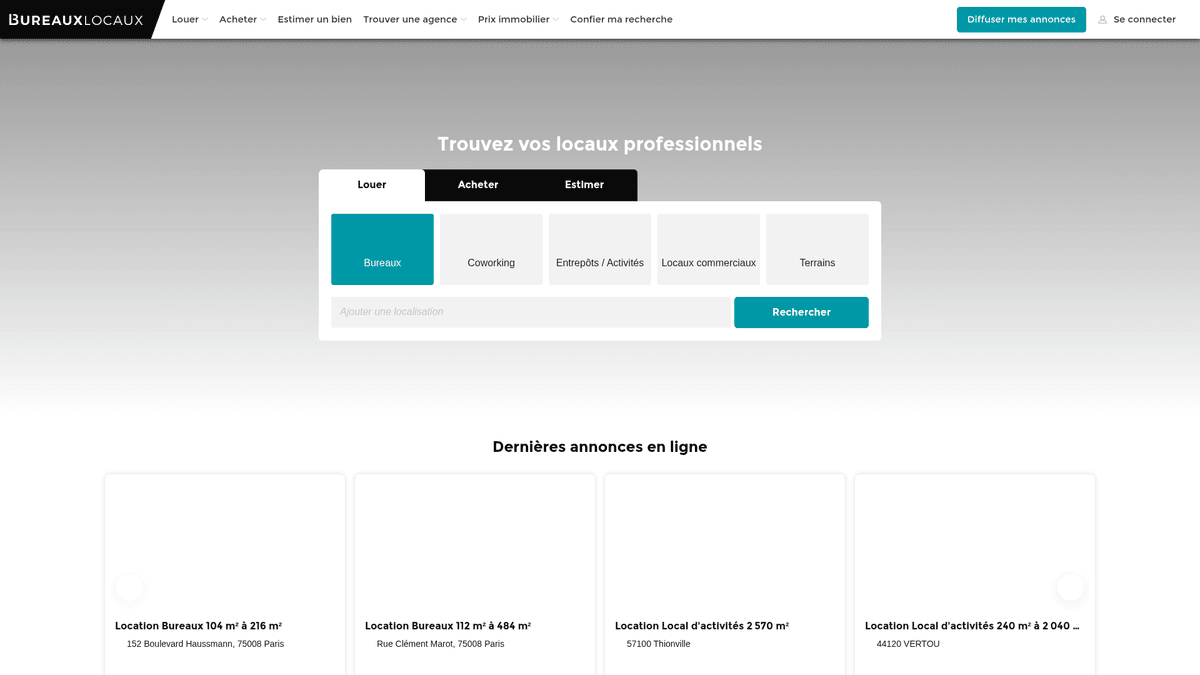
About BureauxLocaux
Learn what BureauxLocaux offers and what valuable data can be extracted from it.
France's Professional Real Estate Marketplace
BureauxLocaux is the premier digital platform in France dedicated to professional real estate, facilitating the lease and sale of offices, warehouses, retail spaces, and coworking hubs. Owned by the CoStar Group, the platform centralizes data from over 1,800 specialized agencies and hosts more than 72,000 active listings, making it a definitive source for B2B property insights.
Comprehensive Market Intelligence
The platform offers a granular view of the French commercial landscape, from high-demand Parisian business districts to logistical hubs in Lyon and Marseille. It serves as a vital bridge between property seekers and specialized brokers, providing detailed technical specifications that go beyond simple price points.
Why the Data Matters
Scraping BureauxLocaux is essential for real estate developers, investors, and urban planners. The platform's listings provide real-time data on rental price trends, vacancy rates, and energy performance (DPE) ratings, which are critical for building predictive market models and identifying high-yield investment opportunities.
Why Scrape BureauxLocaux?
Discover the business value and use cases for extracting data from BureauxLocaux.
Commercial Market Intelligence
Monitor real-time rental and sale price fluctuations for offices and warehouses across different French regions to identify emerging business hubs.
B2B Lead Generation
Identify commercial real estate agencies specializing in specific niches like logistics or high-end retail to offer professional services like office fit-outs or insurance.
Investment Opportunity Sourcing
Detect undervalued properties or urgent sublease opportunities in prime Parisian business districts by tracking price drops and listing duration.
Industrial Supply Tracking
Analyze the availability and technical specifications of industrial warehouses and storage facilities to support logistics and supply chain planning.
Economic Indicator Analysis
Use commercial vacancy rates and square footage availability as leading indicators for regional economic growth or decline in major French cities.
Scraping Challenges
Technical challenges you may encounter when scraping BureauxLocaux.
Advanced DataDome Protection
BureauxLocaux utilizes DataDome, a sophisticated bot management system that identifies and blocks headless browsers through behavioral and fingerprint analysis.
Interaction-Locked Contact Info
Sensitive data like agent phone numbers are often hidden behind buttons that require a physical click to reveal, which can trigger additional verification challenges.
Geographic Traffic Restrictions
The site frequently throttles or outright blocks traffic coming from non-European IP addresses to prevent global scraping attempts while serving local users.
Fragmented Data Formats
Pricing is inconsistently listed as price per workstation, price per m2/year, or total monthly rent, requiring complex normalization logic during extraction.
Scrape BureauxLocaux with AI
No coding required. Extract data in minutes with AI-powered automation.
How It Works
Describe What You Need
Tell the AI what data you want to extract from BureauxLocaux. Just type it in plain language — no coding or selectors needed.
AI Extracts the Data
Our artificial intelligence navigates BureauxLocaux, handles dynamic content, and extracts exactly what you asked for.
Get Your Data
Receive clean, structured data ready to export as CSV, JSON, or send directly to your apps and workflows.
Why Use AI for Scraping
No-Code Web Scrapers for BureauxLocaux
Point-and-click alternatives to AI-powered scraping
Several no-code tools like Browse.ai, Octoparse, Axiom, and ParseHub can help you scrape BureauxLocaux. These tools use visual interfaces to select elements, but they come with trade-offs compared to AI-powered solutions.
Typical Workflow with No-Code Tools
Common Challenges
Learning curve
Understanding selectors and extraction logic takes time
Selectors break
Website changes can break your entire workflow
Dynamic content issues
JavaScript-heavy sites often require complex workarounds
CAPTCHA limitations
Most tools require manual intervention for CAPTCHAs
IP blocking
Aggressive scraping can get your IP banned
Code Examples
import requests
from bs4 import BeautifulSoup

# Note: This may be blocked by Cloudflare without advanced headers/proxies
headers = {
    'User-Agent': 'Mozilla/5.0 (Windows NT 10.0; Win64; x64) AppleWebKit/537.36 (KHTML, like Gecko) Chrome/119.0.0.0 Safari/537.36',
    'Accept-Language': 'fr-FR,fr;q=0.9'
}

url = "https://www.bureauxlocaux.com/immobilier-d-entreprise/annonces/location-bureaux"

try:
    response = requests.get(url, headers=headers, timeout=15)
    response.raise_for_status()
    soup = BeautifulSoup(response.text, 'html.parser')

    # Example: Selecting listing cards
    listings = soup.select('.AnnonceCard')
    for item in listings:
        title = item.select_one('h2').get_text(strip=True)
        price = item.select_one('.price').get_text(strip=True) if item.select_one('.price') else 'N/A'
        print(f'Listing: {title} | Price: {price}')
except Exception as e:
    print(f'Scraping failed: {e}')
When to Use
Best for static HTML pages where content is loaded server-side. The fastest and simplest approach when JavaScript rendering isn't required.
Advantages
- ●Fastest execution (no browser overhead)
- ●Lowest resource consumption
- ●Easy to parallelize with asyncio
- ●Great for APIs and static pages
Limitations
- ●Cannot execute JavaScript
- ●Fails on SPAs and dynamic content
- ●May struggle with complex anti-bot systems
from playwright.sync_api import sync_playwright

def scrape_bureaux():
    with sync_playwright() as p:
        # Launching with stealth or specific UA is recommended
        browser = p.chromium.launch(headless=True)
        context = browser.new_context(user_agent="Mozilla/5.0 (Windows NT 10.0; Win64; x64) AppleWebKit/537.36 (KHTML, like Gecko) Chrome/119.0.0.0 Safari/537.36")
        page = context.new_page()

        # Navigate to the search results
        page.goto("https://www.bureauxlocaux.com/immobilier-d-entreprise/annonces/location-bureaux", wait_until="networkidle")

        # Wait for listings to render
        page.wait_for_selector(".AnnonceCard")

        listings = page.query_selector_all(".AnnonceCard")
        for item in listings:
            title = item.query_selector("h2").inner_text()
            price = item.query_selector(".price").inner_text() if item.query_selector(".price") else "Contact agent"
            print(f"{title}: {price}")

        browser.close()

scrape_bureaux()
When to Use
Use when content loads dynamically via JavaScript, or when you need to interact with the page (clicks, scrolls, form fills). Handles modern anti-bot detection better.
Advantages
- ●Executes JavaScript like a real browser
- ●Handles SPAs and dynamic content
- ●Better anti-bot evasion with stealth plugins
- ●Can take screenshots and PDFs
Limitations
- ●Slower than HTTP requests
- ●Higher memory/CPU usage
- ●More complex to set up
import scrapy

class BureauxSpider(scrapy.Spider):
    name = 'bureaux_spider'
    start_urls = ['https://www.bureauxlocaux.com/immobilier-d-entreprise/annonces/location-bureaux']

    def parse(self, response):
        # Loop through each property card on the page
        for ad in response.css('.AnnonceCard'):
            yield {
                'title': ad.css('h2::text').get(default='').strip(),
                'price': ad.css('.price::text').get(default='').strip(),
                'location': ad.css('.location::text').get(default='').strip(),
                'url': response.urljoin(ad.css('a::attr(href)').get())
            }

        # Pagination: Find the 'Next' page link
        next_page = response.css('a.pagination-next::attr(href)').get()
        if next_page:
            yield response.follow(next_page, self.parse)
When to Use
Ideal for large-scale crawling projects that need to scrape thousands of pages. Built-in support for rate limiting, retries, and data pipelines.
Advantages
- ●Built for scale (millions of pages)
- ●Automatic request throttling
- ●Built-in data export pipelines
- ●Middleware system for proxies/headers
Limitations
- ●Steeper learning curve
- ●Overkill for small projects
- ●No native JavaScript rendering
const puppeteer = require('puppeteer');

(async () => {
  const browser = await puppeteer.launch({ headless: true });
  const page = await browser.newPage();

  // Set a realistic User-Agent
  await page.setUserAgent('Mozilla/5.0 (Windows NT 10.0; Win64; x64) AppleWebKit/537.36 (KHTML, like Gecko) Chrome/119.0.0.0 Safari/537.36');

  await page.goto('https://www.bureauxlocaux.com/immobilier-d-entreprise/annonces/location-bureaux', { waitUntil: 'networkidle2' });

  // Extract data from listing elements
  const data = await page.evaluate(() => {
    const items = Array.from(document.querySelectorAll('.AnnonceCard'));
    return items.map(el => ({
      title: el.querySelector('h2')?.innerText.trim(),
      price: el.querySelector('.price')?.innerText.trim(),
      location: el.querySelector('.location-text')?.innerText.trim()
    }));
  });

  console.log(data);
  await browser.close();
})();
When to Use
Choose this if you're in a Node.js/JavaScript ecosystem or need tight integration with frontend tools. Similar capabilities to Playwright.
Advantages
- ●Native JavaScript/TypeScript support
- ●Chrome DevTools Protocol access
- ●Large ecosystem and community
- ●Good for JS-heavy projects
Limitations
- ●Chrome-only (vs Playwright's multi-browser)
- ●Similar overhead to Playwright
- ●Less mature stealth options
What You Can Do With BureauxLocaux Data
Explore practical applications and insights from BureauxLocaux data.
Commercial Rent Indexing
Financial analysts can build a dynamic index of office rental costs to advise corporate clients on location strategy.
How to implement:
- 1Scrape all active office listings in major French cities weekly.
- 2Calculate price per square meter per year for each entry.
- 3Group data by district (Arrondissement) to identify price clusters.
- 4Visualize the 'Price Heatmap' using a mapping tool like Tableau.
Use Automatio to extract data from BureauxLocaux and build these applications without writing code.
Real Estate Lead Gen
B2B service providers can find companies moving into new spaces that require IT setup, furniture, or insurance.
How to implement:
- 1Target listings marked as 'Recently Available' or 'New on Market'.
- 2Extract the contact details of the listing agency for partnership outreach.
- 3Track property removals to estimate when a company has successfully signed a lease.
- 4Automate a CRM entry for new potential office renovation projects.
Use Automatio to extract data from BureauxLocaux and build these applications without writing code.
Vacancy Duration Tracking
Economic researchers can monitor how long industrial properties stay on the market to gauge local economic health.
How to implement:
- 1Scrape all warehouse listings and store their 'First Seen' date.
- 2Continuously verify which listings are still active vs those removed.
- 3Calculate the average 'Time on Market' (ToM) for each industrial zone.
- 4Correlate high ToM with specific regional economic downturns.
Use Automatio to extract data from BureauxLocaux and build these applications without writing code.
Investment Filter Automation
Investors can receive instant alerts when properties drop below a certain price threshold in specific areas.
How to implement:
- 1Set up a daily scrape for specific categories like 'Vente de Bureaux'.
- 2Compare the daily price against the historical average for that specific zip code.
- 3Trigger a notification if a listing is priced 15% below the market average.
- 4Export the filtered deals to a Google Sheet for immediate review.
Use Automatio to extract data from BureauxLocaux and build these applications without writing code.
Supercharge your workflow with AI Automation
Automatio combines the power of AI agents, web automation, and smart integrations to help you accomplish more in less time.
What to get right first
Expert advice for successfully extracting data from BureauxLocaux.
Prioritize French Residential IPs
Using proxies based in France is the most effective way to avoid being flagged by the site's regional security filters.
Account for Tax Suffixes
Ensure your price parsers recognize 'HT' (Hors Taxes) and 'HC' (Hors Charges) to accurately calculate the total cost of commercial listings.
Monitor Internal XHR Requests
Inspect the network traffic to find the internal JSON endpoints that the site uses to populate listings for more efficient and structured extraction.
Implement Randomized Delays
Introduce variable sleep times between page loads and interactions to replicate human browsing patterns and stay below rate-limiting thresholds.
Handle Cookie Consents First
Ensure your scraper interacts with or hides the cookie consent modal upon landing to prevent it from overlaying and blocking access to listing elements.
Related Web Scraping
How to Scrape Century 21 Property Listings
How to Scrape Geolocaux | Geolocaux Web Scraper Guide

How to Scrape SeLoger Bureaux & Commerces
How to Scrape Rent.com: A Guide to Real Estate Data Extraction
How to Scrape RE/MAX (remax.com) Real Estate Listings
How to Scrape HotPads: A Complete Guide to Extracting Rental Data
How to Scrape Apartments.com | Apartments.com Web Scraper Guide
How to Scrape Homes.com: Real Estate Data Extraction Guide
Frequently Asked Questions
Find answers to common questions about BureauxLocaux
Is it legal to scrape BureauxLocaux?
Scraping publicly available commercial listings for research or market analysis is generally legal under EU law. However, users must avoid harvesting personal data protected by GDPR and should not scrape at a volume that impacts the website's performance.
Does BureauxLocaux provide a public API?
No, BureauxLocaux does not offer a public developer API. Their data is proprietary and typically only accessible to enterprise partners through the CoStar Group ecosystem.
How can I avoid getting blocked by DataDome?
To bypass DataDome, you must use high-quality residential proxies, handle JavaScript execution properly, and maintain a consistent browser fingerprint that does not look like a headless environment.
What is the best format for the extracted real estate data?
JSON is the most flexible format for commercial data because it can handle nested structures like technical building specs, while CSV is ideal for simple price-per-square-meter analysis.
How often should I scrape commercial listings?
Since commercial real estate moves slower than residential, a daily or weekly scraping frequency is usually sufficient to capture new listings and price adjustments.
Can I extract agent phone numbers from the site?
Yes, but these numbers often require a click action to be revealed. Using a browser-based automation tool like Automatio allows you to trigger these events and capture the data as it appears.
What should I do if the price is listed as 'Contact us'?
Your scraper should be configured to flag these as 'Price Upon Request' in your database so they can be excluded from automated numerical averages while remaining in your lead list.