

How to Scrape Geolocaux | Geolocaux Web Scraper Guide
Learn how to scrape Geolocaux.com for commercial real estate data. Extract office prices, warehouse listings, and retail specs in France for market research.
Free to start: 1,000 credits, no card, nothing to install.
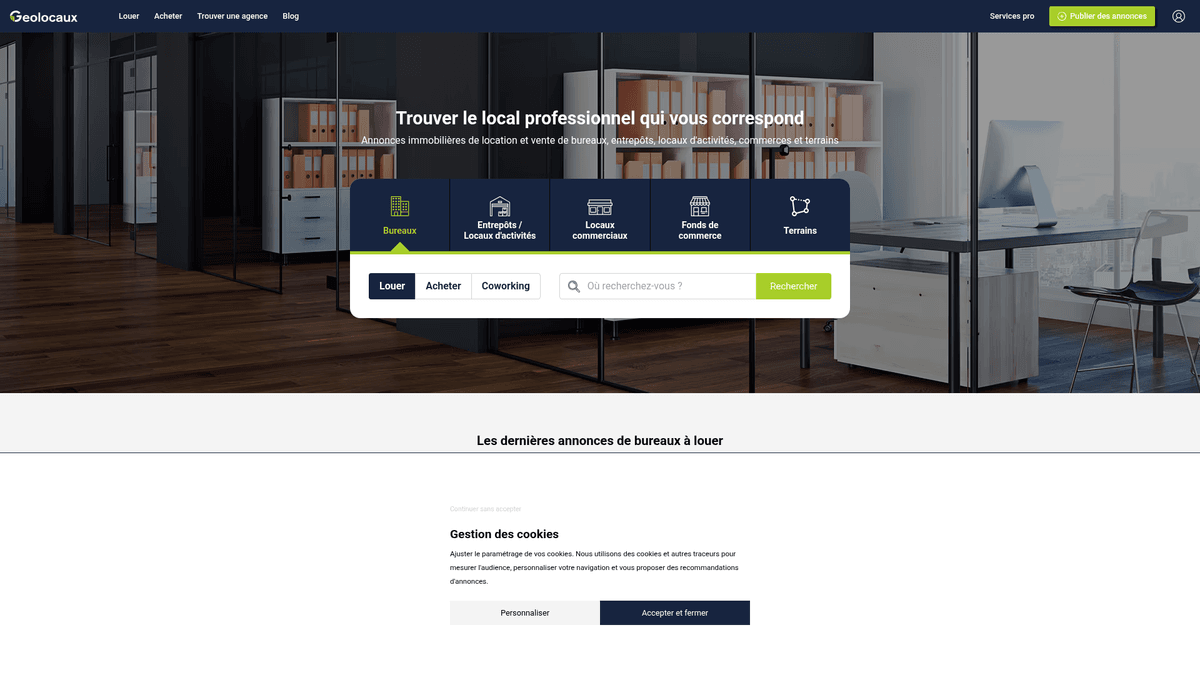
About Geolocaux
Learn what Geolocaux offers and what valuable data can be extracted from it.
France's Leading B2B Real Estate Portal
Geolocaux is a premier French real estate platform dedicated exclusively to professional and commercial properties. It operates as a specialized hub for businesses looking for office spaces, warehouses, logistics centers, and retail premises. By aggregating listings from industry giants like BNP Paribas Real Estate and CBRE, it provides a comprehensive overview of the French commercial landscape.
Geolocation and Market Data
The platform is unique for its geolocation-first strategy, allowing users to search for properties based on proximity to transportation hubs and commute times. This makes the data highly valuable for logistics planning and HR strategy. For scrapers, it offers a dense concentration of technical specifications, including divisibility, fiber optic availability, and precise square-meter pricing across all French regions.
Business Value of Geolocaux Data
Scraping Geolocaux allows organizations to monitor the yield and rental trends of the French commercial market in real-time. Whether you are conducting competitive analysis on agency portfolios or building a lead generation engine for office maintenance services, the structured listings provide the essential granular details required for high-level business intelligence.
Why Scrape Geolocaux?
Discover the business value and use cases for extracting data from Geolocaux.
Market Rent Benchmarking
Establish real-time benchmarks for commercial lease prices per square meter across different French districts to inform negotiation strategies.
B2B Service Lead Generation
Identify businesses moving into new office or warehouse spaces to offer facility management, IT infrastructure, or renovation services.
Investment Opportunity Scouting
Monitor undervalued commercial assets or unique independent buildings entering the market before they are picked up by larger competitors.
Competitor Inventory Monitoring
Track the listing volume and pricing strategies of major real estate agencies like CBRE and BNP Paribas to assess market share.
Supply Chain and Logistics Mapping
Analyze warehouse availability near major French highways to optimize storage costs and improve supply chain efficiency.
Historical Price Trend Analysis
Collect longitudinal data to understand how demand for coworking versus traditional office space evolves in major cities like Paris and Lyon.
Scraping Challenges
Technical challenges you may encounter when scraping Geolocaux.
Dynamic Content Rendering
The website relies heavily on JavaScript to load technical specifications, pricing tables, and the interactive map interfaces.
Contact Data Obfuscation
Agent phone numbers and email buttons are often protected by click-to-reveal mechanisms designed to thwart automated harvesters.
Advanced Anti-Bot Triggers
Frequent requests from data center or non-French IP addresses can trigger Cloudflare security challenges or temporary IP blacklisting.
Data Normalization Complexity
Commercial prices are listed in various formats such as HT, HC, and per m² per year, requiring sophisticated parsing logic for clean datasets.
Map-Based Navigation
The search engine logic is deeply integrated with geographic coordinates, making it difficult for standard crawlers to paginate through all results.
Scrape Geolocaux with AI
No coding required. Extract data in minutes with AI-powered automation.
How It Works
Describe What You Need
Tell the AI what data you want to extract from Geolocaux. Just type it in plain language — no coding or selectors needed.
AI Extracts the Data
Our artificial intelligence navigates Geolocaux, handles dynamic content, and extracts exactly what you asked for.
Get Your Data
Receive clean, structured data ready to export as CSV, JSON, or send directly to your apps and workflows.
Why Use AI for Scraping
No-Code Web Scrapers for Geolocaux
Point-and-click alternatives to AI-powered scraping
Several no-code tools like Browse.ai, Octoparse, Axiom, and ParseHub can help you scrape Geolocaux. These tools use visual interfaces to select elements, but they come with trade-offs compared to AI-powered solutions.
Typical Workflow with No-Code Tools
Common Challenges
Learning curve
Understanding selectors and extraction logic takes time
Selectors break
Website changes can break your entire workflow
Dynamic content issues
JavaScript-heavy sites often require complex workarounds
CAPTCHA limitations
Most tools require manual intervention for CAPTCHAs
IP blocking
Aggressive scraping can get your IP banned
Code Examples
import requests
from bs4 import BeautifulSoup

# Targeting Paris office listings
url = 'https://www.geolocaux.com/location/bureau/paris-75/'
headers = {
    'User-Agent': 'Mozilla/5.0 (Windows NT 10.0; Win64; x64) AppleWebKit/537.36 (KHTML, like Gecko) Chrome/110.0.0.0 Safari/537.36'
}

try:
    response = requests.get(url, headers=headers)
    response.raise_for_status()
    soup = BeautifulSoup(response.text, 'html.parser')

    # Note: Selectors must be verified against current site HTML
    listings = soup.select('article.card')
    for listing in listings:
        title = listing.select_one('h3').text.strip() if listing.select_one('h3') else 'N/A'
        price = listing.select_one('.price').text.strip() if listing.select_one('.price') else 'On Request'
        print(f'Listing: {title} | Price: {price}')
except Exception as e:
    print(f'Request failed: {e}')
When to Use
Best for static HTML pages where content is loaded server-side. The fastest and simplest approach when JavaScript rendering isn't required.
Advantages
- ●Fastest execution (no browser overhead)
- ●Lowest resource consumption
- ●Easy to parallelize with asyncio
- ●Great for APIs and static pages
Limitations
- ●Cannot execute JavaScript
- ●Fails on SPAs and dynamic content
- ●May struggle with complex anti-bot systems
from playwright.sync_api import sync_playwright

def run_scraper():
    with sync_playwright() as p:
        # Launching browser with a French locale to mimic local user
        browser = p.chromium.launch(headless=True)
        context = browser.new_context(locale='fr-FR')
        page = context.new_page()

        page.goto('https://www.geolocaux.com/location/bureau/')

        # Wait for the JS-rendered listing articles to load
        page.wait_for_selector('article')

        # Extract titles and prices
        properties = page.query_selector_all('article')
        for prop in properties:
            title = prop.query_selector('h3').inner_text()
            print(f'Found Property: {title}')

        browser.close()

run_scraper()
When to Use
Use when content loads dynamically via JavaScript, or when you need to interact with the page (clicks, scrolls, form fills). Handles modern anti-bot detection better.
Advantages
- ●Executes JavaScript like a real browser
- ●Handles SPAs and dynamic content
- ●Better anti-bot evasion with stealth plugins
- ●Can take screenshots and PDFs
Limitations
- ●Slower than HTTP requests
- ●Higher memory/CPU usage
- ●More complex to set up
import scrapy

class GeolocauxSpider(scrapy.Spider):
    name = 'geolocaux'
    start_urls = ['https://www.geolocaux.com/location/bureau/']

    def parse(self, response):
        # Iterate through listing containers
        for listing in response.css('article'):
            yield {
                'title': listing.css('h3::text').get(),
                'price': listing.css('.price::text').get(),
                'area': listing.css('.surface::text').get(),
            }

        # Handle pagination by finding the 'Next' button
        next_page = response.css('a.pagination__next::attr(href)').get()
        if next_page is not None:
            yield response.follow(next_page, self.parse)
When to Use
Ideal for large-scale crawling projects that need to scrape thousands of pages. Built-in support for rate limiting, retries, and data pipelines.
Advantages
- ●Built for scale (millions of pages)
- ●Automatic request throttling
- ●Built-in data export pipelines
- ●Middleware system for proxies/headers
Limitations
- ●Steeper learning curve
- ●Overkill for small projects
- ●No native JavaScript rendering
const puppeteer = require('puppeteer');

(async () => {
  const browser = await puppeteer.launch();
  const page = await browser.newPage();

  // Set viewport to trigger correct responsive layout
  await page.setViewport({ width: 1280, height: 800 });

  await page.goto('https://www.geolocaux.com/location/bureau/', { waitUntil: 'networkidle2' });

  const listings = await page.evaluate(() => {
    const data = [];
    document.querySelectorAll('article h3').forEach(el => {
      data.push({
        title: el.innerText.trim()
      });
    });
    return data;
  });

  console.log(listings);
  await browser.close();
})();
When to Use
Choose this if you're in a Node.js/JavaScript ecosystem or need tight integration with frontend tools. Similar capabilities to Playwright.
Advantages
- ●Native JavaScript/TypeScript support
- ●Chrome DevTools Protocol access
- ●Large ecosystem and community
- ●Good for JS-heavy projects
Limitations
- ●Chrome-only (vs Playwright's multi-browser)
- ●Similar overhead to Playwright
- ●Less mature stealth options
What You Can Do With Geolocaux Data
Explore practical applications and insights from Geolocaux data.
Commercial Rent Indexing
Financial firms can track rental price fluctuations per square meter to assess economic health in specific French cities.
How to implement:
- 1Extract price and surface area for all 'Location Bureau' listings.
- 2Group data by Arrondissement or zip code.
- 3Calculate average price per m² and compare with historical data.
- 4Generate heat maps for urban investment analysis.
Use Automatio to extract data from Geolocaux and build these applications without writing code.
B2B Lead Generation
Office supply and cleaning companies can identify recently leased or available properties to find new business opportunities.
How to implement:
- 1Scrape listings tagged as 'New' or 'Available'.
- 2Identify the managing real estate agency and property address.
- 3Cross-reference with corporate databases to find new tenants moving in.
- 4Automate direct mail or cold outreach to the site manager.
Use Automatio to extract data from Geolocaux and build these applications without writing code.
Logistics Site Selection
Logistics companies can analyze the availability of warehouses near major highways and transport hubs.
How to implement:
- 1Target the 'Entrepôt & Logistique' category on Geolocaux.
- 2Extract address data and proximity to 'Axes Routiers' from descriptions.
- 3Map the listings against highway exit data.
- 4Select optimal sites based on transport accessibility.
Use Automatio to extract data from Geolocaux and build these applications without writing code.
Competitor Inventory Audit
Real estate agencies can monitor the portfolio of competitors like CBRE or JLL on the platform.
How to implement:
- 1Filter scraping targets by agency name.
- 2Monitor the total volume of listings per agency per month.
- 3Identify shifts in competitor focus toward specific property types (e.g., Coworking).
- 4Adjust internal marketing budgets to compete in underserved areas.
Use Automatio to extract data from Geolocaux and build these applications without writing code.
Supercharge your workflow with AI Automation
Automatio combines the power of AI agents, web automation, and smart integrations to help you accomplish more in less time.
What to get right first
Expert advice for successfully extracting data from Geolocaux.
Target List View URLs
Always scrape from the paginated list view pages rather than attempting to navigate the interactive map interface for better stability.
Use Local French Residential IPs
Geolocaux is highly sensitive to geo-location; using French residential proxies significantly increases your success rate and prevents blocking.
Incorporate Random Human Delays
Implement delays between 3 and 7 seconds to mimic human browsing behavior and avoid triggering rate-limiting alarms.
Capture the Numeric Listing ID
Always extract the unique numeric ID found in the URL or property metadata to use as a primary key for deduping your database.
Trigger Scroll Events
Ensure your scraper scrolls to the bottom of listing pages to trigger lazy-loaded images and hidden technical attributes.
Related Web Scraping
How to Scrape Century 21 Property Listings

How to Scrape SeLoger Bureaux & Commerces
How to Scrape Homes.com: Real Estate Data Extraction Guide
How to Scrape RE/MAX (remax.com) Real Estate Listings
How to Scrape HotPads: A Complete Guide to Extracting Rental Data
How to Scrape Apartments.com | Apartments.com Web Scraper Guide
How to Scrape Rent.com: A Guide to Real Estate Data Extraction
How to Scrape BureauxLocaux: Commercial Real Estate Data Guide
Frequently Asked Questions
Find answers to common questions about Geolocaux
Is it legal to scrape Geolocaux?
Scraping publicly available data from Geolocaux for internal market research and analysis is generally considered fair use. However, you must avoid reselling the data as a competing product and ensure compliance with GDPR if you are collecting agent contact information.
Does Geolocaux provide an official API?
No, Geolocaux does not offer a public developer API for automated data extraction. Professional users typically build custom web scrapers or use no-code automation platforms to gather data in bulk.
How can I avoid getting blocked while scraping?
To prevent being blocked, you should use French residential proxies, rotate your User-Agent headers, and maintain a reasonable request frequency. Avoiding high-speed spikes and mimicking human interaction like scrolling and clicking will help bypass bot detection.
What is the best format for the extracted real estate data?
JSON is highly recommended for complex property data because it handles nested technical specs easily. CSV is often preferred by business analysts who need to import price data directly into Excel or Google Sheets for financial modeling.
How often should I scrape Geolocaux listings?
Since commercial real estate listings don't change as frequently as residential ones, scraping once per day or once per week is usually sufficient. This frequency allows you to capture new listings and price changes without putting unnecessary strain on the server.
What proxies work best for Geolocaux?
Residential proxies with geo-targeting for France are the most effective choice. Data center proxies are often flagged quickly by Cloudflare, whereas residential IPs appear as legitimate local business traffic.
Can I scrape hidden phone numbers from the listings?
Yes, but you will need a scraping tool capable of simulating a mouse click on the 'Afficher le numéro' button. Once the click is triggered, the phone number is rendered in the DOM and can be extracted easily.
Can I extract data from the maps directly?
While technically possible, scraping the maps is complex and unstable. It is much more efficient to target the listing results pages which contain the same geographic data in a structured list format.