

How to Scrape Trulia Real Estate Data
Learn how to scrape Trulia listings including prices, addresses, and property details. Master the techniques to bypass Akamai protections.
Free to start: 1,000 credits, no card, nothing to install.
About Trulia
Learn what Trulia offers and what valuable data can be extracted from it.
The Power of Trulia Data
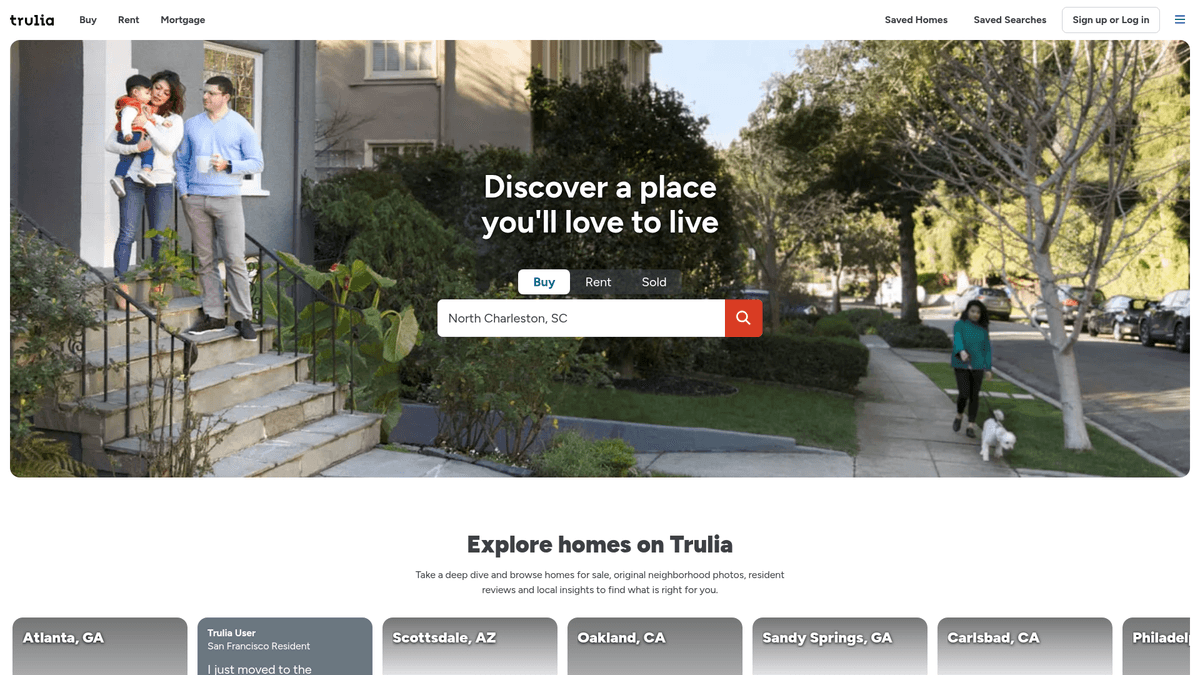
Trulia is a premier American residential real estate platform that provides property buyers and renters with essential neighborhood insights. Owned by Zillow Group, the site aggregates a massive volume of data including crime rates, school ratings, and market trends across thousands of US cities.
Why the Data is Valuable
For real estate professionals and data scientists, Trulia serves as a goldmine for lead generation and predictive modeling. The platform's highly structured data allows for deep analysis of price fluctuations, historical tax assessments, and demographic shifts that define local housing markets.
Accessing the Listings
Because Trulia frequently updates its listings with high-resolution imagery and detailed property descriptions, it is a primary target for competitive analysis. Scraping this data allows businesses to build automated valuation models (AVMs) and monitor investment opportunities in real-time without manual search effort.
Why Scrape Trulia?
Discover the business value and use cases for extracting data from Trulia.
Investment Valuation
Calculate potential ROI and capitalization rates by comparing Trulia's listing prices with local property tax history and square footage data.
Neighborhood Safety Indexing
Access Trulia's unique crime map statistics and resident reviews to build safety profiles for neighborhood-level real estate analysis.
Real Estate Lead Generation
Extract contact information for agents and brokerages to identify active sellers and professional partners in specific geographic markets.
Historical Market Trends
Track property price fluctuations and the 'Days on Trulia' metric to identify motivated sellers and shifting demand in local housing markets.
Competitor Intelligence
Monitor the inventory and market share of various brokerages by scraping the listing agents assigned to properties across different zip codes.
Rental Yield Analysis
Compare for-sale listing prices with nearby rental estimates found on the platform to identify high-yield property investment opportunities.
Scraping Challenges
Technical challenges you may encounter when scraping Trulia.
Akamai Bot Management
Trulia employs Akamai Bot Manager, which is highly effective at detecting and blocking headless browsers and data center IP addresses.
Dynamic Content Loading
Many property details and neighborhood statistics are injected via GraphQL and JavaScript, requiring a scraper that can render dynamic pages.
Geographic Fencing
The website frequently blocks or presents extra security challenges to traffic originating from outside the United States, necessitating local residential proxies.
Unstable CSS Selectors
Trulia updates its frontend architecture regularly, meaning scrapers relying on traditional CSS selectors often break and require constant maintenance.
Scrape Trulia with AI
No coding required. Extract data in minutes with AI-powered automation.
How It Works
Describe What You Need
Tell the AI what data you want to extract from Trulia. Just type it in plain language — no coding or selectors needed.
AI Extracts the Data
Our artificial intelligence navigates Trulia, handles dynamic content, and extracts exactly what you asked for.
Get Your Data
Receive clean, structured data ready to export as CSV, JSON, or send directly to your apps and workflows.
Why Use AI for Scraping
No-Code Web Scrapers for Trulia
Point-and-click alternatives to AI-powered scraping
Several no-code tools like Browse.ai, Octoparse, Axiom, and ParseHub can help you scrape Trulia. These tools use visual interfaces to select elements, but they come with trade-offs compared to AI-powered solutions.
Typical Workflow with No-Code Tools
Common Challenges
Learning curve
Understanding selectors and extraction logic takes time
Selectors break
Website changes can break your entire workflow
Dynamic content issues
JavaScript-heavy sites often require complex workarounds
CAPTCHA limitations
Most tools require manual intervention for CAPTCHAs
IP blocking
Aggressive scraping can get your IP banned
Code Examples
import requests
from bs4 import BeautifulSoup

def scrape_trulia_basic(url):
    # Headers are critical to avoid immediate 403
    headers = {
        'User-Agent': 'Mozilla/5.0 (Windows NT 10.0; Win64; x64) AppleWebKit/537.36 (KHTML, like Gecko) Chrome/119.0.0.0 Safari/537.36',
        'Accept-Language': 'en-US,en;q=0.9',
        'Referer': 'https://www.google.com/'
    }

    try:
        # Using a session to manage cookies
        session = requests.Session()
        response = session.get(url, headers=headers)
        if response.status_code == 200:
            soup = BeautifulSoup(response.text, 'html.parser')
            # Example: Extracting price from property cards
            price = soup.select_one('[data-testid="property-price"]')
            print(f'Price found: {price.text if price else "Not Found"}')
        else:
            print(f'Blocked: HTTP {response.status_code}')
    except Exception as e:
        print(f'Request failed: {e}')

scrape_trulia_basic('https://www.trulia.com/CA/San_Francisco/')
When to Use
Best for static HTML pages where content is loaded server-side. The fastest and simplest approach when JavaScript rendering isn't required.
Advantages
- ●Fastest execution (no browser overhead)
- ●Lowest resource consumption
- ●Easy to parallelize with asyncio
- ●Great for APIs and static pages
Limitations
- ●Cannot execute JavaScript
- ●Fails on SPAs and dynamic content
- ●May struggle with complex anti-bot systems
from playwright.sync_api import sync_playwright

def scrape_trulia_playwright():
    with sync_playwright() as p:
        # Stealth techniques are required
        browser = p.chromium.launch(headless=True)
        context = browser.new_context(
            user_agent='Mozilla/5.0 (Windows NT 10.0; Win64; x64) Chrome/119.0.0.0 Safari/537.36',
            viewport={'width': 1920, 'height': 1080}
        )
        page = context.new_page()

        # Navigate and wait for the dynamic property cards to load
        page.goto('https://www.trulia.com/CA/San_Francisco/', wait_until='networkidle')
        page.wait_for_selector('[data-testid="property-card-details"]')

        # Extract data from the DOM
        listings = page.query_selector_all('[data-testid="property-card-details"]')
        for item in listings:
            address = item.query_selector('[data-testid="property-address"]').inner_text()
            price = item.query_selector('[data-testid="property-price"]').inner_text()
            print(f'Address: {address} | Price: {price}')

        browser.close()

scrape_trulia_playwright()
When to Use
Use when content loads dynamically via JavaScript, or when you need to interact with the page (clicks, scrolls, form fills). Handles modern anti-bot detection better.
Advantages
- ●Executes JavaScript like a real browser
- ●Handles SPAs and dynamic content
- ●Better anti-bot evasion with stealth plugins
- ●Can take screenshots and PDFs
Limitations
- ●Slower than HTTP requests
- ●Higher memory/CPU usage
- ●More complex to set up
import scrapy

class TruliaSpider(scrapy.Spider):
    name = 'trulia_spider'
    # Custom settings for bypassing basic protection
    custom_settings = {
        'USER_AGENT': 'Mozilla/5.0 (Windows NT 10.0; Win64; x64) Safari/537.36',
        'CONCURRENT_REQUESTS': 1,
        'DOWNLOAD_DELAY': 5
    }
    start_urls = ['https://www.trulia.com/CA/San_Francisco/']

    def parse(self, response):
        for card in response.css('[data-testid="property-card-details"]'):
            yield {
                'address': card.css('[data-testid="property-address"]::text').get(),
                'price': card.css('[data-testid="property-price"]::text').get(),
                'meta': card.css('[data-testid="property-meta"]::text').getall(),
            }

        # Follow the "Next" button link
        next_page = response.css('a[aria-label="Next Page"]::attr(href)').get()
        if next_page:
            yield response.follow(next_page, self.parse)
When to Use
Ideal for large-scale crawling projects that need to scrape thousands of pages. Built-in support for rate limiting, retries, and data pipelines.
Advantages
- ●Built for scale (millions of pages)
- ●Automatic request throttling
- ●Built-in data export pipelines
- ●Middleware system for proxies/headers
Limitations
- ●Steeper learning curve
- ●Overkill for small projects
- ●No native JavaScript rendering
const puppeteer = require('puppeteer-extra');
const StealthPlugin = require('puppeteer-extra-plugin-stealth');
puppeteer.use(StealthPlugin());

(async () => {
  const browser = await puppeteer.launch({ headless: true });
  const page = await browser.newPage();

  // Mimic real browser headers
  await page.setExtraHTTPHeaders({ 'Accept-Language': 'en-US,en;q=0.9' });

  await page.goto('https://www.trulia.com/CA/San_Francisco/', { waitUntil: 'networkidle2' });

  const properties = await page.evaluate(() => {
    const data = [];
    const cards = document.querySelectorAll('[data-testid="property-card-details"]');
    cards.forEach(card => {
      data.push({
        address: card.querySelector('[data-testid="property-address"]')?.innerText,
        price: card.querySelector('[data-testid="property-price"]')?.innerText
      });
    });
    return data;
  });

  console.log(properties);
  await browser.close();
})();
When to Use
Choose this if you're in a Node.js/JavaScript ecosystem or need tight integration with frontend tools. Similar capabilities to Playwright.
Advantages
- ●Native JavaScript/TypeScript support
- ●Chrome DevTools Protocol access
- ●Large ecosystem and community
- ●Good for JS-heavy projects
Limitations
- ●Chrome-only (vs Playwright's multi-browser)
- ●Similar overhead to Playwright
- ●Less mature stealth options
What You Can Do With Trulia Data
Explore practical applications and insights from Trulia data.
Predictive Price Modeling
Analysts use historical Trulia data to train machine learning models that predict future property values.
How to implement:
- 1Extract monthly snapshots of property prices and square footage.
- 2Clean the data by removing listings that are outliers or incomplete.
- 3Train a regression model using neighborhood and property attributes as features.
- 4Validate the model against actual sold prices to refine accuracy.
Use Automatio to extract data from Trulia and build these applications without writing code.
Neighborhood Safety Benchmarking
City planners and security firms scrape neighborhood crime and safety ratings for comparative studies.
How to implement:
- 1Scrape the 'Neighborhood' section of Trulia listings across multiple zip codes.
- 2Extract the safety and crime heat map data points provided by the platform.
- 3Aggregate the data into a centralized GIS mapping software.
- 4Overlay demographic data to identify correlations between safety and property value.
Use Automatio to extract data from Trulia and build these applications without writing code.
Real Estate Lead Scoring
Agents identify high-value leads by monitoring price drops and days-on-market metrics.
How to implement:
- 1Set up an automated scraper to monitor listings tagged with 'Price Reduced'.
- 2Calculate the percentage drop relative to the neighborhood average.
- 3Sort the properties by highest investment potential.
- 4Export the list daily to a CRM for immediate outreach by the sales team.
Use Automatio to extract data from Trulia and build these applications without writing code.
Brokerage Performance Audit
Competitors analyze which brokerages hold the most listings in premium neighborhoods to adjust their strategy.
How to implement:
- 1Extract 'Brokerage Name' and 'Agent Name' from all active listings in a specific city.
- 2Count the number of listings per brokerage to determine market share.
- 3Analyze the average listing price handled by each brokerage.
- 4Generate a market share report to identify target areas for expansion.
Use Automatio to extract data from Trulia and build these applications without writing code.
Short-Term Rental Feasibility
Investors evaluate the potential ROI of purchasing a property for conversion into a short-term rental.
How to implement:
- 1Scrape listing prices and school ratings to determine property attractiveness.
- 2Cross-reference with local rental listings to estimate potential nightly rates.
- 3Calculate the break-even point based on the scraped acquisition cost.
- 4Identify 'hot spots' where property values are low but neighborhood amenities are high.
Use Automatio to extract data from Trulia and build these applications without writing code.
Supercharge your workflow with AI Automation
Automatio combines the power of AI agents, web automation, and smart integrations to help you accomplish more in less time.
What to get right first
Expert advice for successfully extracting data from Trulia.
Utilize Residential Proxies
Always use high-quality US-based residential proxies. Trulia easily identifies and blocks data center IPs, leading to immediate 403 Forbidden errors.
Implement Random Delays
Avoid predictable scraping patterns by adding random delays between 5 to 15 seconds to mimic the natural browsing behavior of a human user.
Leverage JSON-LD Data
Check the HTML source for script tags containing JSON-LD; these often contain structured property data that is easier to parse than raw HTML elements.
Monitor GraphQL Traffic
Use browser developer tools to identify GraphQL endpoints, which can sometimes be targeted directly to extract clean JSON data with less overhead.
Scroll to Load Elements
Simulate smooth scrolling to the bottom of property pages to trigger the lazy loading of neighborhood amenities and similar listing sections.
Rotate User Agents
Maintain a pool of modern browser User-Agent strings and rotate them frequently to avoid browser fingerprinting from flagging your automated activity.
Related Web Scraping
How to Scrape Century 21 Property Listings
How to Scrape Geolocaux | Geolocaux Web Scraper Guide

How to Scrape SeLoger Bureaux & Commerces
How to Scrape Rent.com: A Guide to Real Estate Data Extraction
How to Scrape RE/MAX (remax.com) Real Estate Listings
How to Scrape HotPads: A Complete Guide to Extracting Rental Data
How to Scrape Apartments.com | Apartments.com Web Scraper Guide
How to Scrape Homes.com: Real Estate Data Extraction Guide
Frequently Asked Questions
Find answers to common questions about Trulia
Is it legal to scrape Trulia?
Scraping publicly available data on Trulia for personal or research purposes is generally protected under current legal doctrines regarding public data access. However, you should avoid redistributing the data for commercial profit without authorization and ensure you are not scraping private user contact information.
Does Trulia have an official API?
Trulia does not offer a public, standalone API for third-party developers. Access to their property database is generally managed through Zillow Group's enterprise services, which have very strict application requirements and high costs for access.
How can I avoid getting blocked by Trulia's Akamai protection?
To bypass Akamai, you must use a combination of residential proxies and a headless browser that can successfully pass TLS fingerprinting and behavioral checks. Using a tool like Automatio helps by automatically handling these low-level technical requirements while mimicking human-like browsing patterns.
What format is the scraped data available in?
Data extracted from Trulia can be saved in several flexible formats including CSV, JSON, and Excel. You can also automate the workflow to push the data directly into a database or a Google Sheet for real-time market monitoring.
How often should I scrape Trulia for new listings?
For active investors, scraping every 4 to 6 hours is ideal to catch price changes and new listings in competitive markets. For general market research or trend analysis, a daily scrape is usually sufficient to capture the necessary data points without excessive overhead.
Can I scrape neighborhood crime and school data?
Yes, Trulia embeds neighborhood-specific data like school ratings and crime heatmap statistics on individual property pages. Since this content is loaded dynamically, you will need a scraper that supports JavaScript rendering to ensure the maps and scores load before extraction.
What proxies work best for Trulia?
Residential proxies based in the United States are the only reliable option for Trulia. Data center proxies are almost universally blocked by their security layer, while residential IPs mimic real home internet users, significantly reducing the risk of detection.
Why am I seeing a 403 Forbidden error?
A 403 error indicates that Trulia's web application firewall (WAF) has detected your scraper. This typically happens when using data center IPs, having inconsistent request headers, or sending requests too rapidly for the site's rate limits.
Is it possible to scrape property images from Trulia?
Yes, you can extract the source URLs for property images from the listing's gallery section. Note that these images are often high-resolution, so downloading large volumes of them will require significant storage and bandwidth management.